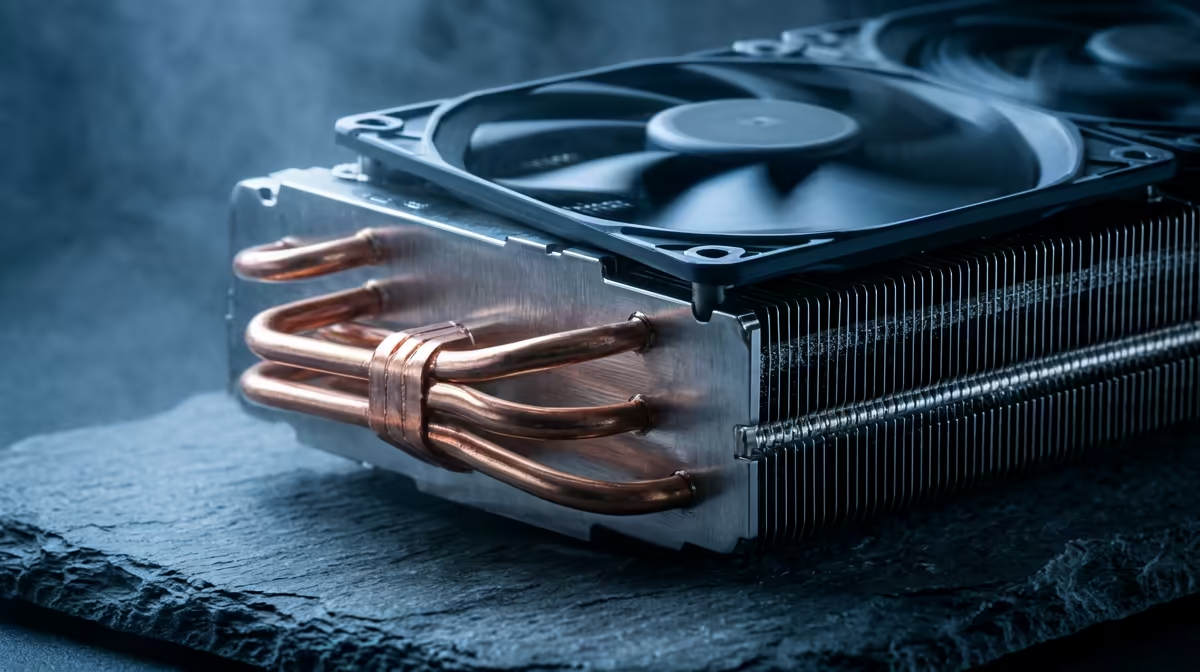
Is your PC sounding like a jet engine during a tense Apex Legends match? Or worse, are you seeing performance drops because your rig is running hotter than a Durban summer day? The secret to a cooler, quieter machine isn't always a pricey new cooler. The solution might be hidden in your BIOS: optimizing fan curves for superior cooling performance. Let's unlock that hidden potential and get your temps under control. 🔧
What Exactly is a Fan Curve?
Think of a fan curve as a set of instructions for your PC's cooling fans. It's a simple graph that tells a fan how fast it should spin (measured in RPM or percentage) based on the temperature of a component, usually your CPU or GPU.
Most motherboards and graphics cards come with a default or "stock" fan curve. This is a one-size-fits-all solution designed to work for everyone, but it's rarely optimised. A custom fan curve, on the other hand, is tailored specifically for your hardware, your environment, and your personal tolerance for noise.
The Benefits of Custom Fan Curve Optimisation
Taking a few minutes to tweak these settings brings some serious advantages. The most obvious is finding the perfect balance between noise and cooling. You can have your fans run whisper-quiet during light tasks like browsing or watching YouTube, then intelligently ramp up to deliver aggressive cooling when you fire up a demanding game.
Proper fan curve optimisation also helps prevent thermal throttling—that's when your CPU or GPU intentionally slows itself down to avoid overheating. By keeping temperatures in check, you ensure you're getting every bit of performance you paid for from your high-end CPU processors.
How to Start Optimizing Your Fan Curves
Ready to dive in? You can typically adjust your fan curves in two places: your motherboard's BIOS/UEFI or through software on your desktop. For GPUs, a tool like MSI Afterburner is the go-to. For system and CPU fans, your motherboard manufacturer's software (like ASUS Armoury Crate or Gigabyte's SIV) is often the easiest starting point.
A Simple 3-Step Process
- Establish a Baseline: Before you change anything, see where you're at. Use a monitoring tool like HWMonitor to check your idle temperatures (when you're just on the desktop) and your load temperatures (while running a stress test or playing a demanding game for 15-20 minutes).
- Adjust the Points: In your chosen software, you'll see a graph. The horizontal axis is temperature (°C) and the vertical axis is fan speed (%). Create a few points on the curve. For example, you could set your fans to 30% speed at 40°C, have them ramp up to 60% at 65°C, and hit 90-100% at 80°C. This ensures your powerful Intel CPUs get the air they need when the action heats up.
- Test and Refine: The final step is crucial. Play your games, run your apps, and listen. Is it too loud? Tweak the curve down. Are temps still creeping up? Make the ramp-up more aggressive. Keep adjusting until you find your perfect balance.
Pro Tip: Check Your Specs Twice
Set a "zero RPM" mode if your software allows it. Below a certain temperature (e.g., 50°C), your case and CPU fans won't spin at all. This is perfect for a completely silent desktop experience during work or browsing.
Finding Your Perfect Balance ⚡
Ultimately, there is no single "best" fan curve. The ideal setup for a gamer in chilly Cape Town will be different from someone battling the heat in Limpopo. The goal is to create a system that's cool and stable under load without being obnoxiously loud when you're just chilling.
This kind of fine-tuning is what separates a good build from a great one. It ensures that every component, especially a multi-core beast like a modern AMD CPU, can perform at its absolute peak. Taking control of your cooling is a free performance boost that every PC enthusiast should explore.
Ready to Tame Your Temperatures?
Mastering your fan curves is a great first step. If your temps are still too high, it might be time for a hardware upgrade that can keep up with your gaming ambitions. Shop now at Evetech for performance that leaves lag in the dust.