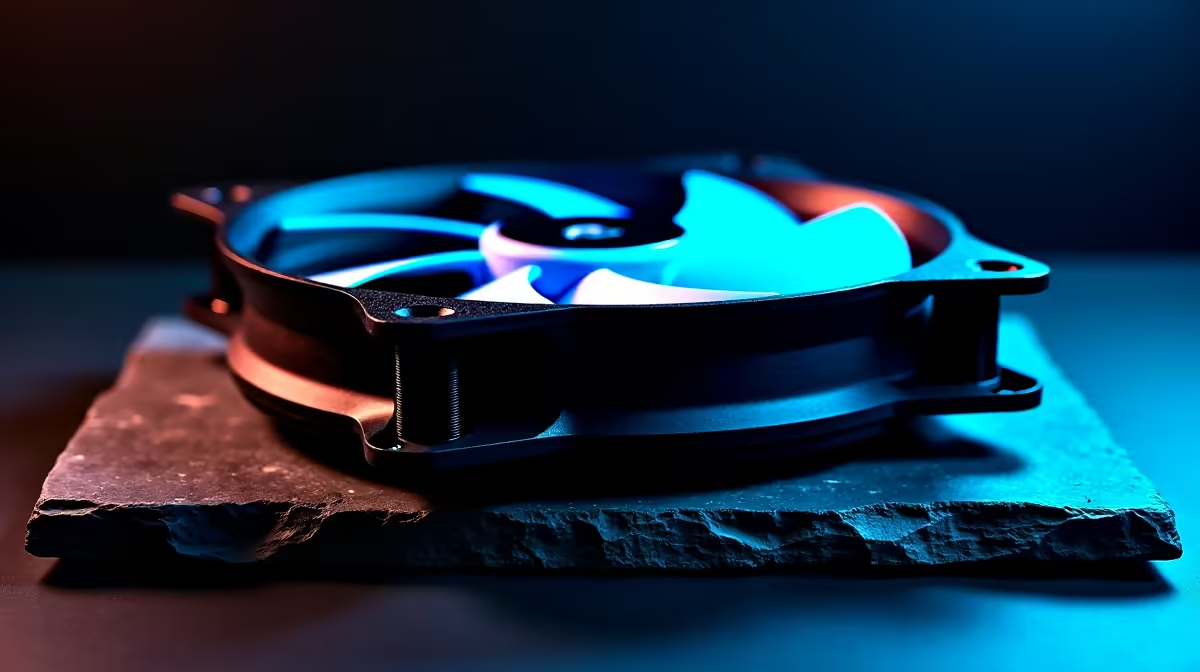
A decibel (dBA) rating of 31.21 dBA is very quiet for a case fan—quieter than most office environments and comparable to a peaceful library. For context, case fans typically range from 15 dBA (barely perceptible) to 45+ dBA (loudly annoying), making 31.21 dBA a genuinely quiet performer.
Understanding Decibel Scale Basics
Decibels use a logarithmic scale, not linear. An increase of 10 dBA represents roughly doubling the perceived loudness. So 31 dBA is not "slightly quieter" than 41 dBA—it's noticeably quieter, roughly half as loud. This logarithmic nature means small dBA changes make measurable differences in comfort.
Decibel Reference Points:
- 10 dBA: breathing (barely audible)
- 15–20 dBA: whisper, quiet rural setting
- 25–30 dBA: quiet office, library, still quiet
- 31–35 dBA: soft conversation, quiet computer
- 40–45 dBA: normal conversation, busy office
- 50+ dBA: loud conversation, noticeable annoyance
A 31.21 dBA fan sits at the boundary between "library quiet" and "soft conversation quiet." You hear it, but it's not intrusive or fatiguing during hours of use.
Why Case Fan Noise Matters
A single loud fan is annoying; three loud fans compound the problem. If your case has three intake and two exhaust fans averaging 38 dBA each, the cumulative effect approaches 44+ dBA perceived loudness. That's audibly loud during focused work. The same case with 31 dBA fans feels significantly quieter despite identical RPM and CFM output.
Noise sensitivity varies individually. Some builders work in noisy environments (offices, workshops) and barely notice fan noise. Others work in silent spaces (home studios, libraries) where 31 dBA is distractingly loud. Consider your environment when evaluating specifications.
Measured vs Perceived Noise
Case Fan dBA Ratings in Practice
Budget Case Fans (20–28 dBA) Typically 80–100 CFM (cubic feet per minute) at maximum speed. Very quiet, but often sacrifice cooling performance slightly. Good for office-focused builds or passive cooling supplementing better CPU coolers.
Mid-Range Case Fans (28–35 dBA) Typically 90–120 CFM. The sweet spot for most builders. Deliver solid cooling without excessive noise. A 31 dBA fan in this category is an excellent balance—quiet enough for daily comfort, efficient enough for gaming.
High-Performance Case Fans (35–45+ dBA) Typically 120+ CFM. More aggressive, cooler, but louder. Useful in cases with poor airflow or extremely dense component layouts. Not recommended for silent builds.
A 31.21 dBA fan likely delivers 95–110 CFM at rated speed, making it both efficient and quiet. This performance-to-noise ratio suits most gaming and content creation builds.
Noise Levels at Different Speeds
Case fans rarely run at maximum speed continuously (thanks to PWM control). More realistically:
Idle / Browsing (30% speed) A 31 dBA fan at full speed drops to roughly 22–24 dBA at 30% PWM speed. Nearly inaudible, comparable to a whisper.
Gaming Load (70–80% speed) The same fan at 75% speed produces ~29–31 dBA—still quiet, but noticeably present.
Thermal Load / Rendering (100% speed) At full 31 dBA, plainly audible but not painful or fatiguing during extended sessions.
This dynamic profile is crucial. Your case spends most time at partial speed, where 31 dBA fans are whisper-quiet. Only during sustained gaming or rendering do they reach audible levels, and even then, 31 dBA is far quieter than 40+ dBA alternatives.
Comparing 31 dBA to Alternatives
31 dBA fan vs 25 dBA fan The 25 dBA fan is noticeably quieter (about 40% quieter perceived), but may move 15–20% less air. For pure silent operation, this trade-off often favours the 25 dBA option.
31 dBA fan vs 38 dBA fan The 38 dBA fan is noticeably louder (about 60% louder perceived), potentially moving 10–15% more air. Most builders prefer the 31 dBA option unless extreme cooling is required.
31 dBA fan vs 45 dBA fan The 45 dBA fan is roughly twice as loud (perceptually) and unsuitable for general use unless water cooling or extremely dense setups demand it.
In three-fan configurations:
- Three 31 dBA fans = moderately quiet (cumulative ~37 dBA perceived)
- Three 38 dBA fans = noticeably loud (cumulative ~44 dBA perceived)
That ~7 dBA difference becomes significant during eight-hour workdays.
Measurement Conditions and Real-World Variation
Manufacturers measure dBA at 1 metre distance under controlled acoustics (anechoic chambers or similar). Real-world setups vary:
Factors That Increase Perceived Noise:
- Measuring closer to fans (25 cm instead of 1 metre increases dBA by 10–15)
- Case resonance amplifying vibration frequencies
- Hard surfaces (desks, shelving) reflecting sound
- Multiple fans running simultaneously
Factors That Decrease Perceived Noise:
- Case insulation and dampening materials
- Fan isolation pads reducing vibration transmission
- Distance from ears (under-desk placement vs ear-level towers)
- Background noise (air conditioning, outdoor sounds)
A 31 dBA specification is trustworthy for comparison purposes, but your actual experience may vary by 3–5 dBA depending on mounting and environment.
Is 31 dBA Quiet Enough?
For most builders: absolutely. A 31 dBA case fan is quiet enough for:
- Silent gaming builds where fans remain below 35 dBA even under load
- Office and creative work (software development, design, writing)
- Recording environments where background fan noise was previously problematic
- Shared living spaces (dorms, apartments) where noise consideration matters
A 31 dBA rating alone isn't sufficient—verify CFM output ensures cooling adequacy for your components. A whisper-quiet 31 dBA fan moving only 60 CFM won't cool a high-end GPU. Check reviews and real-world testing to confirm that 31 dBA fans move adequate air for your build.
When shopping for case fans, prioritise 28–35 dBA models that deliver 90+ CFM. This range offers genuine quiet operation without sacrificing cooling. Browse case fans and components at Evetech to find quiet, efficient options matching your case and cooling needs.
"Find the quiet, high-performance case fans your build deserves. Check Evetech's complete component selection or explore pre-built gaming systems already optimised for silent operation."