Quick Answer
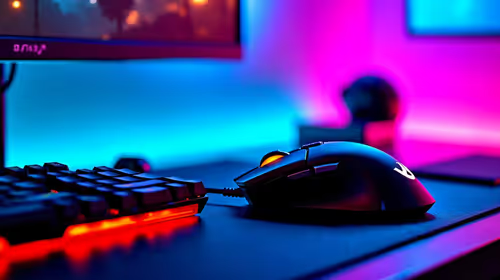
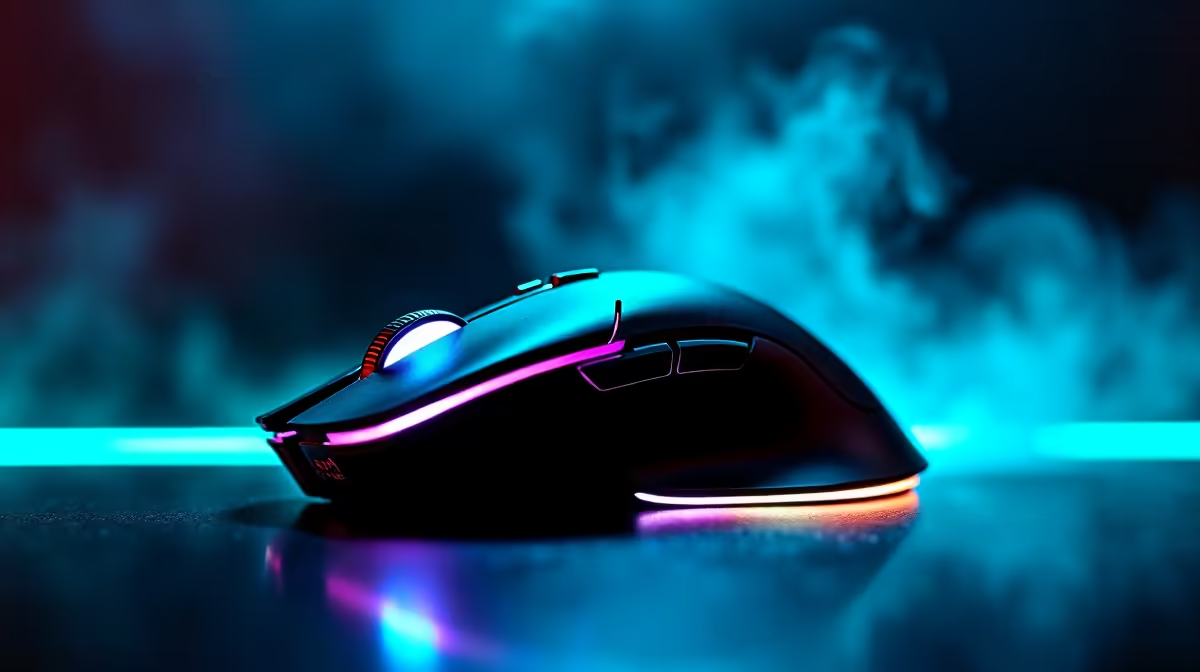
8000Hz polling rate means the mouse reports its position to your PC 8,000 times per second, eight times more often than a standard 1000Hz mouse. The Razer Viper V4 Pro uses it because at high refresh rates above 240Hz, faster polling reduces perceived input latency and smooths cursor motion at the pixel level.
What polling rate actually does
Every time your mouse polls, it sends a packet with its current X, Y, and button state to the PC. At 1000Hz that's once every millisecond. At 8000Hz that's once every 0.125 milliseconds. The benefit isn't that you suddenly aim better, it's that the time between your hand moving and the cursor reflecting that movement gets shorter, and the granularity of motion increases. On a 360Hz or 540Hz monitor, this is the difference between a cursor that updates per frame and one that updates multiple times per frame, which translates to silkier tracking on flick shots.
Why the Viper V4 Pro specifically pushes 8000Hz
Razer's HyperPolling technology in the Viper V4 Pro is built around the new Focus Pro 45K sensor and a custom MCU that can sustain 8000Hz reports without dropouts, which earlier wireless mice couldn't manage at this rate. The dongle uses HyperPolling Wireless Dongle tech to keep the wireless link as stable as a wired connection. Razer targeted competitive shooter players, particularly Valorant, CS2, and Apex pros, who chase any latency reduction they can measure. For the rest of us, the benefit is real but small, you'll feel it most on a 240Hz+ monitor.
Do you need 8000Hz for everyday gaming
Honestly, no. If you play on a 144Hz or 165Hz monitor, you're not seeing the full benefit, and 8000Hz also bumps CPU usage by a small amount, which can hurt FPS on lower-end builds. Where it makes sense is paired with a 360Hz or 540Hz panel, a top-tier CPU, and a competitive title. For SA varsity LAN players running 240Hz monitors, 4000Hz is a more sensible middle ground, less CPU overhead with most of the smoothness gain. The Viper V4 Pro lets you toggle between 1000, 2000, 4000, and 8000Hz so you can experiment.
Frequently Asked Questions
Will 8000Hz polling drop my FPS?
On modern Ryzen 7 or Core i7 CPUs, the FPS impact is roughly 1 to 3%, often within margin of error. On older quad-core chips it can be more noticeable. If you're CPU-limited in your favourite game, drop polling to 4000Hz to reclaim those frames.
Is the Viper V4 Pro worth the SA premium price?
For competitive players running 360Hz+ monitors, yes. For casual or even semi-serious players, the standard Viper V3 Pro at 4000Hz delivers 90% of the experience for less. SA pricing on the V4 Pro reflects its top-tier sensor and wireless tech, you're paying for the best, not for marketing.
Does my monitor need to be 8000Hz too?
No, those are different specifications. Polling rate is mouse-to-PC communication speed. Monitor refresh rate is screen update speed. They're independent, but high polling rates only deliver visible benefits on high refresh rate monitors.
Ready to Find Your Perfect Match? Pair a Viper V4 Pro with a build that can actually feed it. Browse high-end gaming PCs at Evetech