Quick Answer
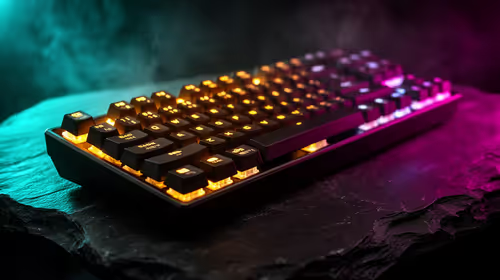
Low-profile keyboards keep trending because they feel faster on smaller desks and suit hybrid gaming-work setups. For SA buyers, the useful answer is to price the whole setup, not the headline part alone. Use Logitech G915-style boards, Keychron K-series low-profile boards, red switches, brown switches, and 2.4GHz wireless models as reference points and plan around a broad R900-R3,500 for common low-profile keyboard tiers budget band.
What changes the buying decision
The deciding factor is fit. A low-profile keyboard must match the desk, workload, monitor, games, noise tolerance, and upgrade plan. shorter switch travel can reduce finger fatigue during long typing and gaming sessions. If the part adds complexity, heat, or locked-in limitations, the headline benefit needs to be strong enough to justify it.
SA buyers should also account for import timing and replacement stock. A part that looks cheap today may be less useful if it forces a weaker motherboard, smaller SSD, or noisier case. the feel difference is larger than any claimed millisecond advantage.
Specs worth checking
Start with the numbers that affect daily use: cores, VRAM, RAM capacity, storage size, wattage, refresh rate, thermals, and warranty coverage. Then compare the named SKU against the rest of the build. A Ryzen X3D chip needs suitable DDR5; an ITX case needs the right cooler height; a PSU needs the right connectors, not just a large wattage number.
For office hardware, prioritise quiet operation, 16GB RAM, a 512GB or larger SSD, and easy servicing. For gaming hardware, prioritise fps target, display resolution, thermals, and power quality.
FAQ
How should SA buyers compare this category?
Compare the full basket price and the limitation it removes. The best value part is the one that improves daily use without creating a cooling, power, or upgrade problem.
Is the premium option always better?
No. Premium parts are worth it only when the workload, monitor, or game target uses the extra performance. Otherwise, the money may improve RAM, SSD capacity, cooling, or display quality more.
What spec should not be ignored?
Do not ignore thermals, warranty, and platform fit. Those three points decide whether the part stays useful after the first benchmark run.
Price the whole setup
Before buying, write down the CPU, GPU, RAM, SSD, case, PSU, monitor, and warranty target. The right choice is the one that keeps that whole list coherent.