Keen to run powerful AI like Stable Diffusion or a private ChatGPT-style model on your own rig? You're not alone. The buzz around Large Language Models (LLMs) is massive, but many South African tech enthusiasts think it requires a supercomputer. The good news? It doesn't. A smart, budget PC upgrade for LLMs is more achievable than you think, and it all starts with understanding one key component. Let's dive in. 🔧
The Core of Your LLM Upgrade: VRAM is King
Before you rush out to buy a new CPU or more RAM, let's get one thing straight: for running LLMs locally, your Graphics Processing Unit (GPU) does most of the heavy lifting. Specifically, its video memory (VRAM) is the single most important factor.
Think of VRAM as the GPU's dedicated workspace. An LLM's parameters... the "brain" of the model... must be loaded into this workspace to function. If you don't have enough VRAM, you simply can't load the model, or you'll be forced to run smaller, less capable versions. For a decent experience with popular open-source models, 12GB of VRAM is a great starting point, with 16GB or more being ideal. This makes choosing the right GPU the most cost-effective guide to better AI performance.
Finding the Best Value GPU for Your AI Build
When it comes to a budget PC upgrade for LLMs, the GPU market offers some fantastic value if you know where to look. While raw gaming power is great, VRAM per Rand is our main metric here.
NVIDIA's CUDA Advantage
For the broadest software support and community tutorials, NVIDIA is currently the top choice. Its CUDA technology is the industry standard for AI development, meaning most tools work out-of-the-box. Many powerful NVIDIA GeForce gaming PCs already come equipped with GPUs that are perfect for getting started, like the RTX 3060 12GB or the RTX 4060 Ti 16GB. These cards offer a fantastic balance of VRAM and price.
Don't Discount AMD
Team Red is catching up fast. While their software ecosystem (ROCm) is less mature than CUDA, it's improving rapidly. If your primary use is gaming, but you want to experiment with AI, modern AMD Radeon gaming PCs with cards like the RX 7800 XT (16GB) offer incredible gaming value and a solid VRAM buffer for your LLM projects. Keep an eye on software compatibility, but the hardware is definitely capable. ✨
Check Before You Buy ⚡
Before committing to a GPU, check model quantisation. Quantisation is a technique that shrinks LLMs to fit into less VRAM, often with a minimal loss in quality. Websites like Hugging Face show different versions of models (e.g., 4-bit, 8-bit) and their VRAM requirements. This can help you match a model to a specific budget GPU.
What About the Rest of the System?
While the GPU is the star, your other components still play a supporting role. You don't need the absolute best of everything, but a balanced system ensures you won't face other bottlenecks.
- System RAM: Aim for at least 32GB. When a model is being loaded, it often passes through your system RAM first before being loaded into VRAM. Having enough capacity keeps this process smooth.
- CPU: A modern 6 or 8-core CPU (like an AMD Ryzen 5 or Intel Core i5) is more than enough. The CPU's job is to prepare data for the GPU, not run the model itself.
- Storage: A fast NVMe SSD is crucial. LLMs can be huge... we're talking 10GB to over 100GB per model. A speedy SSD dramatically reduces loading times, getting you up and running much faster.
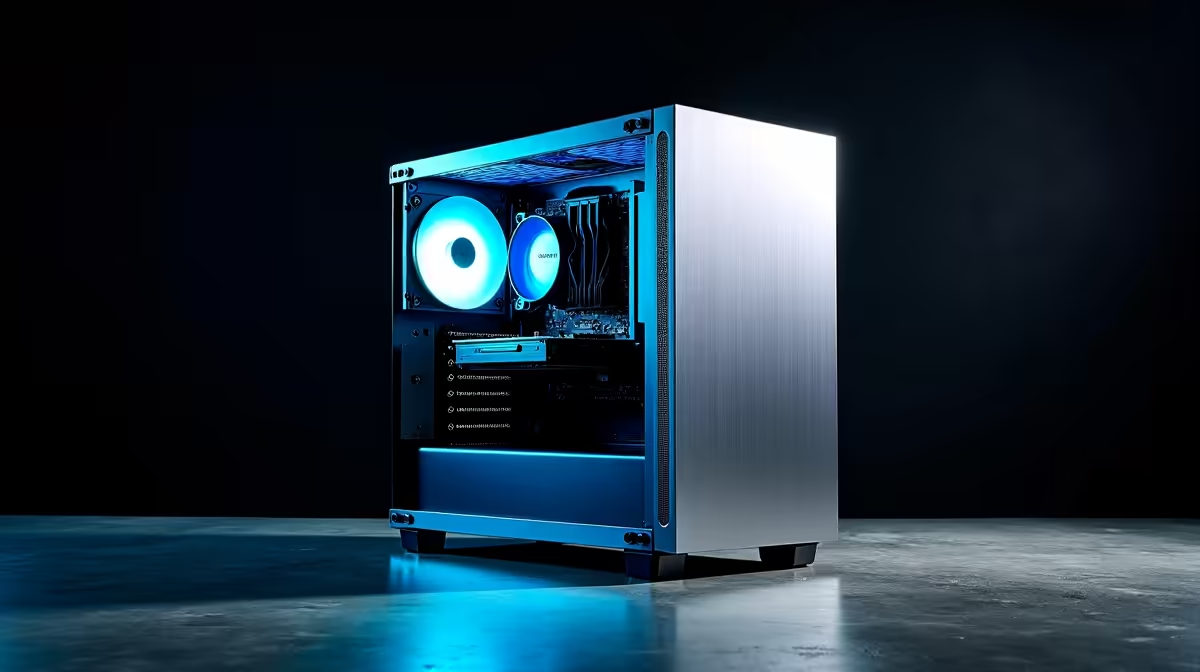
If you're building from scratch or need a robust, balanced machine for more than just AI, exploring pre-built workstation PCs can be a great, hassle-free option. 🚀
A budget PC upgrade for LLMs in South Africa is all about smart allocation. Prioritise a GPU with the most VRAM you can afford, ensure you have sufficient system RAM and fast storage, and you'll have a capable machine ready for the exciting world of local AI.
Ready to Start Your AI Upgrade? Running powerful AI models locally is within reach. A strategic component choice makes all the difference. Explore our massive range of PC components and find the perfect parts to build your own LLM powerhouse today.