So, you've just dropped some serious cash on a beastly new graphics card. You unbox it, slot it in, and... hold on. Your trusty old monitor only has an ancient DVI port. Suddenly, your high-tech rig feels like a Ferrari stuck in first gear. Buying a new display in South Africa isn't just about screen size or resolution anymore; understanding and choosing future proof monitor ports is the key to unlocking your PC's true potential.
Why Your Monitor's Ports Matter More Than You Think
Think of your monitor's ports as the highways connecting your GPU to your screen. A powerful graphics card can render incredible visuals, but if the "highway" is too narrow, you get a traffic jam. This bottleneck limits your refresh rate, resolution, and access to modern features like HDR (High Dynamic Range) and adaptive sync technologies. A poor port choice today means you'll be shopping for another new screen sooner than you'd like.
Making an informed decision now ensures your display keeps up with your future upgrades. It’s the smartest way to protect your investment and enjoy buttery-smooth performance for years to come. Browsing the wide variety of PC monitors available is the first step to finding your perfect match.
Decoding the Port Alphabet: HDMI vs. DisplayPort vs. USB-C
Choosing the right connection can feel a bit like alphabet soup. Let's break down the main contenders to help you create a future proof monitor port setup.
HDMI: The Versatile All-Rounder
HDMI (High-Definition Multimedia Interface) is everywhere—on your PC, your PlayStation 5, and your TV. It's incredibly convenient, but not all HDMI is created equal.
- HDMI 2.0: Still very capable for most people, handling 4K at 60Hz or 1440p at 144Hz. It's a solid baseline.
- HDMI 2.1: This is the current gold standard. It has massively increased bandwidth, enabling 4K at 120Hz (or even higher) and 8K at 60Hz. For next-gen console and high-end PC gamers looking at glorious 5K and 4K monitors, HDMI 2.1 is non-negotiable.
DisplayPort (DP): The Gamer's Choice 🚀
For a long time, DisplayPort has been the top choice for the PC master race, and for good reason. It often supports higher refresh rates at top resolutions before its HDMI counterpart catches up.
- DisplayPort 1.4: This is the current sweet spot for most gamers. It comfortably handles 4K at 120Hz and 1440p at 240Hz, making it perfect for the competitive esports scene. It's the workhorse behind many of today's best gaming monitors.
- DisplayPort 2.1: The new kid on the block, offering mind-boggling bandwidth for future 8K-and-beyond gaming. While still rare, a monitor with DP 2.1 is about as future-proof as it gets.
Check Your Cables! 🔧
A high-spec port is useless without the right cable. An HDMI 2.1 port needs an "Ultra High Speed" HDMI cable to deliver its full potential. Don't let a R200 cable bottleneck your R10,000 monitor!
USB-C: The One-Cable Wonder ✨
USB-C is the ultimate minimalist's port. Using protocols like Thunderbolt or DisplayPort Alt Mode, a single USB-C cable can transmit video, audio, data, and even power to your device. It’s perfect for connecting a laptop to a larger screen for a clean, one-cable desk setup. This versatility is why it's the go-to for powerful and convenient portable monitors that you can take anywhere.
A Practical Guide to Buying Your New Display
So, which port is for you? Ask yourself these questions:
- What's my primary use? For competitive FPS gaming, a DisplayPort 1.4 monitor that pushes high refresh rates is ideal. For a mix of PC and console gaming, HDMI 2.1 offers the best compatibility.
- What GPU am I using? Check your graphics card's outputs. There's no point buying a DP 2.1 monitor if your GPU only has DP 1.4 ports. Match them up for optimal performance.
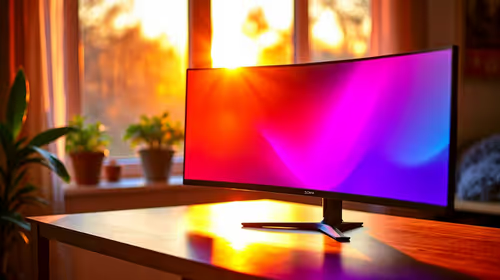
- Do I want an immersive experience? Many gamers find that curved monitors pull them deeper into the action, and these often come equipped with the latest ports to handle the wide field of view.
Don't Forget the Extras
Beyond the main video inputs, look for a built-in USB hub. Having a few USB-A ports on your monitor is incredibly handy for plugging in your mouse, keyboard, or headset without crawling under your desk. Also, check for a VESA mount pattern on the back. This allows you to attach the screen to a monitor arm, freeing up desk space and giving you perfect ergonomic positioning. You can find a range of monitor accessories to complete your ultimate setup.
Ready to Upgrade Your View? A great display is more than just pixels; it's about having the right connections for tomorrow's tech. Stop guessing and explore our massive range of future-proof monitors with the best PC monitor deals in South Africa.