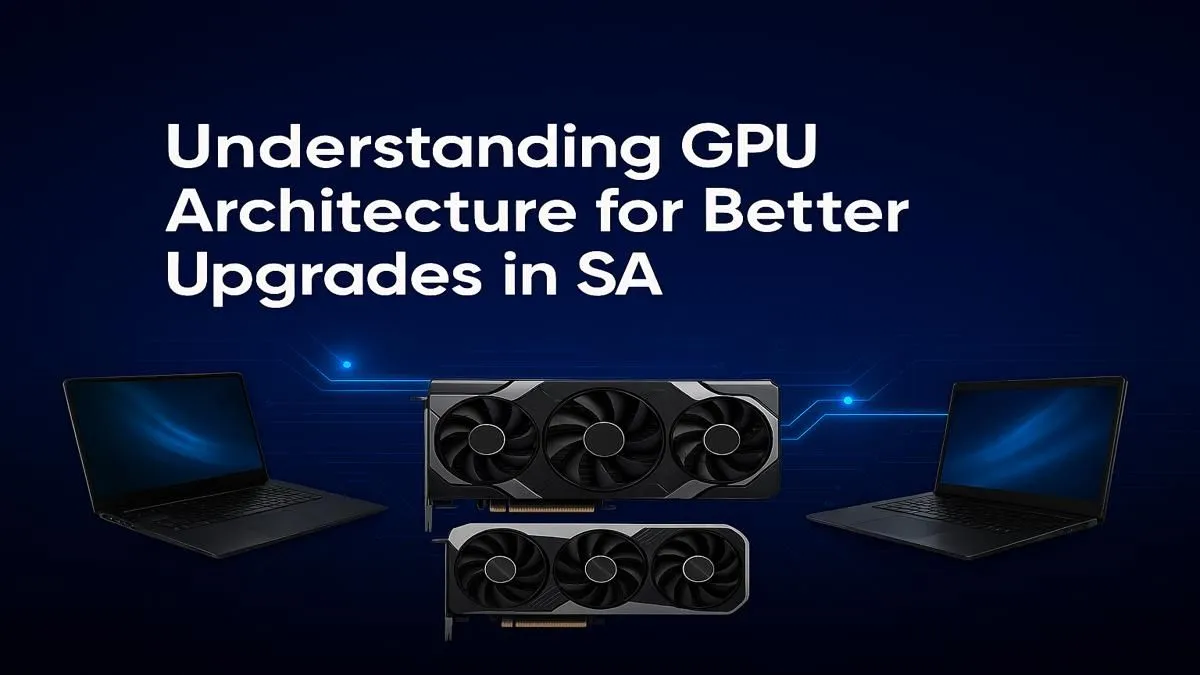
Choosing a new GPU in South Africa can feel like a boss battle. You see terms like "Ada Lovelace" or "RDNA 3" and your wallet starts sweating. But what do they actually mean for your frame rates in Helldivers 2? Understanding GPU architecture is the secret to a smart upgrade, not just an expensive one. Let's decode the tech jargon so you can make the best choice for your rig. 🚀
What is GPU Architecture, Really?
Think of GPU architecture as the fundamental blueprint for a graphics card. It’s the master plan that dictates how the thousands of tiny cores work together to process information and splash gorgeous pixels across your screen. Like the difference between a 4-cylinder engine and a V8, two GPUs might have the same amount of VRAM, but their underlying architecture determines their true power, efficiency, and special features.
A newer, more refined graphics card architecture can process instructions faster, handle complex lighting more efficiently, and even use AI to boost your performance. This is why a brand-new RTX 4060 can often outperform an older, beefier-sounding RTX 3070 in certain scenarios… it's all down to the smarter design.
Key Architectural Differences: NVIDIA vs. AMD
For years, the battle has been between Team Green (NVIDIA) and Team Red (AMD). While both make incredible cards, their GPU architecture explained simply comes down to different philosophies.
NVIDIA's Approach: Ray Tracing & AI Dominance
NVIDIA's recent architectures, like Ada Lovelace (RTX 40 Series), are famous for two things:
- RT Cores: These are dedicated processing units built specifically for Ray Tracing—a rendering technique that simulates how light behaves in the real world for incredibly realistic reflections, shadows, and lighting.
- Tensor Cores: This is the hardware that powers DLSS (Deep Learning Super Sampling). It uses AI to cleverly upscale lower-resolution images, giving you a massive FPS boost with minimal loss in visual quality.
If you crave the absolute best visual fidelity and cutting-edge features, NVIDIA's architecture is often the top choice.
AMD's Approach: Raw Power & Open Standards
AMD's RDNA architectures (like RDNA 3 in the RX 7000 Series) focus on a different strategy:
- Rasterization Performance: AMD often delivers phenomenal raw performance in traditional gaming (without ray tracing). This can mean better price-to-performance for many gamers.
- Chiplet Design: A modern innovation where the GPU is built from multiple smaller chips. This can improve efficiency and reduce manufacturing costs.
- FSR (FidelityFX Super Resolution): This is AMD's answer to DLSS. A key difference is that it's open-source, meaning it can run on almost any modern GPU… including older NVIDIA cards.
Don't Forget the Bottleneck! 🔧
Your GPU is only one part of the performance puzzle. A brand-new, powerful GPU architecture will be held back if it's paired with an old, slow CPU. This is called a bottleneck. Ensure your processor is up to the task to get every frame you paid for.
Why GPU Architecture Matters More Than VRAM
It's easy to get caught up in the VRAM numbers—8GB, 12GB, 16GB! And while having enough VRAM is crucial, especially for high-resolution gaming, the underlying GPU architecture is far more important for overall performance. An efficient architecture uses its VRAM more effectively and processes data much faster.
Think of it this way: VRAM is the size of the workbench, but the architecture is the skill of the craftsman. A master craftsman with a smaller bench can still work faster and better than an amateur with a huge one. This is why an informed upgrade decision always starts with understanding the core technology. A powerful GPU also needs a solid CPU to keep up, preventing performance bottlenecks that waste your hardware's potential.
How to Choose the Right Architecture for Your Build ✨
So, which path should you take? The right choice depends entirely on you, the South African gamer.
- For the Competitive Player: If you're playing Valorant or CS2 and need the highest possible frame rates with ray tracing switched off, an AMD card with its strong rasterization performance might offer the best bang for your buck.
- For the Visual Enthusiast: If you love breathtaking single-player games like Cyberpunk 2077 or Alan Wake 2 and want to experience them with all the glorious ray-traced visuals enabled, NVIDIA's architecture is purpose-built for that.
If you're starting a new build from scratch, choosing a foundation is key. You can find pre-configured Intel barebone kits or powerful AMD barebone kits that provide a great starting point, letting you focus on picking the perfect GPU architecture for your needs.
Ready to Unleash True Next-Gen Power? 🚀
Understanding GPU architecture is your first step to a smarter upgrade. Now it's time to find the card that fits your budget and your gaming style. From NVIDIA's RTX powerhouses to AMD's RDNA challengers, we've got the perfect GPU for your rig. Browse Evetech's massive range of graphics cards and find your next upgrade today.