Quick Answer
Pairing an RTX 5080 with a Ryzen 9 9900X delivers an exceptionally well-matched high-end gaming and content creation system. The 9900X's 12 cores and strong single-threaded performance keep up with the RTX 5080's throughput at 1440p and 4K, making this one of the most capable consumer PC combinations available in 2026.
Why the RTX 5080 and Ryzen 9 9900X Work Well Together
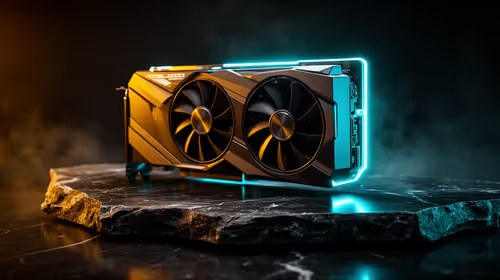
The RTX 5080 is Nvidia's second-tier flagship in the Blackwell generation, built on the GB203 die with 10,752 CUDA cores and 16GB of GDDR7 memory. The Ryzen 9 9900X brings 12 Zen 5 cores with boosted IPC over Zen 4 and a maximum boost of 5.6GHz. At 1440p and 4K, GPU-bound workloads dominate, meaning the CPU rarely becomes the limiting factor. Where the 9900X shines in this pairing is in CPU-bound scenarios: open-world games that stream large amounts of data, simulation titles, and any creative workload running alongside gaming. The 12-core count also ensures future titles that leverage more threads will not leave you bottlenecked. The pairing avoids the diminishing returns of going all the way to the Ryzen 9 9950X. Unless you are running heavy multi-threaded production work like 3D rendering or video encoding simultaneously with gaming sessions, the 9900X handles every game the RTX 5080 can throw at it without compromise. ## Platform and Motherboard Choices for This Build
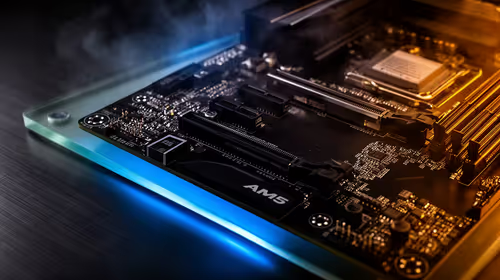
The Ryzen 9 9900X requires an AM5 socket motherboard. An X670E or B650E board is the practical choice. X670E boards offer PCIe 5.0 for both the GPU slot and M.2 storage, which pairs well with the RTX 5080's bandwidth requirements. B650E boards typically provide PCIe 5.0 on the primary GPU slot and PCIe 4.0 for storage, which is still entirely adequate since real-world GPU bandwidth utilization rarely saturates even PCIe 4.0 x16 at current game resolutions. For RAM, DDR5-6000 running in EXPO mode at CL30 is the sweet spot for Zen 5. The Infinity Fabric runs at its optimal 2000MHz divider at this speed, giving you the best balance of latency and bandwidth. Fit at least 32GB for this tier of build. Budget roughly R6,000 to R10,000 for the motherboard and R3,500 to R6,000 for a quality 32GB DDR5 kit at South African pricing. ## Cooling Requirements for the RTX 5080 and Ryzen 9 9900X
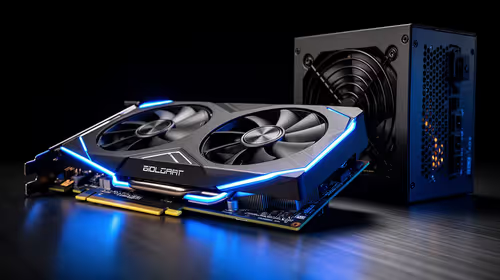
The RTX 5080 has a TDP of around 360W and the Ryzen 9 9900X is rated at 120W base with PPT limits that can run higher. Together this build can pull over 500W under sustained load. You need a power supply of at least 850W, and a quality 1000W unit gives comfortable headroom. A reputable 80 Plus Gold or Platinum PSU in that range costs between R2,500 and R4,500 locally. For CPU cooling, the 9900X responds well to a 240mm or 280mm AIO liquid cooler. A high-end air cooler from a premium brand works too, especially in cases with good airflow. Do not underestimate case airflow for the RTX 5080 as well. Triple-fan GPU coolers on this card can push significant heat into the chassis, so a case with at least three intake fans is the right approach. ## Performance Expectations at 1440p and 4K
At 1440p the RTX 5080 with Ryzen 9 9900X will exceed 165 FPS in most AAA titles and push well above 200 FPS in competitive shooters. The RTX 5080 is genuinely capable of hitting high frame rates at 4K in demanding titles, which was previously the domain of the RTX 4090. With DLSS 4 Multi Frame Generation, even the most demanding 4K workloads become fluid at very high frame rates. For South African gamers connecting to EU servers with 180ms latency, raw frame rate matters less than consistency, and this build delivers rock-solid frametimes. Content creation performance is equally strong. Video editing in DaVinci Resolve and 3D work in Blender both benefit from the 9900X's strong single-core and solid multi-core numbers alongside the RTX 5080's VRAM and tensor core capabilities. ## Frequently Asked Questions
Will the Ryzen 9 9900X bottleneck the RTX 5080 at 1440p? At 1440p the CPU is rarely the limiting factor in GPU-bound titles, and the 9900X is more than capable of feeding the RTX 5080. You may see a small theoretical gain with a 9950X in CPU-heavy games, but it will not be meaningful in the majority of titles. What PCIe generation does the RTX 5080 need? The RTX 5080 uses a PCIe 5.0 x16 connector but is backward-compatible with PCIe 4.0 x16 with minimal real-world performance difference. Tests show less than 1% difference between PCIe 4.0 and 5.0 in most gaming scenarios at current resolutions. How much does this build cost in South Africa? Expect to pay in the region of R25,000 to R35,000 for the RTX 5080 and R12,000 to R16,000 for the Ryzen 9 9900X, depending on availability and rand/dollar exchange rates. Total system cost including board, RAM, storage, and cooling typically runs R70,000 to R90,000 for a complete high-end build. Is this build good for loadshedding-affected setups? High-end builds like this draw significant power, which is a consideration if you are running a UPS. A quality 1000W PSU paired with a 2000VA online UPS will handle the system, but be aware that heavy gaming under loadshedding will drain a standard UPS battery within 10 to 20 minutes depending on battery capacity. A dedicated backup power solution for gaming is worth planning for in the SA context.
Ready to Find Your Perfect Match? Find the RTX 5080 and the full range of Nvidia Blackwell GPUs at Evetech. Get the best pricing on graphics cards in South Africa today.