Is your fibre connection fast at the router but useless in the bedroom or braai area? You're not alone. Those thick South African brick walls are WiFi killers. For years, the go-to solution was a simple range extender, but now Mesh WiFi systems are here, promising to banish dead spots for good. So, when it comes to the Mesh WiFi vs Range Extender debate, which is actually the best choice for your home? Let's break it down. 📶
What's a WiFi Range Extender, Really?
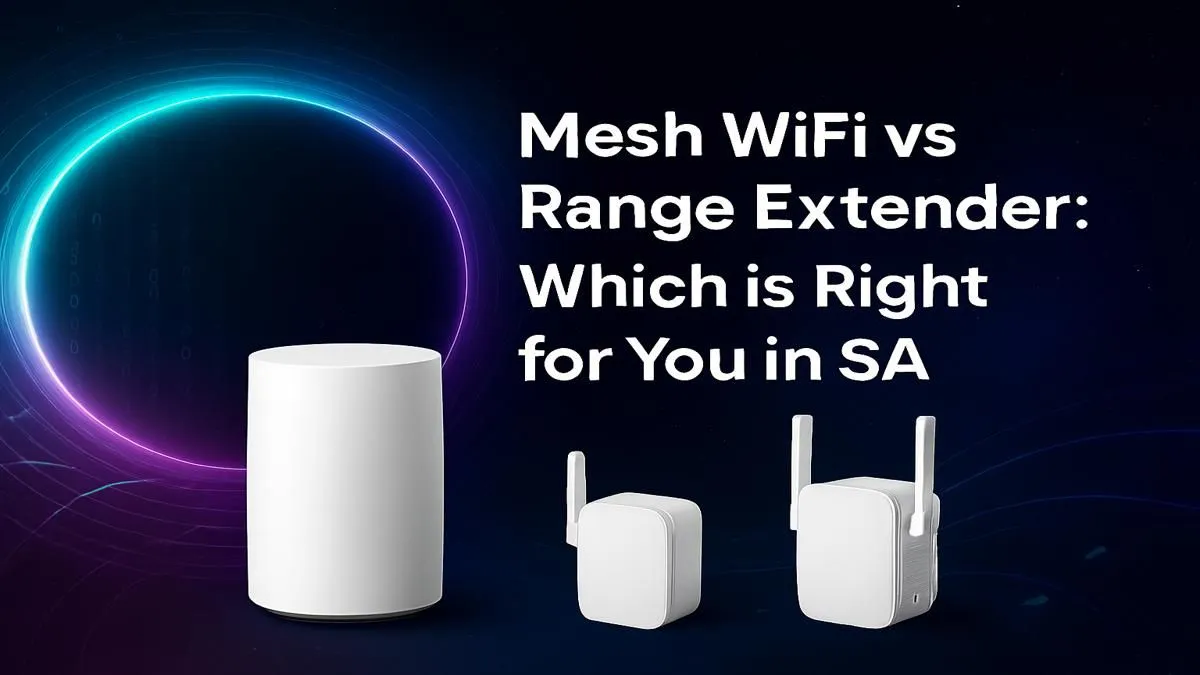
Think of a WiFi range extender as a signal booster. It captures the wireless signal from your main router and rebroadcasts it, extending its reach to cover a dead zone. It’s a simple, effective solution for a very specific problem.
How it Works
A range extender creates a new network, often with "_EXT" added to your original network's name. You place it halfway between your router and the area with poor signal. Your devices then connect to whichever signal is stronger—the router's or the extender's.
Pros & Cons
- Pro: They are incredibly affordable and easy to set up. Plug it in, follow a few steps, and you're done.
- Con: The biggest drawback is performance. By rebroadcasting the signal, a simple WiFi range extender typically cuts your potential bandwidth in half. This also means you have to manually switch networks as you move around your house, which can be a pain.
Best for: Smaller homes, apartments, or houses with just one or two specific dead spots, like a home office at the far end of the passage.
The Mesh WiFi System Explained
A Mesh WiFi system is a more modern and intelligent solution. Instead of one device boosting another, a mesh system uses multiple "nodes" or satellites that work together as a single, unified team. They create one seamless, powerful WiFi network that covers your entire property. 🏡
How it Works
The main node connects to your modem (just like a normal router), and you place the other nodes around your home. They all communicate with each other, automatically routing traffic in the most efficient way. As you walk from the lounge to the garden, your phone or laptop seamlessly hands off from one node to the next without ever dropping the connection.
Pros & Cons
- Pro: You get one network name (SSID) for your whole home. The performance is far superior to an extender, as the nodes are designed to talk to each other without massive speed loss.
- Con: The initial cost is higher than a single extender.
Best for: Larger or double-storey homes, properties with thick walls, and anyone who demands consistent, high-speed internet for gaming, streaming 4K content, or running a busy smart home. The debate of range extender vs mesh often ends here for power users.
First, Check Your Router's Position! 🔧
you spend a cent, try moving your main [wireless router](https: www.evetech.co.za PC-Components buy-wireless-routers-138) to a more central, open location in your home, away from thick walls and appliances. Sometimes, optimising its placement is all you need to improve coverage significantly. It's a free fix that might just solve your problem.
Mesh WiFi vs Range Extender: The Head-to-Head for SA Homes
So, how do they stack up in a typical South African scenario? Let's get straight to the point.
Performance & Speed 🚀
A range extender will always be a bottleneck. It's great for basic browsing or checking emails in a dead zone, but it's not ideal for high-demand tasks. A mesh system, however, is built for speed and reliability, ensuring your fast fibre connection is actually usable everywhere. For online gaming, where low latency is crucial, mesh is the undisputed winner. A great network also relies on great hardware in your machine, so ensure you have powerful wireless adapters for your PC to take full advantage.
Coverage & Reliability
While an extender patches one hole, a mesh system provides a complete blanket of coverage. It intelligently manages your connection, so if one node goes down (thanks, an unexpected outage!), the others can often pick up the slack. This makes it a more robust and reliable WiFi solution for the modern, connected home.
The Verdict: Which is Best for You?
The Mesh WiFi vs Range Extender decision comes down to your needs and budget.
- Choose a Range Extender if: You have a small-to-medium-sized home and just one annoying dead spot you need to cover for light internet use. It's a quick, budget-friendly fix.
- Choose a Mesh WiFi System if: You live in a larger house, have multiple floors, or simply refuse to compromise on speed and stability for gaming, streaming, or working from home. It's a true network upgrade.
Ready to Banish Buffering for Good?
Whether you need a simple fix or a total network overhaul, the right gear makes all the difference. Stop fighting with your WiFi and start enjoying the seamless connection you pay for. Explore our full range of wireless networking solutions and find the perfect fit for your home today.