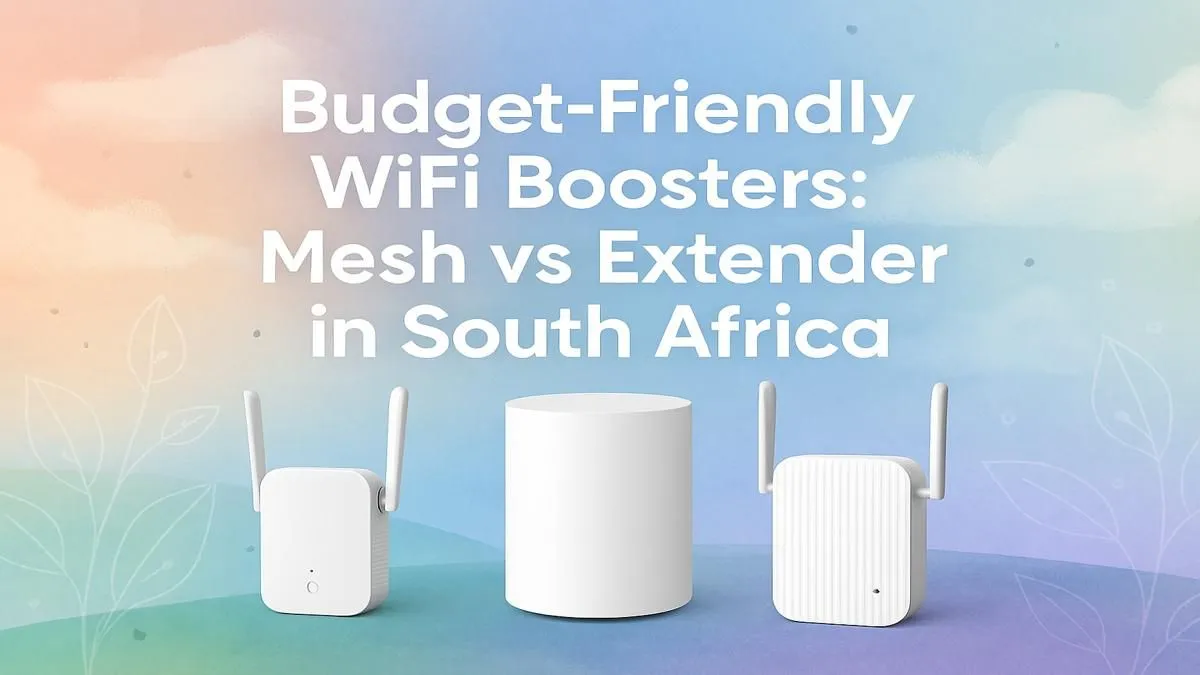
Is your WiFi signal weaker than a outage schedule? 😩 Lag spikes in your favourite game, endless buffering on Showmax... we've all been there. Choosing the right WiFi booster in South Africa can feel tricky, especially on a budget. Do you go for a simple extender or a full mesh system? Let's break down the mesh vs extender debate so you can get the fast, stable connection you pay for.
Understanding Your WiFi Booster Options
Before you spend your hard-earned Rands, it's crucial to know what you're buying. At its core, a WiFi booster takes your existing wireless signal and rebroadcasts it to cover areas your main router can't reach. The two most common types you'll find in South Africa are WiFi Extenders and WiFi Mesh Systems. They both aim to kill dead zones, but they do it in very different ways.
The Budget-Friendly Fix: WiFi Extenders
A WiFi extender, or repeater, is the classic solution for boosting your signal. It's a single device you plug into a power socket somewhere between your router and your WiFi dead zone. It captures the existing signal and simply re-broadcasts it, extending its reach.
Why Choose an Extender?
For many South African homes, this is the perfect fix.
- Affordability: Extenders are incredibly budget-friendly, often costing a fraction of a mesh kit.
- Simplicity: Setup is usually as easy as plugging it in and pressing a WPS button.
- Targeted Solution: It's ideal for solving one or two specific problem areas, like a single upstairs bedroom or the braai area outside.
The downside? Extenders often create a new network name (like "MyWiFi_EXT") that you have to switch to manually. They can also sometimes cut your potential bandwidth in half. Still, for a quick and cheap fix, you can't go wrong exploring some affordable wireless range extenders.
The Seamless Solution: WiFi Mesh Systems
Think of a WiFi mesh system as a team of smart routers working together. You replace your existing router with a main mesh "node" and then place other nodes around your house. They all communicate with each other, creating one large, seamless and intelligent WiFi network under a single name. 🚀
When Does Mesh Make Sense?
A mesh system is a bigger investment, but it provides a superior experience.
- Seamless Roaming: You can walk around your house on a video call without ever dropping the connection. Your device automatically connects to the strongest node.
- Intelligent Traffic: Mesh systems are smart. They route your data through the fastest, least congested path back to the modem.
- Full Coverage: They are designed to eliminate dead spots completely in larger, multi-story, or oddly shaped homes with thick walls.
This technology is the gold standard for modern wireless networking solutions and is perfect for demanding users who need reliable speed everywhere.
Placement is Everything! 📍
Don't hide your mesh nodes behind the TV or in a cupboard. For the best performance, place them in open areas, about halfway between your main router and the dead zone. Think line-of-sight for the strongest signal possible.
Mesh vs Extender: Which WiFi Booster is for You?
So, how do you choose? It really comes down to your home, your needs, and your budget.
- Choose an Extender if... you have one specific dead zone, your budget is tight, and you just need a simple signal boost for browsing or streaming in that one room.
- Choose a Mesh System if... you have multiple dead zones, a larger home, need seamless and reliable coverage for gaming or work calls, and are willing to invest in a long-term solution.
Sometimes, the bottleneck isn't the range but the router itself. Before investing in any booster, ensure your foundation is solid by considering if upgrading your main wireless router could solve your problems first.
Before You Buy: Quick Optimisation Checks ✨
A new WiFi booster is a great tool, but don't forget the basics. First, try moving your router to a more central, elevated position in your home. Second, ensure its firmware is up to date. Finally, if it's just your PC struggling with a weak signal in a room with otherwise decent coverage, a powerful wireless adapter could be a more direct and cost-effective upgrade.