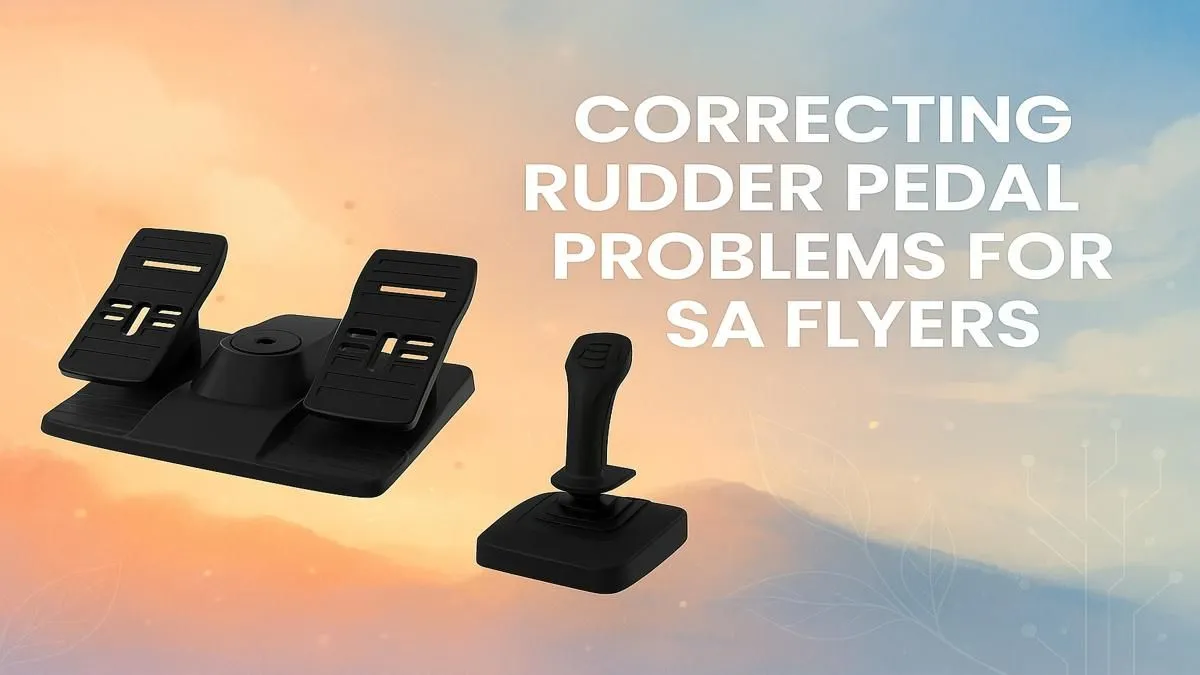
You're on final approach into Cape Town International, wings steady, glide slope perfect... until your aircraft suddenly yaws hard to the left. Your rudder pedals are acting up again. Sound familiar, boet? For many South African flight sim pilots, frustrating rudder pedal problems can ruin an otherwise perfect flight. Don't stress. This guide will help you diagnose and fix rudder pedal problems so you can get back to smooth landings and precise taxiing. ✈️
Identifying Common Rudder Pedal Issues
Before you can fix the problem, you need to know what you're looking for. Most rudder pedal issues fall into a few categories:
- Spiking: The input jumps to 100% with only a slight touch, causing erratic and uncontrollable movement.
- Dead Zone Drift: The rudder is slightly engaged even when your feet are off the pedals, making your aircraft drift on the ground or in the air.
- No Response: The pedals aren't detected by your PC or the simulator at all.
- Jittery Input: The rudder input flickers rapidly, causing a shaky or unstable flight path.
Understanding these symptoms is the first step to a successful rudder pedal fix.
Your Step-by-Step Troubleshooting Guide
Let's work through the solutions, from the simplest physical checks to the more complex software tweaks. Follow these steps to fix your rudder pedal problems and get your virtual aircraft flying straight.
1. The Physical Check-Up 🔧
Always start with the hardware itself. It's often the simplest things that cause the biggest headaches.
- Check Your Connections: Unplug the USB cable from both the pedals and your PC, then plug it back in firmly. Try a different USB port, preferably one directly on your motherboard, not a hub.
- Inspect for Dust & Debris: Dust bunnies are the enemy of precision electronics. Use a can of compressed air to clean out the pedal mechanism, paying close attention to the potentiometers (the sensors that read the pedal position).
- Cable Management: Ensure the cable isn't stretched, pinched, or tangled. A poor setup, especially without a proper ergonomic gaming chair, can lead to accidental cable damage over time.
2. Calibrating in Windows & Your Sim
If the physical inspection doesn't solve it, the issue is likely software-related. Calibration is key.
First, search for "Set up USB game controllers" in the Windows Start Menu. Select your rudder pedals, click "Properties," and then go to the "Settings" tab to calibrate them. This process resets the centre point and range of motion for your hardware.
After calibrating in Windows, you must do it inside your flight simulator (like MSFS 2020 or X-Plane). Go to the control settings and look for options to adjust sensitivity, dead zones, and reactivity. This is where you can fine-tune the pedals to your liking. An immersive view on one of our stunning curved monitors can make spotting subtle calibration changes much easier.
Pro Calibration Tip ⚙️
When setting your dead zone, increase it just enough to eliminate any 'jitter' or drift when your feet are off the pedals. For sensitivity, a negative curve (e.g., -20%) will make the initial pedal movements less sensitive, which is perfect for small, precise adjustments during takeoff and landing.
When Troubleshooting Isn't Enough
Sometimes, you can do everything right, and the hardware is simply at the end of its life. Potentiometers wear out, and older pedals can lose their precision. If you've tried everything and still can't fix your rudder pedal problems, it might be time for an upgrade.
Modern flight sim gear offers incredible accuracy and durability. Brands like Thrustmaster use advanced magnetic sensors (H.E.A.R.T) that don't degrade over time, eliminating spiking and jitter for good.
Of course, the best peripherals in the world won't help if your PC can't keep up. A smooth, stutter-free simulation requires a powerful rig, especially for a demanding title like MSFS 2020. If your frame rates drop during complex approaches, one of our purpose-built Microsoft Flight Simulator Gaming PCs could be the ultimate solution. Paired with a high-quality display from our wide range of PC monitors, you'll have a cockpit that's the envy of every virtual pilot in South Africa.
Ready for the Ultimate Cockpit Upgrade?
Fixing rudder pedal problems is a great first step, but a truly immersive flight experience relies on a solid foundation of quality hardware. From responsive controls to stutter-free visuals, Evetech has everything a South African pilot needs. Explore our massive range of PC components and build your dream flight sim rig today.