


Stuck Pixel Checks for a Mechanical Keyboard Setup
Stuck pixel on a Mechanical Keyboard is likely a display symptom around that setup, not the part itself. Check the monitor, cable, GPU output, drivers, and warranty path first.
Read moreUnlock peak performance with our expert gaming pc maintenance guide. Learn essential tips from dusting components and managing cables to updating drivers and optimizing software. Keep your rig running cool, fast, and ready for any battle! 💻✨ This checklist makes it easy.

Remember that feeling? Unboxing your new gaming rig, booting it up, and watching your favourite games run smoother than a hot knife through butter. But lately... are those frame rates dropping? Is that fan noise getting a bit... loud? Don't stress, Mzansi. Your beastly machine probably just needs a bit of TLC. This pro's guide to gaming PC maintenance will help you restore that day-one glory and keep you dominating the lobby. 🚀
Let's start with the basics. Dust is the number one enemy of performance. It clogs fans, insulates components, and turns your PC into a miniature oven. Heat forces your CPU and GPU to throttle (slow down) to protect themselves, which means lower FPS for you. A simple gaming PC maintenance routine can prevent this.
Here’s a quick-and-dirty guide to a physical clean-up:
This simple act makes a massive difference, and it's why even our budget gaming PCs are built with good airflow in mind to make cleaning easier.
A clean PC on the inside is just as important as a clean one on the outside. Over time, your system gets cluttered with temporary files, old drivers, and programs that launch at startup, eating up valuable resources. Maintaining your gaming PC's software is crucial for snappy performance.
Your graphics card (GPU) driver is the most critical piece of software for gaming. NVIDIA, AMD, and Intel release updates constantly that optimise performance for new games and fix bugs. Make it a habit to check for new drivers every few weeks.
For a truly fresh start, use Display Driver Uninstaller (DDU) to completely remove old GPU drivers before installing new ones. This can solve stubborn performance issues and graphical glitches that a normal update won't fix. It’s a must-do step in any serious gamer's PC maintenance schedule.
Beyond drivers, a little digital housekeeping goes a long way.
A clean OS ensures that even the most powerful gaming PCs under R20k can dedicate all their power to what matters: the game itself.
Once you've handled the cleaning and software, you can move on to monitoring. Understanding how your PC is behaving is key to long-term health and peak performance. Tools like MSI Afterburner or HWMonitor are fantastic for keeping an eye on your CPU and GPU temperatures. 🔧
If you notice temps creeping up even after a good clean, it might be time to look at your thermal paste or case airflow. Proper gaming PC maintenance sometimes means re-applying thermal paste to the CPU every couple of years. For the truly dedicated, optimising cable management to improve airflow can drop temperatures by a few critical degrees, especially in high-end gaming rigs over R20k packed with powerful components.
Maintenance can work wonders, but it can't turn a GTX 1050 into an RTX 4090. If you've cleaned, tweaked, and optimised everything and still can't hit a stable 60 FPS in the latest titles, it might be time for an upgrade. ✨
Recognising the limits of your hardware is part of being a savvy PC owner. Sometimes, the best performance boost comes from a new component or a completely new system. If your current rig is starting to feel a bit long in the tooth, it might be more cost-effective to check out our latest pre-built PC deals than to sink more time into an aging platform. After all, your time is better spent gaming, not troubleshooting.
A solid PC maintenance routine will extend the life of any PC, but technology moves fast. When you're ready to make the jump, exploring South Africa's best gaming PC deals is the perfect next step to getting back on top of the leaderboards.
Ready for a Performance Overhaul? Whether it's a deep clean or a brand-new machine, peak performance is within reach. If your PC is ready for retirement, explore our massive range of gaming PC deals and find the perfect rig to conquer your world.
For optimal performance, a light dusting of your gaming PC's exterior and filters should be done weekly. A deep internal clean, including fans and heatsinks, is recommended every 3-6 months.
Keeping components cool is crucial. Regularly dusting a gaming pc, especially the CPU and GPU fans and heatsinks, prevents overheating and performance throttling during intense gaming sessions.
Yes. Regularly updating graphics drivers, Windows, and games ensures you have the latest optimizations and bug fixes, which can significantly boost FPS and system stability.
Use monitoring software like MSI Afterburner or HWMonitor. These tools display real-time CPU and GPU temperatures, helping you identify potential overheating issues before they cause damage.
Absolutely. Good cable management improves airflow inside the case, which helps keep components cool and makes future cleaning and upgrades much easier. Better airflow equals better performance.
It's a good practice to replace thermal paste every 2-3 years, or sooner if you notice your CPU temperatures are consistently higher than normal under load.
Stuck pixel on a Mechanical Keyboard is likely a display symptom around that setup, not the part itself. Check the monitor, cable, GPU output, drivers, and warranty path first.
Read more
How to fix stuck pixel Windows 11 USB DAC issues starts with display-only tests. Check HDR, scaling, monitor input, USB cable movement, and safe South African support options before connecting the pixel issue to audio hardware.
Read more
Windows 11 Steam Deck monitor issues often start with display mode, USB-C output, drivers, or dock power. Use this how to fix monitor not detected windows 11 steam deck checklist for SA handheld PC setups.
Read more
Stalker 2 Heart of Chornobyl PC build planning at R100,000 should stay cautious about parts and settings. Balance GPU, CPU, RAM, storage, cooling, and upgrade room before picking a South African gaming PC.
Read more
RX 9070 XT build stuttering needs a step-by-step check before replacing parts. Review drivers, settings, thermals, power, background apps, display limits, cables, and game options before changing hardware.
Read more
GTA 6 on R15,000 needs careful part balance. This SA build guide frames CPU, GPU, RAM, SSD, cooling, and upgrade trade-offs without promising live prices, stock, or exact FPS.
Read more
NVIDIA lists 550W required system power for the RTX 5060 reference specification, based on a high-end test system. A quality 550W unit can be enough, but CPU draw, transient load, connectors and ageing decide real headroom.
80+ Gold vs 80+ Platinum for couch co-op gaming is about PSU efficiency, heat, fan behaviour, quality, and wattage headroom, not direct FPS. SA buyers should compare the whole build.
Upgrade your setup with the best USB-C hubs for creators. Discover why high-capacity card readers and dual 4K output are essential for professional South African content production. 🚀💻

B850 motherboard FPS drops needs a methodical troubleshooting pass. Review drivers, thermals, power settings, background apps, cables and game settings before replacing parts in an SA gaming setup.
NVIDIA lists 550W required system power for the RTX 5060 reference specification, based on a high-end test system. A quality 550W unit can be enough, but CPU draw, transient load, connectors and ageing decide real headroom.
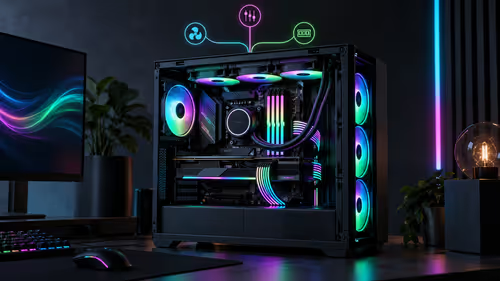
OpenRGB's master branch now carries changes labelled for 1.0 final, including translation and platform work, but the official tags page still lists 1.0rc3.1 as the newest packaged release. Stable users should wait for the signed release channel.
A motherboard can remain useful for many years when power, cooling and connectors stay healthy. Replace it for confirmed faults, damaged power delivery or a blocked platform need, not simply because the calendar reaches a fixed age.
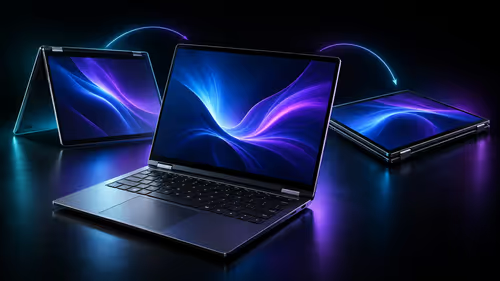
The VAIO T combines a 13.3-inch display with a multi-flip mechanism for laptop, tablet and outward-facing viewing modes. Orders begin in Japan on 18 September; South African availability is unconfirmed.

The smallest ATX case 2026 buyers should choose is the smallest chassis that still fits their exact graphics card, cooler, power supply and airflow plan. ATX support alone does not prove a case has the smallest footprint or volume.
In a 6 bit + FRC vs 8 bit comparison, native 8-bit panels can produce 256 levels per colour channel directly, while 6-bit plus FRC rapidly alternates nearby values to approximate the wider palette. Panel quality still depends on more than bit depth.

The UGREEN LinkStation Pro eGPU dock combines Thunderbolt 5 and OCuLink connections with an integrated 850W ATX 3.1 power supply and up to 140W laptop charging. South African availability is unconfirmed.
Windows 11 KB5124008 can leave some USB Audio Class 1.0 devices with no sound, Code 10 or failed multichannel output. Microsoft confirms the issue and says switching to two-channel stereo can restore audio for some users.