


Fix Dead pixel checks on Ryzen 7 9800X3D build
Dead pixel on Ryzen 7 9800X3D build needs careful display-chain checks, not a single-part blame. Test the screen, cable, port, scaling, drivers, and setup context before replacing hardware.
Read more• List best parts • Optimize for sandbox games • Balance budget and performance • Recommend upgrade paths Gaming PC for Sandbox Games: step-by-step build advice to maximize mods, open-world performance, and FPS — from budget to high-end. ⚙️
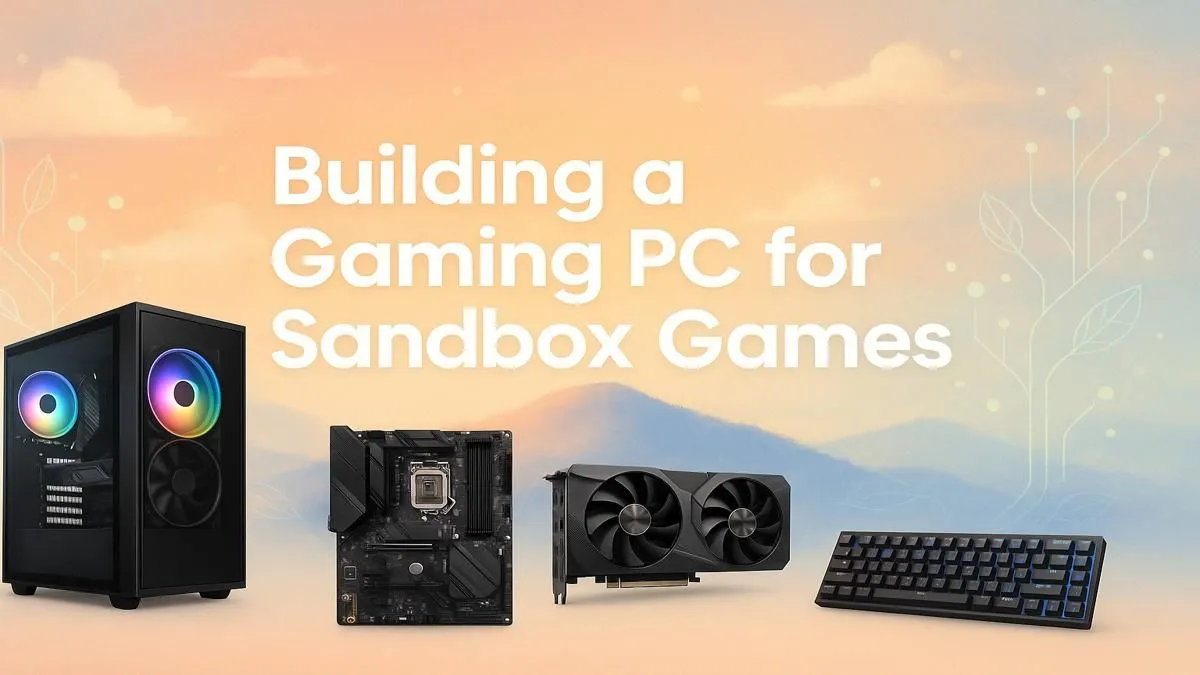
From the infinite blocky landscapes of Minecraft to the brutal survival of Valheim, sandbox games offer endless freedom. But that freedom can be surprisingly demanding on your hardware. If your PC starts to stutter when you load in a massive world or a few too many mods, you’re in the right place. This guide will help you configure the perfect gaming PC for sandbox games, ensuring your creativity is the only limit. Let's build your ultimate world-building machine. 🚀
Unlike many fast-paced shooters that lean heavily on the graphics card (GPU), the best build for sandbox games requires a more balanced approach. These games are often simulating complex worlds, tracking thousands of objects, and running intricate game logic in the background. This makes them incredibly hungry for processing power and memory.
Think of it this way: your GPU paints the picture, but your CPU and RAM have to build the world first. When you’re running a heavily modded Terraria server or a sprawling factory in Satisfactory, the processor is doing the heavy lifting. That's why simply buying the most expensive graphics card won't guarantee a smooth experience. A smart build focuses on the components that truly matter for this genre, which is great news for your wallet, as many excellent budget gaming PCs can be optimised for incredible sandbox performance.
Building a great PC for sandbox games means prioritising components differently. Here’s a breakdown of what you should focus on to get the best performance for your money.
The Central Processing Unit (CPU) is the absolute heart of your sandbox rig. Game logic, AI behaviour, and world generation all run on the CPU. Many popular sandbox titles, like Minecraft, rely heavily on strong single-core performance to manage the main game thread.
Random Access Memory (RAM) is where your game stores all its active data. For sandbox games, this includes world data, textures, and—most importantly—mods! If you love customising your experience, more RAM is non-negotiable.
When choosing RAM, don't just look at the capacity (GB). Pay attention to the speed (measured in MHz). Faster RAM, like 3200MHz or 3600MHz for DDR4, allows your CPU to access data more quickly, which can provide a noticeable performance boost in CPU-intensive sandbox games.
While the CPU is king, a capable GPU is still essential for a great visual experience. It handles everything from high-resolution textures and lighting to those beautiful "god ray" shaders in Minecraft. You don't need the absolute best, but a modern mid-range card like an NVIDIA GeForce RTX 4060 will let you play at 1080p or 1440p with high settings. For those wanting to push 4K textures and complex shaders, exploring high-end rigs above R20k is the way to go.
For storage, a fast NVMe Solid-State Drive (SSD) is a must. It drastically cuts down on loading times, so you can jump into your massive, meticulously built worlds in seconds, not minutes. ✨
So, how do you put it all together without breaking the bank? The key to building a cost-effective gaming PC for sandbox games is smart allocation. Prioritise your budget on a strong CPU and at least 16GB of fast RAM first, then choose the best GPU you can afford with the remaining funds.
This balanced approach ensures your PC has the raw processing power to run the game's simulation smoothly. If you're not keen on building it yourself, exploring well-balanced pre-built PC deals is a fantastic, hassle-free way to get a perfectly optimised machine delivered to your door.
Ready to Build Your World? A powerful, well-balanced PC is your ticket to limitless creativity in your favourite sandbox games. Stop letting lag and stuttering get in the way of your vision. Explore our best gaming PC deals and find the perfect rig to bring your worlds to life.
Minimum: quad-core CPU, 8–16GB RAM, GTX 1650 or equivalent, and a SATA SSD. For smoother mods, consider 16GB+ RAM and NVMe SSD.
Choose a strong multi-core CPU like Ryzen 5/7 or Intel i5/i7 to handle world simulation and mods; look for higher single-thread and core counts.
A capable GPU matters for large draw distances and textures. For high settings, target an RTX 3060 Ti or better as in many best GPU for sandbox games guides.
Aim for 16GB as a baseline; 32GB benefits heavy mods and multitasking—this is common in budget sandbox gaming PC build recommendations.
Yes—NVMe SSDs significantly reduce world streaming stutter and load times compared to SATA SSDs; essential for smoother open-world performance.
Prioritize adding RAM, switching to NVMe storage, and upgrading the GPU. These upgrades target the biggest wins for mods and world detail.
Use a quality AIO or high-performance air cooler plus good case airflow to sustain CPU/GPU boost clocks during long open-world sessions.
Dead pixel on Ryzen 7 9800X3D build needs careful display-chain checks, not a single-part blame. Test the screen, cable, port, scaling, drivers, and setup context before replacing hardware.
Read more
AM5 motherboard upgrade dead pixel checks should verify the screen before the platform. This how to fix dead pixel after a AM5 motherboard upgrade guide covers colour tests, ports, cables, BIOS screens, and SA support proof.
Read more
Ultrawide monitor upgrade stuck pixel checks should confirm the panel before blaming the new setup. Test full-width colours, cables, ports, GPU drivers, and scaling in your SA gaming workspace.
Read more
Wi-Fi 7 router upgrades should not change text rendering directly. To fix blurry text after a Wi-Fi 7 upgrade, check display scaling, GPU drivers, remote desktop quality, browser zoom, monitor cables, and PC settings.
Read more
A wireless mouse upgrade should not change monitor refresh rate, but it can expose stutter or input feel issues. Check Windows Hz, receiver placement, drivers, and SA gaming setup basics before replacing gear.
Read more
Wireless gaming headset setups in South Africa do not have a monitor refresh rate. Treat the issue as a display setting problem, then check Windows, GPU drivers, cable bandwidth, and any audio app overlay on the same PC.
Read more
RTX 5090 on a 1200W PSU has usable headroom when the supply is strong and the build is measured. For SA gamers, OC potential depends on CPU draw, cooling, cabling, stability targets, and how much safety margin you keep.

How to fix low FPS on gaming laptop starts with power mode, drivers, heat, and game settings. Use this South Africa-focused checklist to confirm charger use, GPU selection, RAM pressure, and cooling before changing parts or tweaking every setting.
Real world difference between b850 b650 mmo live service games sits in stability, networking, storage, and upgrade room. SA players should compare LAN quality, USB layout, RAM support, and SSD slots for always-updated games.

Dead Pixel on Wi-Fi 7 Router is likely a display-path or source-title issue, so check the screen, cable, driver state, and related system symptoms before blaming the device itself.

Put the headphones in pairing mode, open Bluetooth and devices in Windows 11, then add the headset. If it fails, remove the old pairing and check charge, range and drivers.

Microsoft says upcoming Windows 11 work will target memory use on 8GB PCs and improve boot and sign-in responsiveness. There is no public release date or measured uplift yet.
Windows 11 does not show CPU temperature in its standard Settings pages. Use your CPU maker's supported utility or a trusted monitor, then read idle and loaded temperatures in context.
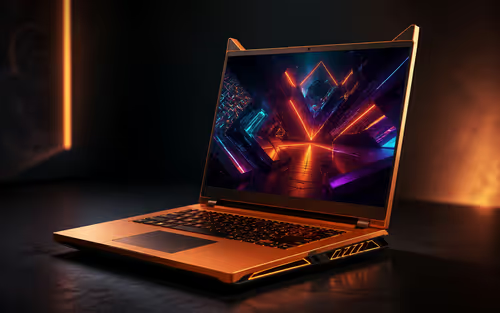
The Colorful MEOW X16 Pro pairs a Ryzen 7 8745HX with a 115W RTX 5060 Laptop GPU. It is a China-only launch for now, so local RTX 5060 pricing is the practical benchmark.
Industry reports point to another roughly 10 percent Intel processor increase from 5 October, but Intel has not published a consumer price list confirming the scope. South African buyers should treat it as a risk signal, not a guaranteed Rand change.

Tests reported audio capture and local-network scanning on a specific LG television with its screen off. LG says supported standby modes can keep voice and connected-device features active, so owners should review model-specific settings.
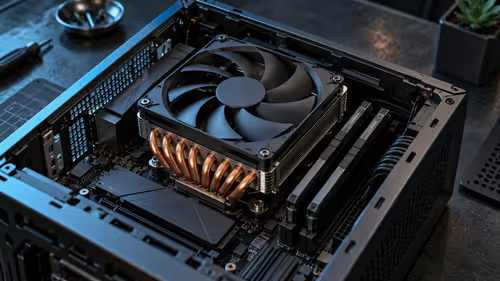
Thermalright's AXP120-X77 is a 77 mm top-down cooler with six heatpipes and a slim 120 mm fan. Local availability is not confirmed, so compact-PC builders should verify case height, memory clearance and socket support before comparing it with stocked coolers.

One-sided sound can come from balance settings, a dirty or loose connector, Bluetooth pairing data, firmware, the source device or a failed cable or driver. A short swap test isolates the cause before you reset software or replace the headset.