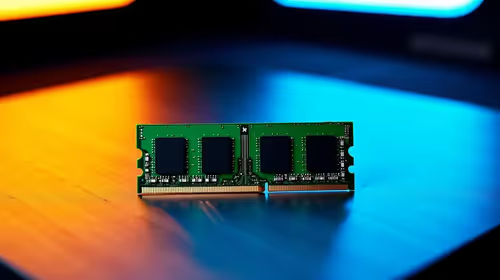
An SSD cache promises to make a NAS feel faster, and sometimes it genuinely does. Other times it sits there using a drive slot and delivering almost nothing. The difference comes down to what your NAS actually does all day. Adding an SSD cache speeds up frequent, random, small-file access, but it does little for the large sequential transfers, like streaming a 4K movie, that many home users assume it will fix.
Quick Answer
Install M.2 NVMe SSDs into your NAS cache slots and create a read or read-write cache pool in the storage manager. The cache accelerates frequently accessed small files and random reads and writes, so it helps databases, virtual machines, and busy file sharing. It gives little benefit for large sequential transfers such as 4K video streaming, where the hard drives already keep up.
What an SSD Cache Actually Does
A NAS stores bulk data on mechanical hard drives, which are spacious and cheap but slow at scattered, random access because the heads physically move to find data. An SSD cache puts a small, fast layer of NVMe flash in front of those drives. The NAS watches which data you access often and keeps a copy on the fast flash, so the next time you reach for it, the request is served from the SSD at far lower latency instead of waiting on the spinning disk.
The key word is frequently. The cache only helps data you return to repeatedly, because the first access still comes from the hard drive before the cache learns to hold it. That is why the benefit is real for workloads full of repeated small reads and writes, and minimal for data you touch once.
Installing the Cache Step by Step
- Confirm your NAS has cache slots. Many NAS units include dedicated M.2 NVMe slots for caching. Check your model's specification before buying drives, since not every enclosure supports it.
- Choose NVMe SSDs sized for caching. A cache does not need to be large; it needs to be fast and reliable. Pick NVMe drives rated for the sustained writes a cache endures, and remember the system uses a portion of RAM to manage the cache, roughly proportional to its size.
- Fit the drives into the M.2 slots. Power down if your model requires it, seat the SSDs in the cache slots, and secure them. Boot back up and the NAS should detect the new flash.
- Decide read-only or read-write. A read cache uses a single SSD and accelerates reads only, with no risk to your data if the SSD fails. A read-write cache speeds up both but should use two or more SSDs in a protected configuration, because cached writes that have not yet flushed to disk would otherwise be at risk.
- Create the cache pool in the storage manager. Open the storage tool, create an SSD cache, assign your drives, and pick the volume it should accelerate. Confirm and let the system mount it.
- Let it warm up. A fresh cache is empty and learns your access patterns over time. Performance improves over the following hours and days as it fills with the data you use most.
When It Helps and When It Does Not
The cache earns its keep on workloads with lots of repeated random access: running virtual machines off the NAS, hosting databases, busy multi-user file sharing, or web hosting. These hammer the same small files over and over, exactly what the cache is built to accelerate.
It does little for the opposite pattern. Streaming a large 4K video or copying a single huge file is a long sequential read, which mechanical drives already handle at full speed, so the cache adds nothing meaningful. If your NAS is mostly a media library you stream from once, an SSD cache is the wrong upgrade, and the money is better spent on more bulk capacity from the diskless NAS and storage range. For genuinely cache-friendly workloads, a fast, endurance-rated drive from the best-selling SSDs is the part to look at.
Frequently Asked Questions
Will an SSD cache speed up 4K video streaming?
No, not meaningfully. Streaming is a large sequential read that mechanical drives already handle at full speed, so the cache, which targets repeated small-file access, adds little for media playback.
What is the difference between read and read-write cache?
A read cache accelerates only reads and can use a single SSD safely. A read-write cache speeds up both reads and writes but should use two or more protected SSDs, since unflushed cached writes would be at risk if a single drive failed.
How big should my SSD cache be?
A cache prioritises speed and endurance over size, so a modest NVMe drive is usually enough. Bear in mind the system reserves some RAM to manage the cache, scaling with its capacity.
What workloads benefit most from an SSD cache?
Anything with heavy repeated random access: virtual machines, databases, busy file sharing, and web hosting. These keep returning to the same small files, which the cache holds in fast flash.
Does adding a cache risk my data?
A read-only cache carries no data risk, since the originals stay on the hard drives. A read-write cache needs redundant SSDs to protect writes that have not yet been flushed to the main drives.
Wondering whether your NAS would gain from flash acceleration? Browse cache-ready drives in the best-selling SSDs at https://www.evetech.co.za/ssd-best-sellers/x/1926 and match the upgrade to how you actually use your storage.