


Stuck Pixel Checks for a Mechanical Keyboard Setup
Stuck pixel on a Mechanical Keyboard is likely a display symptom around that setup, not the part itself. Check the monitor, cable, GPU output, drivers, and warranty path first.
Read moreReady for a silent PC build? This guide covers everything from choosing quiet components like fans and cases to advanced noise reduction techniques. 🤫 Learn how to build a whisper-quiet machine in South Africa without sacrificing performance. Your perfect setup awaits! 💻
Is your gaming PC starting to sound like a jet engine preparing for takeoff at OR Tambo? ✈️ You’re not alone. That constant whirring and buzzing can pull you right out of a tense final circle in Warzone or a deep story moment. The good news? A powerful PC doesn't have to be a loud one. This silent PC build guide is packed with noise reduction tips specifically for South African gamers looking for whisper-quiet performance.
Before we can silence the beast, we need to understand where the noise comes from. A PC's sound profile is a symphony of moving parts, and identifying the loudest instruments is the first step in this noise reduction guide.
Crafting a quiet PC starts at the component selection screen. Prioritising acoustics doesn't mean sacrificing performance; it just means building smarter.
Your chassis is more than a pretty box; it's the foundation of your silent build. Look for cases with sound-dampening materials like foam or bitumen on the side panels. While mesh-front cases offer amazing airflow, a solid-front case with clever indirect vents can often provide a quieter experience. It’s all about finding the right balance for the best gaming PC deals that suit your needs.
When it comes to fans, size matters. A larger 140mm fan can move the same amount of air as a 120mm fan while spinning much slower, resulting in significantly less noise.
For the most demanding CPUs found in high-performance rigs over R20k, a premium AIO with quiet fans can offer the best of both worlds: top-tier cooling and low noise levels.
Your GPU is often the loudest part of a gaming PC. Many modern cards now feature a "zero RPM" or "fan stop" mode, where the fans don't spin at all under light loads like browsing or watching videos. When shopping, look for cards with large, multi-fan cooling solutions.
Similarly, a high-quality PSU with an 80 Plus Gold or higher rating is not only more efficient but also tends to have a better, quieter fan. Some even offer a hybrid mode, turning the fan off completely at low power draws.
This one's simple: switch to Solid State Drives (SSDs). An NVMe M.2 SSD has zero moving parts, making it completely silent. Ditching mechanical hard drives is one of the most effective noise reduction tips for any PC build. Even a SATA SSD is a massive acoustic improvement over an old HDD.
The single most effective free tweak for a silent PC is setting a custom fan curve. Dive into your motherboard's BIOS UEFI and find the fan control section (often called Q-Fan, Smart Fan, etc.). Instead of the default aggressive curve, create a gentler one that keeps fans at a low, inaudible RPM until your CPU or system temps hit around 60-70°C. This prevents them from constantly ramping up and down with minor tasks.
You don't need a brand-new machine to make a difference. These tips can help quiet down your current setup, whether it's one of our budget-friendly gaming PCs or a custom rig you've had for years.
These principles are just as important for powerful systems under R20k, where smart optimisation can deliver a premium, quiet experience without the premium price tag.
Putting together a perfectly balanced silent PC build takes research and careful part selection. If you'd rather skip the hassle and jump straight into quiet gaming, a professionally assembled PC is an excellent choice. Our technicians are experts at balancing thermal performance with acoustics, ensuring your rig runs cool and quiet right out of the box. Check out our fantastic pre-built PC deals to see systems already optimised for silence.
Ready for a Whisper-Quiet Rig? The quest for a silent PC is a rewarding one, leading to deeper immersion and fewer distractions. Whether you're hand-picking every component or looking for a professionally assembled rig, the perfect quiet setup is waiting. Explore our massive range of PC deals and find the machine that lets you focus on what matters... the game.
The primary sources of PC noise are moving parts, mainly fans (CPU, GPU, case, and power supply) and traditional hard disk drives (HDDs). High RPMs and component vibration contribute most to the noise.
A fanless PC build offers total silence but often at the cost of performance and higher temperatures. It's ideal for low-power tasks but not recommended for high-end gaming without very careful planning.
Start by cleaning dust from fans and vents. You can also replace stock fans with quieter models, use fan control software, and swap your HDD for a silent SSD for an immediate improvement in noise levels.
The PC case is crucial. A high-quality, sound-dampening PC case with good airflow is the foundation for managing noise. Look for models with insulated panels and smart intake designs.
Not always. While the pump is quiet, the radiator still requires fans. However, AIOs move heat away from the CPU, allowing fans to run at lower, quieter speeds, often resulting in a lower overall noise profile.
Absolutely. A silent power supply with a high efficiency rating (like 80+ Gold) generates less heat, allowing its fan to spin slower or even turn off completely under low loads, reducing system noise.
Stuck pixel on a Mechanical Keyboard is likely a display symptom around that setup, not the part itself. Check the monitor, cable, GPU output, drivers, and warranty path first.
Read more
How to fix stuck pixel Windows 11 USB DAC issues starts with display-only tests. Check HDR, scaling, monitor input, USB cable movement, and safe South African support options before connecting the pixel issue to audio hardware.
Read more
Windows 11 Steam Deck monitor issues often start with display mode, USB-C output, drivers, or dock power. Use this how to fix monitor not detected windows 11 steam deck checklist for SA handheld PC setups.
Read more
Stalker 2 Heart of Chornobyl PC build planning at R100,000 should stay cautious about parts and settings. Balance GPU, CPU, RAM, storage, cooling, and upgrade room before picking a South African gaming PC.
Read more
RX 9070 XT build stuttering needs a step-by-step check before replacing parts. Review drivers, settings, thermals, power, background apps, display limits, cables, and game options before changing hardware.
Read more
GTA 6 on R15,000 needs careful part balance. This SA build guide frames CPU, GPU, RAM, SSD, cooling, and upgrade trade-offs without promising live prices, stock, or exact FPS.
Read more
NVIDIA lists 550W required system power for the RTX 5060 reference specification, based on a high-end test system. A quality 550W unit can be enough, but CPU draw, transient load, connectors and ageing decide real headroom.
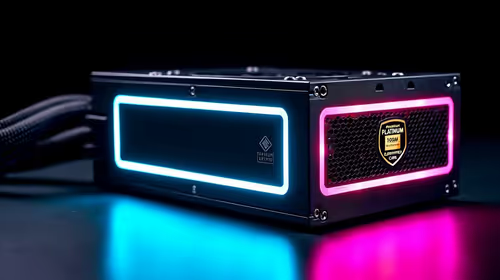
80+ Gold vs 80+ Platinum for couch co-op gaming is about PSU efficiency, heat, fan behaviour, quality, and wattage headroom, not direct FPS. SA buyers should compare the whole build.
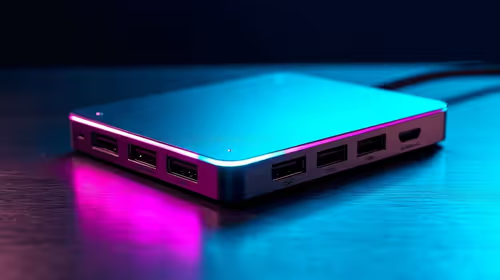
Upgrade your setup with the best USB-C hubs for creators. Discover why high-capacity card readers and dual 4K output are essential for professional South African content production. 🚀💻

B850 motherboard FPS drops needs a methodical troubleshooting pass. Review drivers, thermals, power settings, background apps, cables and game settings before replacing parts in an SA gaming setup.
NVIDIA lists 550W required system power for the RTX 5060 reference specification, based on a high-end test system. A quality 550W unit can be enough, but CPU draw, transient load, connectors and ageing decide real headroom.

OpenRGB's master branch now carries changes labelled for 1.0 final, including translation and platform work, but the official tags page still lists 1.0rc3.1 as the newest packaged release. Stable users should wait for the signed release channel.
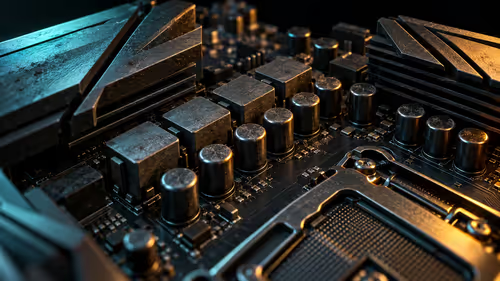
A motherboard can remain useful for many years when power, cooling and connectors stay healthy. Replace it for confirmed faults, damaged power delivery or a blocked platform need, not simply because the calendar reaches a fixed age.

The VAIO T combines a 13.3-inch display with a multi-flip mechanism for laptop, tablet and outward-facing viewing modes. Orders begin in Japan on 18 September; South African availability is unconfirmed.

The smallest ATX case 2026 buyers should choose is the smallest chassis that still fits their exact graphics card, cooler, power supply and airflow plan. ATX support alone does not prove a case has the smallest footprint or volume.

In a 6 bit + FRC vs 8 bit comparison, native 8-bit panels can produce 256 levels per colour channel directly, while 6-bit plus FRC rapidly alternates nearby values to approximate the wider palette. Panel quality still depends on more than bit depth.

The UGREEN LinkStation Pro eGPU dock combines Thunderbolt 5 and OCuLink connections with an integrated 850W ATX 3.1 power supply and up to 140W laptop charging. South African availability is unconfirmed.
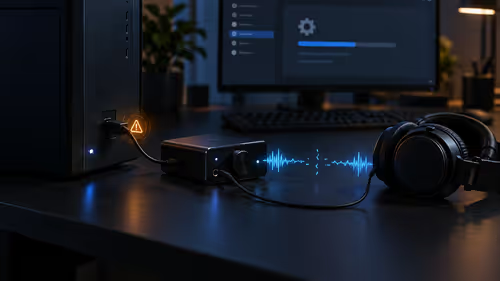
Windows 11 KB5124008 can leave some USB Audio Class 1.0 devices with no sound, Code 10 or failed multichannel output. Microsoft confirms the issue and says switching to two-channel stereo can restore audio for some users.