The single decision that shapes how much usable space you get, how many drives can fail without losing data, and how easily you can grow later is the RAID type you pick when first setting up a NAS. RAID 1, RAID 5 and Synology Hybrid RAID each answer the same question differently, and the right answer depends on how many bays you have, whether your drives are the same size, and how you plan to expand. Get this right at setup and you avoid a painful migration down the line.
Quick Answer
On a 2-bay NAS, RAID 1 simply mirrors two identical drives and survives one failure. On 3-plus bays with same-size drives, RAID 5 gives the most capacity, with usable space equal to the smallest drive multiplied by the number of drives minus one. Synology Hybrid RAID (SHR) is the easiest choice when your drives are different sizes or you plan to upgrade them one at a time, because it reclaims space traditional RAID would waste.
What each level actually does
Before picking, it helps to see what each layout trades. All three protect against at least one drive failing, but they differ on capacity efficiency, flexibility, and which hardware they need.
- RAID 1 (mirror). Two drives hold identical copies. Usable space equals one drive. One drive can fail with zero data loss. It is the simplest and most predictable layout, which is why it dominates 2-bay units.
- RAID 5 (striping with parity). Three or more drives stripe data with one drive's worth of parity spread across the array. Usable space is the smallest drive size times the drive count minus one. Any single drive can fail and rebuild from parity.
- SHR (Synology Hybrid RAID). Synology's automated layout that behaves like RAID 1 on two drives and RAID 5 on three or more, but crucially tolerates mixed drive sizes and uses the extra capacity on larger drives that classic RAID 5 would strand.
Step 1: Count your bays
Bay count narrows the field immediately. On a 2-bay NAS, your realistic choice is RAID 1, since RAID 5 needs at least three drives. SHR on two drives is functionally identical to RAID 1, so on a 2-bay unit the practical decision is whether you want Synology's flexibility for a future migration to a bigger enclosure.
On a 4-bay or larger NAS you have a genuine choice between RAID 5 and SHR, and that is where drive sizes become the deciding factor.
Step 2: Check whether your drives match
This is the step most people skip, and it is the one that wastes the most space. Traditional RAID 5 treats every drive as if it were the size of the smallest one. Put two 12TB drives and two 4TB drives into RAID 5 and the array assumes four 4TB drives, leaving 8TB per large drive completely unused.
SHR refuses to waste that capacity. With the same two 12TB and two 4TB drives, SHR-1 delivers roughly 20TB usable against RAID 5's 12TB, because it layers protection across the matching portions and still uses the surplus on the bigger drives. If your drives are mismatched now, or you expect them to be after a future upgrade, SHR is the clear winner. If every drive is identical and you want maximum predictability, RAID 5 is fine.
Step 3: Think about how you will grow
How you plan to expand matters as much as today's drives. With classic RAID 5, increasing total capacity usually means swapping every drive for a larger matched set before you see any gain. SHR lets you upgrade drives one at a time, mixing sizes as you go, and grow capacity incrementally. For a home or small-office user buying drives over months rather than all at once, that flexibility is the strongest argument for SHR.
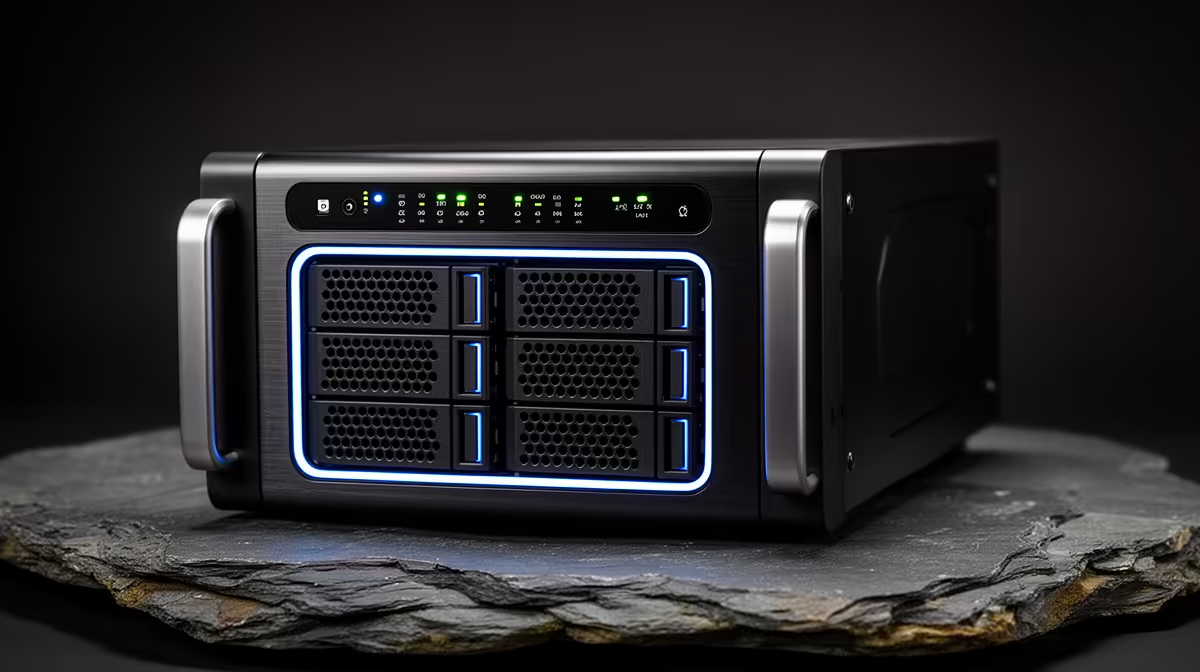
If you are sizing the storage pool itself rather than the RAID type, the companion walkthrough on how to set up the pool and volume is a useful next step, and you can stock the drives to fill it from the SSD and storage best sellers.
Step 4: Make the call
Use this as your decision shortcut. Two bays: RAID 1, or SHR if you want migration flexibility later. Three or more bays with identical drives and a preference for standard, predictable RAID: RAID 5. Three or more bays with mixed drive sizes, or any plan to upgrade drives gradually: SHR. None of these is a backup, so whichever you choose, keep a separate copy of anything irreplaceable. When you are ready to buy the enclosure, the diskless NAS range lets you match the bay count to the layout you have chosen.
Frequently Asked Questions
Is SHR always better than RAID 5?
Not always. SHR wins decisively with mixed drive sizes and gradual upgrades. With a set of identical drives the usable capacity is the same, and some users prefer RAID 5 because it is a standard layout readable on non-Synology hardware. Choose SHR for flexibility, RAID 5 for portability.
How much space does RAID 5 give me?
Usable capacity equals the smallest drive size multiplied by the number of drives minus one. Four 4TB drives in RAID 5 yield about 12TB usable, with the remaining drive's worth of space used for parity.
Can I change RAID type later without losing data?
Some conversions are supported in place, such as adding drives to expand, but many RAID-type changes require destroying and rebuilding the array. That is exactly why picking the right type at setup matters. Always have a backup before any conversion.
Does RAID replace backups?
No. RAID protects against a drive failing, not against deletion, ransomware, theft or a failed array. Treat any RAID level as availability, not backup, and keep a separate copy of important data elsewhere.
Which level is best for just two drives?
RAID 1. It mirrors the two drives, survives one failure, and is the simplest option. SHR on two drives gives the same result while keeping Synology's expansion flexibility open for later.
Decide your RAID type before you commit a single drive, matching it to your bays, your drive sizes and your upgrade plan. Browse the current NAS enclosures at Evetech and build storage that grows the way you want it to.