


Stuck Pixel Checks for a Mechanical Keyboard Setup
Stuck pixel on a Mechanical Keyboard is likely a display symptom around that setup, not the part itself. Check the monitor, cable, GPU output, drivers, and warranty path first.
Read moreLearn how to clean your pc safely and effectively with our expert guide! 🖥️ SA's top tech pros share their secrets for removing dust, improving performance, and extending your computer's lifespan. Get step-by-step instructions for a spotless rig. ✨

Is your PC sounding more like a jet engine than a high-end rig? Are your frame rates dropping at the worst possible moment during a tense match? Before you start blaming game updates or your internet connection, the culprit might be a silent performance killer... dust. Learning how to clean your PC is one of the most effective ways to boost performance, lower temps, and extend the life of your precious components. This is your expert guide to getting it done right.
Think of dust as a thick, fuzzy blanket suffocating your hardware. When components like your CPU and GPU get too hot, they automatically slow down to protect themselves—a process called thermal throttling. This is often the cause of frustrating stuttering and lower FPS in games.
A proper clean-up doesn't just reclaim lost performance; it's preventative maintenance. By keeping temperatures down, you reduce the strain on your hardware, which can significantly extend its lifespan. Whether you're running one of our best gaming PC deals or a trusty older rig, regular cleaning is essential for a smooth, stable experience. ✨
Before you start, gather your tools. You don't need a professional workshop, just a few key items to do a thorough job.
Having the right gear makes the process of cleaning your PC far easier and safer for your components. It's a small investment that protects much bigger ones, from affordable builds to high-performance machines over R20k.
Always use canned air in short, controlled bursts. Never shake the can during use or hold it upside down. This can cause the liquid propellant to spray out, which can damage your components. Also, gently hold fan blades in place with a finger while you spray them to prevent them from spinning too fast.
Ready to get started? Find a well-lit, ventilated area (like a garage or balcony) to avoid blowing dust all over your room.
This is the most crucial step. Shut down your computer completely. Switch off the power supply unit (PSU) using the switch on the back, and then unplug the power cable from the wall. Unplug all other peripherals like your monitor, keyboard, and mouse. For extra safety, press the power button on the case a few times to discharge any remaining electricity.
Place your PC on its side and remove the main side panel (usually the left one). Take a moment to look at the interior. The main dust culprits are usually the CPU cooler, the GPU fans, and the case intake fans. Taking a "before" picture can be a satisfying way to see your progress. From entry-level builds to powerful PCs under R20,000, they all gather dust in the same places.
Take your PC outside if possible. Using your compressed air, start from the top of the case and work your way down. Use short bursts to dislodge dust from the motherboard, RAM slots, and graphics card. Pay special attention to heatsinks and fan blades. If your case has removable dust filters (at the front, top, or bottom), take them out and give them a good clean. This single step is the core of how to clean your PC effectively.
For any remaining stubborn dust, use your cotton swabs and a microfibre cloth. You can lightly dampen a swab with isopropyl alcohol to clean fan blades, but ensure it's completely dry before you power anything on. Wipe down the inside of the case panels and any cable shrouds. A clean interior isn't just for looks; it improves airflow, helping even the most affordable budget gaming PCs run cooler.
Once you're satisfied that the inside is sparkling, it's time to reassemble. Secure the side panel, plug everything back in, and flip the PSU switch back on. The moment of truth... booting up your newly cleaned machine. You should immediately notice it running quieter and, once you jump into a game, cooler and smoother. 🚀
If, after all this effort, your performance still isn't where you want it to be, it might be a sign that your hardware is showing its age. Cleaning is powerful, but it can't turn an old GPU into a new one. Sometimes, an upgrade is the only real answer. Many gamers find that our range of professionally assembled pre-built PCs offers the perfect, hassle-free path to next-level performance.
Ready for a Real Performance Boost? A clean PC is a happy PC, but sometimes it's just time for an upgrade. If your machine is still struggling to keep up, explore our massive range of custom-built and pre-built PC deals and find the perfect rig to conquer any game you throw at it.
For optimal performance, a light cleaning every 3-6 months is recommended. If you have pets or live in a dusty area, consider cleaning it more frequently to prevent overheating.
The safest way to clean a PC interior is with compressed air. Hold the can upright and use short bursts to blow dust out of components, fans, and heat sinks. Never use a vacuum.
Use a microfiber cloth for the exterior case. For internal components, avoid cloths that can create static electricity. Use isopropyl alcohol on a cotton swab for stubborn grime.
Yes, cleaning a pc for better performance is crucial. Dust buildup insulates components, causing them to overheat and throttle, which slows your system down significantly.
A great PC cleaning kit includes canned compressed air, isopropyl alcohol, microfiber cloths, anti-static brushes, and cotton swabs for detailed work on sensitive components.
If you don't have compressed air, you can use an anti-static brush to gently loosen dust from fans and components. A small, soft paintbrush also works well in a pinch.
Stuck pixel on a Mechanical Keyboard is likely a display symptom around that setup, not the part itself. Check the monitor, cable, GPU output, drivers, and warranty path first.
Read more
How to fix stuck pixel Windows 11 USB DAC issues starts with display-only tests. Check HDR, scaling, monitor input, USB cable movement, and safe South African support options before connecting the pixel issue to audio hardware.
Read more
Windows 11 Steam Deck monitor issues often start with display mode, USB-C output, drivers, or dock power. Use this how to fix monitor not detected windows 11 steam deck checklist for SA handheld PC setups.
Read more
Stalker 2 Heart of Chornobyl PC build planning at R100,000 should stay cautious about parts and settings. Balance GPU, CPU, RAM, storage, cooling, and upgrade room before picking a South African gaming PC.
Read more
RX 9070 XT build stuttering needs a step-by-step check before replacing parts. Review drivers, settings, thermals, power, background apps, display limits, cables, and game options before changing hardware.
Read more
GTA 6 on R15,000 needs careful part balance. This SA build guide frames CPU, GPU, RAM, SSD, cooling, and upgrade trade-offs without promising live prices, stock, or exact FPS.
Read more
NVIDIA lists 550W required system power for the RTX 5060 reference specification, based on a high-end test system. A quality 550W unit can be enough, but CPU draw, transient load, connectors and ageing decide real headroom.
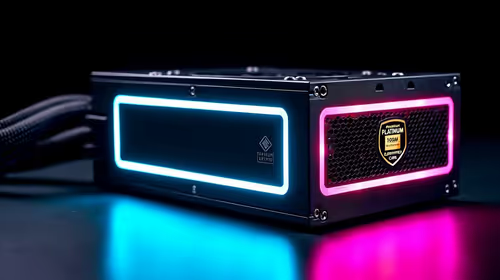
80+ Gold vs 80+ Platinum for couch co-op gaming is about PSU efficiency, heat, fan behaviour, quality, and wattage headroom, not direct FPS. SA buyers should compare the whole build.
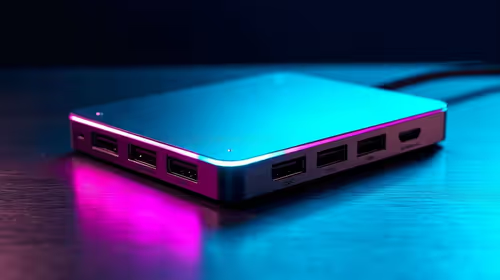
Upgrade your setup with the best USB-C hubs for creators. Discover why high-capacity card readers and dual 4K output are essential for professional South African content production. 🚀💻

B850 motherboard FPS drops needs a methodical troubleshooting pass. Review drivers, thermals, power settings, background apps, cables and game settings before replacing parts in an SA gaming setup.
NVIDIA lists 550W required system power for the RTX 5060 reference specification, based on a high-end test system. A quality 550W unit can be enough, but CPU draw, transient load, connectors and ageing decide real headroom.

OpenRGB's master branch now carries changes labelled for 1.0 final, including translation and platform work, but the official tags page still lists 1.0rc3.1 as the newest packaged release. Stable users should wait for the signed release channel.
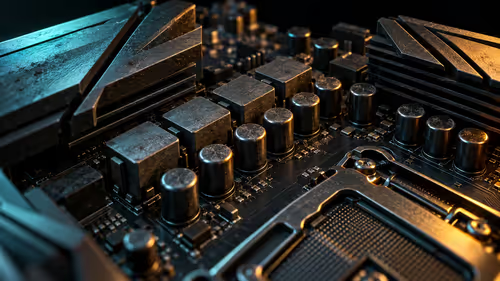
A motherboard can remain useful for many years when power, cooling and connectors stay healthy. Replace it for confirmed faults, damaged power delivery or a blocked platform need, not simply because the calendar reaches a fixed age.
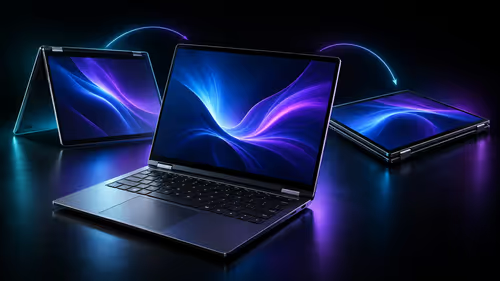
The VAIO T combines a 13.3-inch display with a multi-flip mechanism for laptop, tablet and outward-facing viewing modes. Orders begin in Japan on 18 September; South African availability is unconfirmed.

The smallest ATX case 2026 buyers should choose is the smallest chassis that still fits their exact graphics card, cooler, power supply and airflow plan. ATX support alone does not prove a case has the smallest footprint or volume.
In a 6 bit + FRC vs 8 bit comparison, native 8-bit panels can produce 256 levels per colour channel directly, while 6-bit plus FRC rapidly alternates nearby values to approximate the wider palette. Panel quality still depends on more than bit depth.

The UGREEN LinkStation Pro eGPU dock combines Thunderbolt 5 and OCuLink connections with an integrated 850W ATX 3.1 power supply and up to 140W laptop charging. South African availability is unconfirmed.
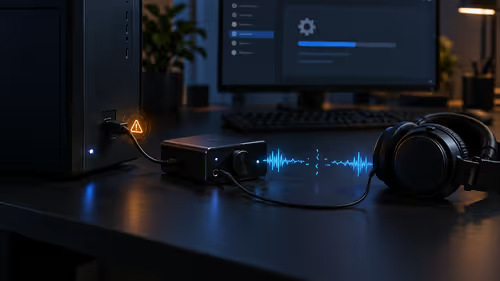
Windows 11 KB5124008 can leave some USB Audio Class 1.0 devices with no sound, Code 10 or failed multichannel output. Microsoft confirms the issue and says switching to two-channel stereo can restore audio for some users.