Stuttering 4K playback in your editing timeline is almost never the GPU's fault. Nine times out of ten the bottleneck is storage that cannot feed frames fast enough. Configuring storage for smooth 4K timeline playback comes down to sustained read bandwidth: an NVMe SSD delivering 3,500 MB/s or more, or a RAID array built for throughput, keeps even ProRes 4444 timelines scrubbing cleanly. Here is how to set the drives up properly.
Quick Answer
Slow storage is the main cause of 4K timeline stutter. Fix it with an NVMe SSD rated around 3,500 MB/s sustained reads, or a multi-drive RAID array for very high-bitrate footage. Separate your media, project, and scratch onto fast drives so no single disk has to do everything, and your timeline plays back smoothly.
Step 1: Understand what 4K playback actually demands
A 4K frame holds four times the pixels of 1080p, and high-bitrate codecs like ProRes 4444 or high-data-rate 10-bit footage can push each clip past 100 MB/s on its own. Stack two or three video layers, add effects, and the storage has to deliver several streams at once in real time. If the drive cannot keep up, the player drops frames and the timeline stutters.
This is why a fast CPU and GPU do not rescue a slow disk. They sit idle waiting for data that arrives too slowly. The cure is bandwidth at the storage layer, not more compute. Heavy effects and renders still lean on the GPU, and the workstation graphics cards at Evetech cover that side, but playback smoothness starts with the drive.
Step 2: Put your media on an NVMe drive
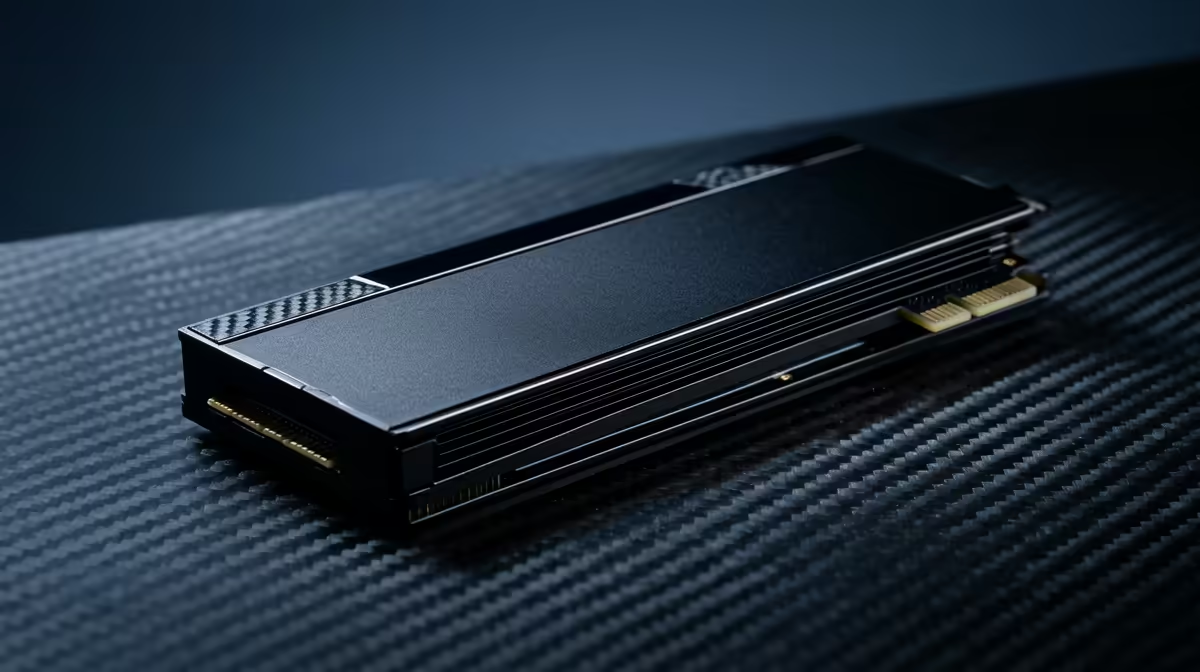
Your active footage belongs on the fastest drive you own. A modern NVMe SSD running at 3,500 MB/s or higher handles single and multi-stream 4K comfortably, and faster PCIe 4.0 drives give you even more headroom for ProRes 4444 and multicam timelines.
Avoid editing directly off a slow external HDD or a USB flash drive. A spinning disk tops out around 150 to 250 MB/s, which is fine for storage but not for live 4K scrubbing. If your media currently lives on a HDD, copy the active project to an NVMe before you start cutting, and your playback problems often vanish on the spot.
Step 3: Separate scratch, project, and media drives
The classic mistake is running everything off one disk. When media files, the project database, cache, and exports all hit the same drive at once, they compete for bandwidth and the timeline chokes. Split the workload:
- Media drive: a fast NVMe holding your source footage.
- Scratch and cache drive: ideally a second NVMe so render cache and previews do not fight the media drive.
- Project and exports drive: a separate drive for project files and finished renders.
Even on a single-NVMe machine, pointing the cache to a different partition or a secondary SSD reduces contention. With each task on its own fast drive, no single disk becomes the choke point.
When to step up to a RAID array
If you edit very high-bitrate 4K or move into 8K, a single NVMe can run short of sustained bandwidth. A RAID 0 array of fast SSDs, or a striped array of several drives, multiplies read throughput so multiple uncompressed streams stay fluid. RAID 0 carries no redundancy, so always keep a backup of anything irreplaceable on a separate drive.
Step 4: Build optimised media for the heaviest timelines
Even with fast storage, some codecs are simply hard to decode. If you still see stutter after sorting the drives, generate optimised or proxy media inside your editor. Proxies are lower-resolution stand-ins your storage and CPU can play effortlessly, and the software swaps the full-resolution footage back in for the final export.
Pair proxies with a good cache drive and a strong workstation, and even an ambitious multicam 4K project plays back like 1080p. To see which high-throughput components SA editors are buying, the PC best sellers list is a fast reference for editing-grade builds.
Frequently Asked Questions
How fast does my SSD need to be for 4K editing?
Aim for an NVMe rated around 3,500 MB/s sustained reads for comfortable single and multi-stream 4K. For ProRes 4444 or heavy multicam work, a faster PCIe 4.0 drive or a RAID array gives more headroom.
Can I edit 4K from an external hard drive?
A spinning external HDD tops out around 150 to 250 MB/s, which is too slow for smooth 4K timeline playback. Use it for archive and backup, and copy the active project to an NVMe SSD before editing.
Do I need RAID for 4K editing?
Not usually. A single fast NVMe handles most 4K work. RAID becomes worthwhile for very high-bitrate 4K, uncompressed formats, or 8K, where you need sustained bandwidth beyond what one drive provides.
Why does my timeline stutter even with a fast GPU?
Because playback is limited by how fast the drive feeds frames, not by the GPU. If the storage cannot deliver the data rate the codec demands, the player drops frames regardless of how powerful the rest of the machine is.
What is a scratch drive and do I need a separate one?
A scratch drive holds cache, previews, and render files. Keeping it separate from your media drive stops the two workloads competing for bandwidth, which noticeably smooths playback on busy timelines.
Building or upgrading an editing rig? Pair a high-throughput NVMe with a workstation graphics card from Evetech for stutter-free 4K and 8K timelines, and check the PC best sellers for editing-grade components other SA creators trust.