Nothing kills your competitive rank faster than a dead battery mid-match. You are holding the perfect angle... and suddenly your character stops moving. Wireless tech offers incredible freedom for your desk setup. But constantly searching for a charging cable ruins the experience. Let us look at how to extend wireless keyboard battery life without sacrificing performance... so you stay in the fight.
Understanding What Drains Your Power
Most modern peripherals pack serious technology. From rapid polling rates to intense RGB lighting, these features demand constant power. If you are using standard office and productivity keyboards, a single charge might last months.
However, enthusiast gear is a different story entirely. When you spend R2,500 on a premium peripheral, you expect top-tier responsiveness. That performance requires more energy. You do not have to turn off every feature to keep your device alive. You just need to optimise how those features run.
Smart Ways to Extend Wireless Keyboard Battery Life ⚡
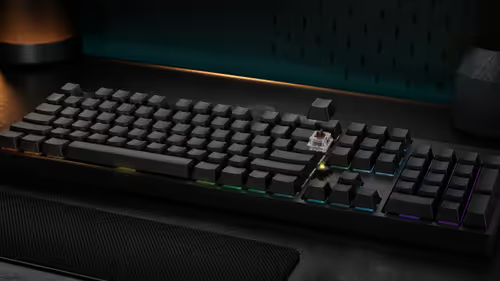
The biggest culprit behind poor battery performance is illumination. Vibrant RGB lighting looks fantastic on your desk. But running it at maximum brightness drains power incredibly fast. Try lowering your brightness to around thirty percent. The colours will still pop... but your battery will easily last much longer.
Another massive power drain comes from your sleep settings. Most high-performance gaming keyboards allow you to adjust the idle timer via software. Set your device to dim after two minutes of inactivity. Then set it to sleep entirely after five minutes. This simple tweak saves hours of battery over a busy week of gaming and working.
Battery Saving Pro Tip 🔧
If your keyboard uses a 2.4GHz USB dongle instead of Bluetooth, plug it into a port directly on your motherboard rather than a USB hub. A direct connection ensures a stable signal, stopping the keyboard from constantly boosting its transmission power to maintain the link.
Balancing Responsiveness and Power 🚀
Polling rate determines how often your device reports to your PC. A 1000Hz polling rate is standard for competitive play. It delivers ultra-low latency for fast-paced shooters. But if you are just typing emails or playing slow-paced games, that speed is total overkill.
Dropping your polling rate to 500Hz will drastically extend wireless keyboard battery life. You will barely notice the difference in daily tasks. Your battery will easily last twice as long.
You should also consider your connection type. Bluetooth is far more power-efficient than a 2.4GHz wireless dongle. If you are working on spreadsheets, switch to Bluetooth mode. Save the high-speed 2.4GHz connection for when you boot up your favourite competitive shooter.
Knowing When to Upgrade ✨
Batteries naturally degrade over time. If your peripheral is a few years old, it might struggle to hold a charge. This happens regardless of how well you optimise your settings.
Replacing an internal battery is often difficult and risky. If your current board dies after just a few hours, it might be time for an upgrade. You can always check out our latest tech specials to find a replacement. Modern boards offer far better power efficiency and rapid charging capabilities.
Ready to Cut the Cord? Finding the perfect balance between battery life and performance is easy when you have the right gear. Whether you need a low-latency mechanical board for esports or a sleek setup for your home office in South Africa, we have you covered. Explore our massive range of keyboards and upgrade your desktop experience today.