When input lag shows up on a fresh AM5 motherboard, the instinct is to blame the new part. In practice the cause sits in drivers, sync settings, or the display path - all things you can rule out in minutes.
Quick Answer
The input lag you feel after this upgrade is almost always V-Sync stacking with an uncapped frame rate. Turn V-Sync off, cap frames around 3-5fps under your panel's refresh, and enable a low-latency mode to bring the delay back under roughly 25ms. For South African buyers that matters: it tells you whether you actually need to budget for new parts or just spend ten minutes in the right menus.
Isolating Input Lag Before You Spend
To isolate input lag on a AM5 motherboard, set one familiar game scene as a baseline and measure the same flick or turn each time. Turn off V-Sync, then enable NVIDIA Reflex (or AMD Anti-Lag) and cap frames 3-5fps below your panel's refresh. If a wired mouse at 1000Hz feels instantly tighter, the original problem was wireless or polling. If nothing changes, move to the display and HDR processing path.
AM5 motherboard Settings That Actually Matter
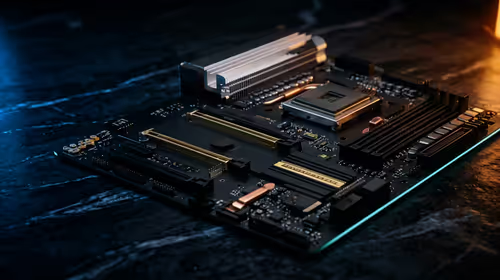
On a AM5 motherboard, the BIOS version decides a lot: an early release often ships with loose memory training and aggressive power saving. Install the board's chipset package fresh and disable any 'gaming mode' utility that overrides Windows scheduling. Flash to the current BIOS, then load defaults and re-enable EXPO/XMP from scratch rather than carrying an old profile forward. As a yardstick, a stable board holds DDR5-6000 (the AM5 sweet spot) without WHEA errors and keeps frametimes flat under 16 ms at 60fps, so use that as your pass/fail line rather than chasing a perfect number.
When a Fix Becomes an Upgrade
After two or three controlled tests you'll see the pattern. If the input lag clears with settings, you've saved the cost of a part - the fix was free. If it only improves with a hardware change, that's your signal to upgrade the one component the test exposed, not the whole rig. For South African buyers that means matching spend to a proven bottleneck: a sub-R2,000 cable or peripheral, a R3,000-R6,000 NVMe drive, or a larger am5 motherboards purchase only when the numbers justify it.
FAQ
Is the AM5 motherboard faulty if I still get input lag?
Usually not. Input lag that survives a clean driver install, a verified memory profile and the correct sync settings is rare - work the free fixes first. Only book a hardware check if a known-good test scene still misbehaves after every setting is ruled out.
Will updating drivers actually reduce input lag?
A clean driver install (not just an update over the top) removes leftover profiles that commonly cause hitching. Install the board's chipset package fresh and disable any 'gaming mode' utility that overrides Windows scheduling.
Does storage speed matter for input lag?
For loading and streaming hitches, yes. On a AM5 motherboard, the BIOS version decides a lot: an early release often ships with loose memory training and aggressive power saving. Keeping the game on your fastest NVMe drive with 15-20% free space removes a lot of avoidable stutter.
Worked through every free fix and the input lag is still there? That's the point to look at the right part - browse current AM5 Motherboards stocked at Evetech and match the upgrade to the exact bottleneck your test exposed.