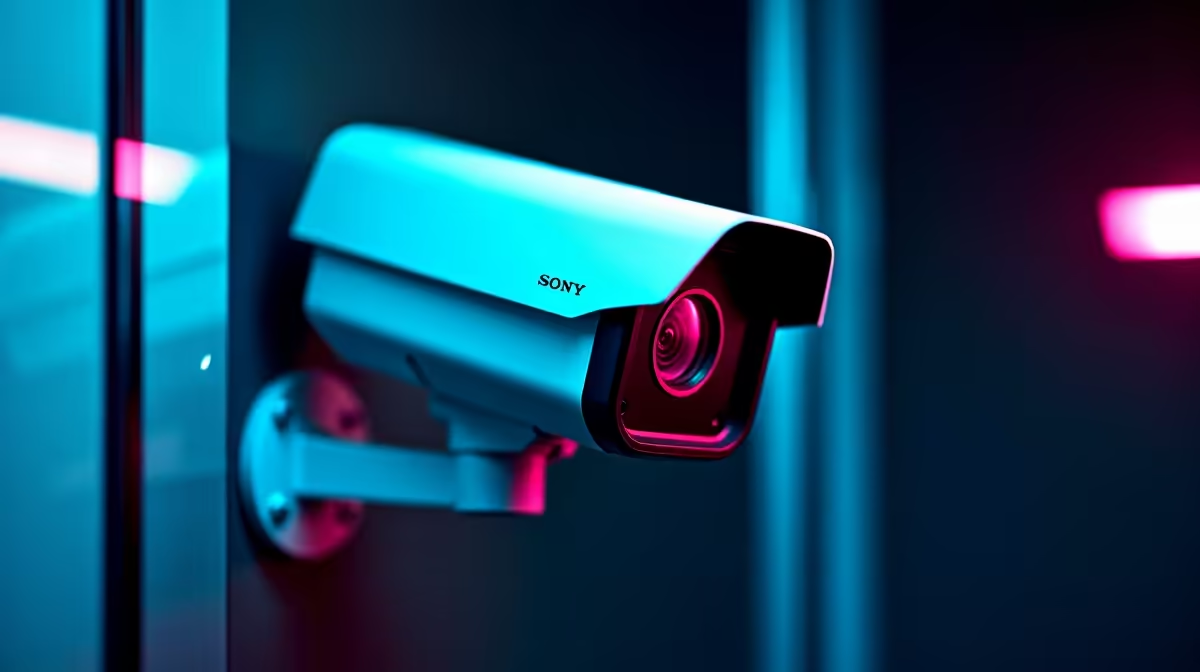
Putting a camera inside a window to watch the driveway feels like the easy, weatherproof option, right up until you check the night footage and find a glowing white wall of nothing. Mounting a camera behind glass is the single most reliable way to trigger IR wash, because the camera's own infrared LEDs bounce straight off the pane back into the lens. The good news is there are a handful of reliable techniques to shoot through a window at night, and one that beats them all.
Quick Answer
A camera's built-in IR LEDs reflect off glass at night and wash out the entire image, so to film through a window you must either disable the camera's IR and use a separate light source, or press the lens flush against the glass to eliminate the air gap that causes the reflection. The cleanest fix is to mount the camera outside the glass entirely, but where that is not possible, IR-off plus a flush lens works.
Why Glass Wrecks Night Vision
In daylight a camera behind a window is fine. At night it switches to infrared and fires its IR LEDs, which sit right beside the lens. Glass is reflective to infrared, so a large share of that light bounces off the pane and straight back into the sensor before any of it reaches the scene outside. The camera ends up photographing its own reflected glare, producing a bright haze and a black, detail-free view beyond.
Every method below attacks that same reflection, either by removing the IR light, removing the air gap, or removing the glass from the equation.
Step One: Try Pressing The Lens Against The Glass
- Position the camera so the front of the lens sits as flush against the window as physically possible.
- Eliminate any gap between the lens housing and the glass, since the gap is where reflected IR collects.
- Use a soft surround or mount that holds the lens tight to the pane without scratching it.
Getting the lens hard against the glass removes most of the reflection path, because there is no longer an air gap for the IR to bounce around in. This alone fixes many setups and costs nothing.
Step Two: Disable The Camera's IR LEDs
If pressing to the glass is not enough, turn the camera's infrared off entirely.
- In the camera app or settings, find the night vision or infrared option.
- Set IR to off, or to a schedule that disables it after dark for this camera.
- Also disable any status LEDs, which can cause their own smaller reflections.
With the IR LEDs off, there is nothing to bounce off the glass. The catch is that the camera now has no light of its own at night, so you need to supply light another way.
Step Three: Add An External Light Source
With IR disabled, the camera needs illumination that does not originate next to the lens.
- Use existing ambient light, such as a porch or street light, if the scene already has some.
- Or fit a separate IR illuminator mounted away from the camera, not beside it.
- Position that illuminator so its infrared spreads across the area rather than firing back toward the window.
Because the light source is now distant from the lens, its glow lights the scene instead of reflecting into the camera. This is the standard professional approach for shooting through glass at night.
Step Four: The Better Answer, Mount Outside
If the goal is reliable night footage, mounting the camera outside the glass beats every behind-glass workaround. An outdoor-rated camera fixed on the exterior wall has a clear, reflection-free view and uses its own IR without any pane to bounce off. Behind-glass mounting is best treated as a compromise for when drilling outside truly is not an option, not as the first choice. You can compare indoor and weatherproof models in the smart home and appliances range at Evetech to find one rated for outdoor use.
Step Five: Test, Then Refine
- Check the result after dark, since IR wash only appears at night.
- Look for haze, a bright central glow, or a black background, all signs of remaining reflection.
- Adjust how flush the lens sits, confirm IR is genuinely off, and reposition any external illuminator.
- Keep the glass and the lens cover clean, because smears scatter light and soften the image.
A few small mounting brackets and accessories from the Evetech accessories best sellers make these flush-mount and illuminator adjustments far easier to get right.
Frequently Asked Questions
Why is my indoor camera useless at night through a window?
Its infrared LEDs are reflecting off the glass back into the lens, washing the image out. The camera films its own glare instead of the scene outside. Pressing the lens flush to the glass or disabling IR and adding outside light fixes it.
Does pressing the camera against the glass really work?
Often, yes. Removing the air gap between the lens and the pane eliminates most of the reflection path, so the IR no longer bounces around in front of the sensor. It is the simplest fix to try first and it costs nothing.
What do I do once I have disabled the IR?
Provide light another way, since the camera no longer lights the scene itself. Use existing ambient light, or fit a separate IR illuminator mounted away from the lens so its infrared spreads across the area rather than reflecting back off the window.
Is it always better to mount outside?
For dependable night vision, yes. An outdoor-rated camera on the exterior wall avoids the glass reflection entirely and uses its own IR cleanly. Behind-glass mounting is a reasonable compromise only when an exterior install genuinely is not possible.
Need a camera that actually sees at night, window or no window? Browse indoor and weatherproof options in the smart home and appliances range at Evetech and choose the mounting approach that keeps your footage clear after dark.