Running a code assistant that never phones home is now genuinely practical, and the build is simpler than most people expect. A fully offline, private local coding stack pairs Ollama to run open-weight models on your own hardware with Open WebUI as the chat front end, so once the model weights are pulled, every query and every line of your code stays on the machine. No outbound calls during inference, no usage meter, no terms-of-service question mark over your source.
Quick Answer
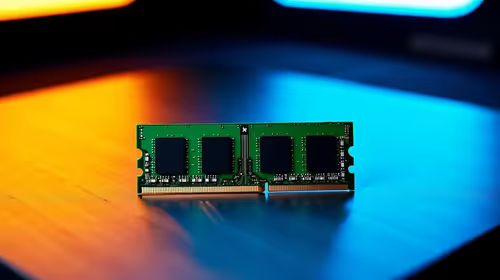
Install Ollama, pull a coding model such as Qwen2.5-Coder or DeepSeek-Coder V2, then run Open WebUI in Docker and point it at Ollama. After the weights are downloaded once, the whole stack runs air-gapped. A workable setup wants 32GB of system RAM and a 16GB GPU for a 14B model at 4-bit; 64GB plus a 24GB card handles the larger 32B coder models comfortably.
What the Stack Actually Is
Two pieces do the heavy lifting. Ollama is the model runner. It downloads quantised open-weight models, loads them onto your GPU or CPU, and exposes a local API on your machine. Open WebUI is the interface, a self-hosted chat front end that looks and behaves much like a cloud assistant but talks only to your local Ollama instance.
The privacy guarantee comes from the architecture, not a setting you toggle. During inference there is no network round-trip. The only time the stack touches the internet is the initial model pull and any optional software update, both of which you control. For sensitive client code, internal tooling, or simply work you would rather not hand to a third party, that boundary is the whole point.
Step One: Size the Hardware First
The model you can run is dictated by memory, so plan this before anything else.
- A 7B coder model runs on a 16GB system with a modest GPU and is fine for everyday Python, JavaScript, TypeScript, Go, and Rust work.
- A 14B model at 4-bit quantisation wants around 32GB RAM and a 16GB GPU.
- A 32B coder model, the closest local experience to a cloud assistant, is comfortable on 64GB RAM with a 24GB GPU.
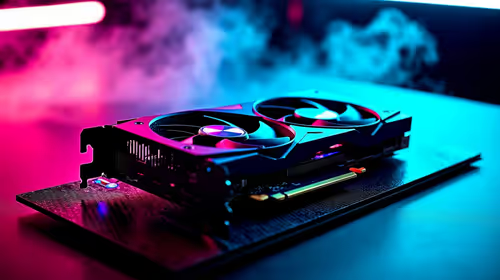
A discrete NVIDIA card matters here because Ollama uses the GPU for fast token generation, and VRAM is the hard ceiling on model size. If you are buying for this from scratch, the AI-ready PCs at Evetech are configured for precisely this GPU and memory profile.
Step Two: Install Ollama and Pull a Model
Install Ollama for your operating system, then pull a coding model from a terminal, for example a Qwen2.5-Coder or DeepSeek-Coder variant sized to your hardware. The first pull downloads several gigabytes of weights, so do it once on a connection you trust. Verify it works by running the model and asking it to write a short function. From this point the model lives entirely on disk.
Step Three: Run Open WebUI in Docker
The cleanest way to add the interface is a single Docker container for Open WebUI, pointed at your local Ollama API. Once it is up, open the local address in a browser, create an account that exists only on your machine, and your pulled models appear automatically in the model picker. You now have a conversation sidebar, model switching without restarts, and document upload for asking questions against your own files, all served locally.
Step Four: Wire It Into Your Editor
For inline completions and chat inside your editor, an extension like Continue connects VS Code to the same local Ollama models. That gives you autocomplete and an in-editor assistant with the identical privacy boundary: the editor talks to localhost, never to a cloud endpoint. At this point the loop is complete, with research, chat, and coding assistance all running offline.
Confirming It Is Truly Offline
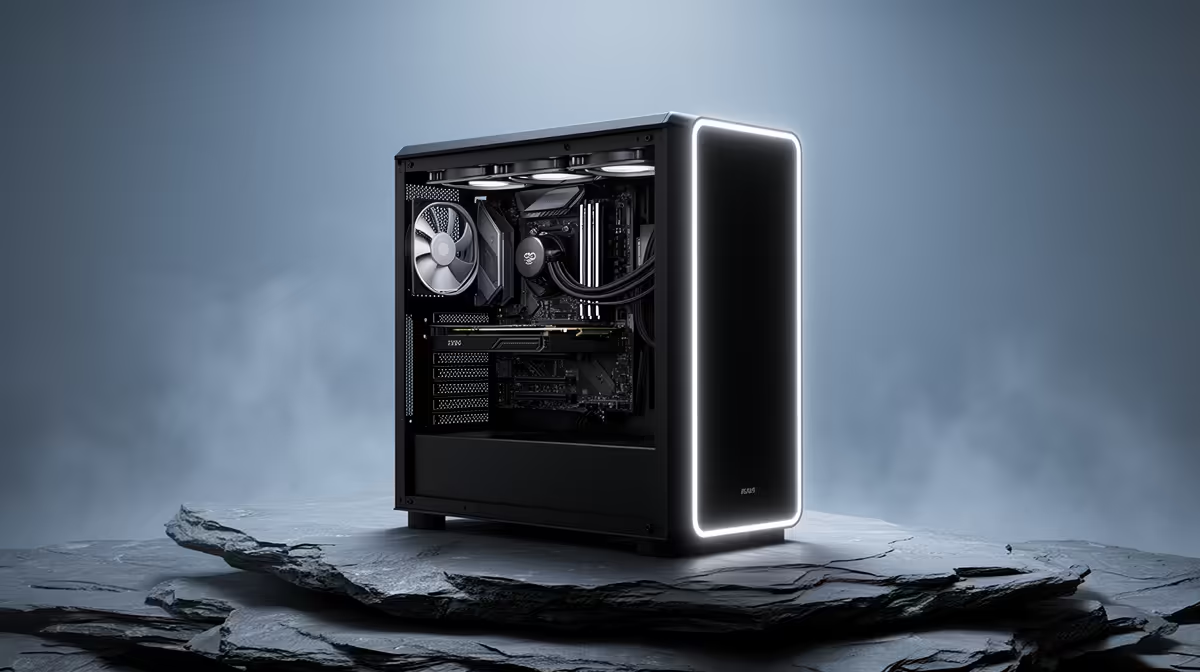
To prove the air-gap, pull your models, then disconnect from the network and run a query. It should answer normally because nothing in the inference path needs the internet. The honest trade-off is quality: a local 32B model lands somewhere around the level of a capable cloud assistant for routine work, and the gap is narrow enough on day-to-day coding that most engineers stop noticing it. For heavy multi-file reasoning a cloud model may still pull ahead, but for privacy-sensitive work the local stack wins outright. If you would rather buy a proven configuration than spec one yourself, the best-selling desktop range is a sensible starting point.
Frequently Asked Questions
Does the stack send any data to the cloud during use?
No. After the one-time model download, inference happens entirely on your hardware. The only network activity is optional software updates and the initial weight pull, both under your control.
Which model should I start with for coding?
A 7B coder model such as Qwen2.5-Coder is the best balance of quality and resource use on modest hardware. Step up to a 14B or 32B variant if you have the RAM and VRAM and want stronger multi-file reasoning.
Can I run this without a discrete GPU?
You can run smaller models on CPU alone, but generation will be noticeably slower. A 16GB or larger GPU makes the experience responsive enough for real work.
How much disk space do the models need?
Plan for several gigabytes per model, more for the larger ones. Keeping two or three models on disk for different tasks is common, so an NVMe drive with room to spare helps.
Is Open WebUI required, or can I just use the terminal?
The terminal works fine for quick queries. Open WebUI adds a polished chat interface, history, and document upload, and an editor extension adds inline coding help. Most people run all three for convenience.
A private coding assistant starts with the right memory and GPU. Browse the AI-ready PC range at Evetech to find a machine with the VRAM headroom to run larger local models, and keep your code on your own hardware where it belongs.