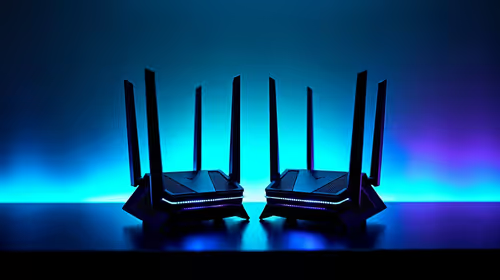
A single router gives a gaming device the shortest home-network path when one unit can cover the space. Mesh earns its place when distance and thick walls make that single access point unreliable. The backhaul decides how large the trade-off becomes.
Quick Answer
Choose one well-placed router for a flat, compact home or gaming room that it can cover. Choose mesh for a larger layout, multiple floors or dead zones that remain after sensible placement.
Use Ethernet backhaul between mesh nodes when you can. A dedicated wireless backhaul is the next choice. Connecting the gaming PC or console by cable to the main router gives the cleanest baseline. Compare router and mesh options alongside useful accessories for the rest of the setup.
Begin With the Floor Plan
Mark the fibre terminal, router, gaming position and the walls between them. Dense brick, concrete, metal-backed insulation and floor slabs weaken higher-frequency Wi-Fi. A straight line on the plan can cross more material than the distance suggests.
Test at the gaming desk with the router in an open, raised position. Record signal, throughput, ping and packet loss. Walk the areas where phones and televisions are used. If one router covers them with stable performance, extra nodes add cost and management without solving a problem.
Mesh becomes useful when the home has separate wings, another floor or walls that create deep dead zones. It gives devices more access points under one managed system. Good roaming helps mobile clients move through the house, though a fixed gaming system values a stable link over roaming.
Understand the Backhaul
The backhaul carries traffic from a satellite node to the main router. With wired Ethernet backhaul, the node does not spend wireless airtime relaying that traffic. This is the strongest layout for latency and capacity.
A tri-band mesh can reserve a radio for wireless backhaul, depending on the model and configuration. It still shares radio spectrum and has to cross the same walls. A dual-band system may use the client radio for both your device and the relay, which can reduce available airtime.
One wireless hop can work well when nodes have a strong link. Chaining several distant satellites increases the chance of delay and instability. Place each node where it can hear the previous one clearly, rather than at the centre of the dead zone where the incoming signal is already weak.
Wire the Gaming Device Where It Helps
Ethernet from the console or PC to the main router removes Wi-Fi from the game path. A cable to a mesh satellite removes the client wireless hop, but the satellite may still use a wireless backhaul. That can improve local stability without matching a full wired path to the main node.
If the home has Ethernet in the walls, use it for backhaul and fixed devices. Keep switches and cables at a suitable gigabit or faster standard for the equipment. Avoid running data cable beside mains wiring for long parallel distances, and use a qualified installer where the building route requires it.
Test the exact path. A clean wireless mesh hop can beat a weak direct link to the main router. The floor plan tells you where to start; latency and loss tell you which design won.
Keep One Routing Layer
Mesh kits often include a router mode and an access-point mode. If the ISP gateway remains in charge, use the mesh's supported access-point mode to avoid double NAT. If the mesh will route the home, place the upstream gateway into supported bridge or passthrough mode.
Only the routing device can manage the full internet queue. A mesh system in access-point mode may lose some QoS, parental or usage features. Check the model's mode limitations before deciding which unit owns the connection.
Use one DHCP server and one coherent wireless system. Leaving the old ISP Wi-Fi active on overlapping channels can add interference and encourage devices to cling to the wrong access point.
Place Nodes for Signal, Not Symmetry
Start with the main unit in an open spot near the centre of the active area, within reach of the fibre hand-off. Put a satellite before the thickest barrier or around a passage that opens into the next room.
Keep nodes off the floor and away from television cabinets, large appliances and metal shelving. A beautiful symmetrical layout can perform poorly if each node sits behind concrete. Small moves can change the backhaul quality, so retest after each one.
Use the mesh app's link-quality reading as a guide and confirm it with a sustained test. A green icon does not replace a real match under household load.
Compare the Cost With a Cable
A long Ethernet run and one strong access point can cost less than a multi-node premium mesh, especially in a home where a safe cable route exists. Mesh is valuable when wiring is impractical and coverage matters across several rooms.
Count the nodes you need, the backhaul type and the Ethernet ports available at each point. Check whether the system supports the internet speed you may buy later. Do not pay for the highest Wi-Fi headline when the floor plan and backhaul remain the limiting factors.
FAQ
Does mesh always add gaming lag?
Each wireless relay adds work, but a strong mesh path can outperform a weak direct connection. Wired backhaul keeps the extra delay small and predictable.
Can I mix mesh brands?
Some standards support limited interoperability, yet management, roaming and feature support can differ. A matched system is easier to configure and troubleshoot.
How many mesh nodes should I buy?
Begin with the smallest set that covers the measured dead zones. Too many close nodes can create extra interference and poor roaming choices.
Map the walls and backhaul route first, then choose a router or mesh kit that fits the home you have.