Quick Answer
For cinematic story games in South Africa, Gen 5 NVMe brings little over Gen 4 in real use: a 1TB WD Black SN850X (around R1,500) loads worlds at 7,000MB/s, while Gen 5 drives hit 12,000MB/s+ for around R2,800 to R4,000. Choose Gen 4 for value, and Gen 5 only if your board supports it and you also do heavy editing.
What changes for story games
Cinematic titles like Cyberpunk and Alan Wake 2 load large worlds, but storage matters most at launch, fast travel, and patching, not during play. A Gen 4 NVMe at 7,000MB/s handles those moments in seconds, and DirectStorage in newer games speeds asset streaming. The Gen 5 jump shaves a fraction you won't perceive in a story-driven session.
When Gen 5 earns its place
Gen 5 NVMe (12,000MB/s+) suits 8K video editing and large file transfers where raw bandwidth counts. Drives like the Samsung 9100 Pro run hot at 70C to 90C and need a heatsink. For pure gaming, the money is better spent on a stronger GPU or more RAM than on Gen 5 storage.
Sizing and setup
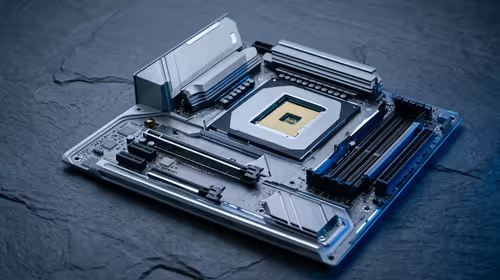
Modern cinematic games need 80GB to 150GB each, so a 1TB drive is the minimum. Prefer a Gen 4 drive with a DRAM cache for consistent speed as it fills, and confirm your motherboard includes an M.2 heatsink. A second cheaper drive handles your archive and backups.
FAQ
Is Gen 5 worth it for story games?
Not really. Story games stream data in small chunks, so a Gen 4 drive at 7,000MB/s loads almost as fast as Gen 5. The Gen 5 speed helps editing and transfers more than gaming.
Which Gen 4 SSD should I buy?
A 1TB WD Black SN850X or Samsung 990 Pro (around R1,500) gives fast loading and a DRAM cache for consistency. These suit cinematic games better per rand than pricier Gen 5 drives.
Do Gen 5 drives run hot?
Yes, Gen 5 NVMe can reach 70C to 90C and needs a heatsink. Many boards include one for the main M.2 slot; confirm this before buying a Gen 5 drive.
For story games at Evetech, choose a 1TB Gen 4 NVMe like the WD Black SN850X; reserve Gen 5 for editing builds where the bandwidth is genuinely used.