Stage 4 hits and your screen goes black mid-clutch in Valorant. The familiar groan echoes across South Africa. For PC gamers, an unexpected outage isn't just an inconvenience; it's a direct threat to our expensive hardware and hard-earned MMR. But what if you could build a high-end PC that sips power instead of guzzling it? A rig designed for the unique challenge of PC an unexpected outage in South Africa, giving you longer UPS runtime without sacrificing those glorious frame rates.
Electricity Use and Heat Output
When we talk about a power-efficient PC in South Africa, we're not just trying to save a few Rands on the electricity bill, though that's a nice bonus. The real goal is resilience. A PC that draws less power means your Uninterruptible Power Supply (UPS) can keep it running for much longer during an outage.
Think about it: a system pulling 500W might only give you 5-7 minutes on a standard UPS… barely enough time to save and shut down. A carefully planned build drawing 250-300W under load could double that runtime, letting you finish your match or safely wrap up your work. This efficiency also means less heat, quieter fans, and reduced stress on your components. 🚀
Choosing Components for a Power-Sipping Beast 🔧
It’s a balancing act between raw performance and power consumption, and thankfully, modern hardware makes it easier than ever.
The CPU: Performance-per-Watt is Everything
The heart of your power-efficient build is a CPU that delivers maximum performance for every watt it consumes.
- AMD's Ryzen 7000 Series: Chips like the Ryzen 5 7600 or Ryzen 7 7700 are incredibly efficient right out of the box. For an extra edge, you can enable "Eco Mode" in the BIOS, which significantly lowers power draw with a minimal impact on gaming performance.
- Intel's 13th & 14th Gen: Intel’s hybrid architecture, with its mix of powerful Performance-cores and low-power Efficient-cores, is brilliant for this. A CPU like the Core i5-13500 or i5-14500 provides fantastic gaming muscle while letting the E-cores handle background tasks with minimal energy use.
The GPU: The Biggest Power Hog, Tamed
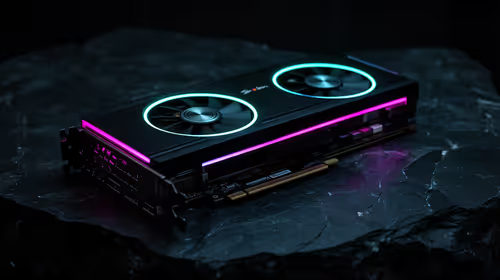
Your graphics card is the single biggest power consumer in your rig. Luckily, the latest generation has made huge leaps in efficiency.
- NVIDIA's RTX 40-Series: Cards like the GeForce RTX 4060 and RTX 4070 are standouts. They offer incredible performance while drawing significantly less power than their predecessors. Plus, with DLSS 3 Frame Generation, you get a massive FPS boost that feels like free performance, putting less strain on the hardware.
- AMD's Radeon RX 7000 Series: Options like the Radeon RX 7700 XT also provide a great performance-per-watt ratio, making them a solid choice for an efficient gaming PC.
PSU Sizing Pro Tip 💡
Don't just buy the biggest PSU you can find! Use an online PSU calculator to estimate your build's peak power draw, then add about 20-30% headroom. For a modern, efficient build with an RTX 4070 and a Ryzen 7, a high-quality 650W or 750W 80+ Gold-rated PSU is often the sweet spot for peak efficiency and stability.
The Power Supply (PSU): Your Build's Foundation
Never cheap out on your PSU, especially when dealing with an unstable grid. An 80 Plus Gold-rated power supply is the minimum you should consider. It runs more efficiently, converting more power from the wall into power for your PC, which means less waste, less heat, and a lower overall load for your UPS to handle.
Software Tweaks to Maximise Your UPS Runtime
Hardware is only half the battle.
- Set a Power Limit: Using tools like MSI Afterburner, you can easily set a power limit for your GPU. Capping it at 80% or 90% can shave off significant wattage with a performance drop you’ll barely notice.
You can adjust settings like "Minimum processor state" and "Maximum processor state" to force your CPU to run more conservatively when you know the power might trip.
- Undervolting (For Enthusiasts): For those who love to tinker, undervolting your CPU and GPU can lead to massive efficiency gains. It involves lowering the component's operating voltage without reducing clock speeds, resulting in the same performance for much less power. ✨
By choosing efficient components and making smart optimisations, you can create a powerful gaming rig that won't leave you in the dark.
Ready to Improve Your Pc Setup? ⚡**
it's about building smarter. A power-efficient PC gives you longer UPS runtime and peace of mind. Use our powerful, easy-to-use tool to configure your dream machine today.
Design Your Custom Power-Efficient PC with Evetech