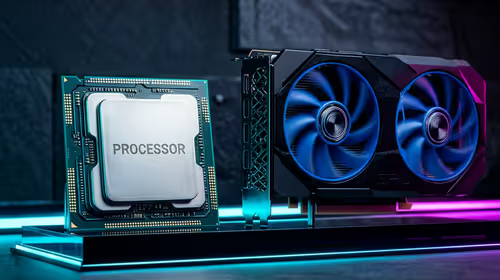
So, you’ve just dropped a small fortune on a killer GPU and a CPU that could launch a rocket. Your new rig is going to be legendary... until it isn't. An unstable PC, random shutdowns during a clutch moment in Apex, or worse... the smell of burnt electronics. What’s the culprit? Often, it's the one component many South African builders overlook: the power supply. Making a PC power supply mistake can be a costly, heartbreaking lesson.
The Biggest PC Power Supply Mistake: Treating It as an Afterthought
It's tempting, we get it. After allocating your budget to the flashy parts like the graphics card and RGB everything, the PSU feels like the last, boring box to tick. But here’s the reality: your power supply unit (PSU) is the heart of your PC. It feeds clean, stable power to every single expensive component you just bought. Skimping here is like putting retread tyres on a Ferrari.
A cheap, unrated PSU can deliver "dirty" power with voltage fluctuations that slowly degrade your components or kill them outright during a power surge... Investing in a quality power supply unit isn't an expense; it's insurance for your entire build. 🔧
Miscalculating Your Wattage Needs
"More is always better, right?" Not necessarily. While you definitely don't want to under-power your system, buying a massive 1200W PSU for a mid-range build is just wasting money. PSUs are most efficient when running at 40-60% of their total capacity. An oversized PSU will run less efficiently, pulling more power from the wall and generating more heat.
Conversely, getting a PSU with too little wattage is a recipe for disaster. Your PC might boot, but the moment your GPU spins up for a heavy gaming session, you'll face crashes and instability. For a modern gaming rig with a high-end card like an RTX 4070, something like a solid 850W PSU often hits the sweet spot, providing enough headroom for future upgrades.
Quick Wattage Check ⚡
Before you buy, use a free online PSU calculator like PCPartPicker's. Just plug in your components (CPU, GPU, drives, etc.), and it will give you a reliable estimate of your power needs. Always add about 100-150W on top of its recommendation for safety and future upgrades.
Ignoring Efficiency Ratings and Brand Reputation
You’ll see a sticker on PSUs: 80 Plus Bronze, Gold, Platinum, or Titanium. This isn’t just marketing fluff. It’s a certification for efficiency. An 80 Plus Gold PSU, for example, is at least 87% efficient at converting AC power from your wall to DC power for your PC. A more efficient unit wastes less energy as heat, runs quieter, and saves you real money on your Eskom bill over time. ✨
This is where brand reputation becomes critical. Making a PC power supply mistake often involves choosing a no-name brand with questionable claims. Sticking with trusted brands like Corsair ensures you're getting a unit with quality components, reliable performance, and a solid warranty. You'll also find other reliable options from Gamdias that offer excellent value and peace of mind. A good warranty (5-10 years) shows the manufacturer stands behind their product.
Forgetting Cables and Form Factor
The final common power supply error is a practical one: connectivity and size.
- Cabling: PSUs come in non-modular (all cables attached), semi-modular, and fully-modular (you only attach the cables you need). For a clean build with good airflow, modular is the way to go. It makes cable management a breeze.
- Form Factor: Most PC cases use a standard ATX power supply. But if you're building in a compact, small form-factor (SFF) case, you'll likely need an SFX or SFX-L PSU. Always double-check your case specifications to avoid buying a PSU that simply won't fit.
Avoiding these common PC power supply mistakes is the key to a stable, reliable, and long-lasting gaming rig. Give your components the clean power they deserve. 🚀
Ready to Power Your Build Correctly?
Don't let a poor power supply choice be the downfall of your dream PC. We've got the right PSU for every build and budget. Explore our massive range of power supplies and give your components the stable power they deserve.