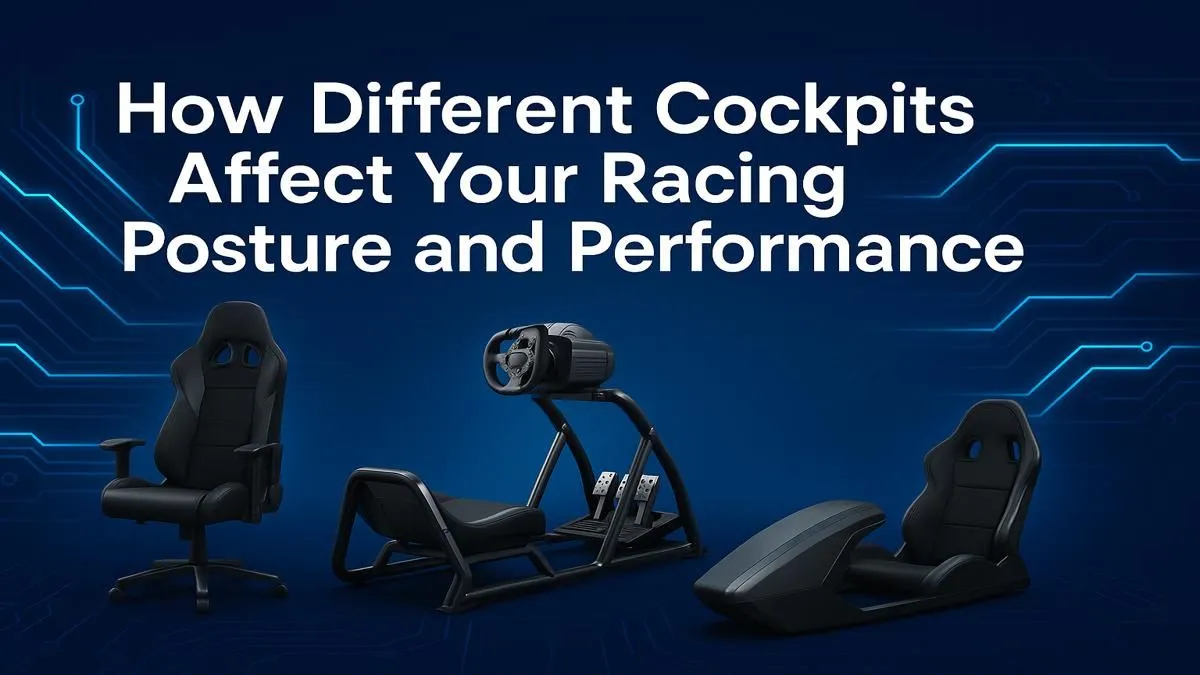
Ever finished a long sim race feeling more beaten up than the tyres on your car? A sore back, aching shoulders, a numb leg… these aren't just discomforts. They're lap-time killers. When you're fighting your setup, you can't focus on the apex. This is where mastering racing cockpit ergonomics comes in. It's not about just buying expensive gear; it's about making your gear work perfectly for you, transforming pain into podiums. 🏁
From Desk Chair Driver to Sim Racing Pro
Let's be honest, that office chair you're using was designed for spreadsheets, not for hitting the braking zone at Kyalami. It rolls, it swivels, and it offers zero support when you're stamping on the brake pedal. Proper racing cockpit ergonomics begin with a stable foundation. You need a setup that holds you securely, allowing your inputs to be precise and consistent, lap after lap. It’s the difference between wrestling your equipment and becoming one with the car.
Nailing the Fundamentals of Cockpit Ergonomics
Getting your setup right is a personal journey, but the core principles are universal. Think of it as your custom suit fitting for the digital track. A few small adjustments here can unlock massive gains in comfort and control.
Seating Position and Angle 🔧
Your seat is your primary connection to the car. A sloppy, unsupportive seat means sloppy driving. You want a snug fit that eliminates body movement, especially under heavy braking. Whether you prefer an upright GT style or a laid-back Formula position, the goal is to have your back fully supported. Many dedicated Playseat chairs are designed specifically to provide this crucial support and rigidity, forming the backbone of good cockpit ergonomics.
Wheel and Pedal Placement
This is where most people get it wrong. Your steering wheel should be positioned so that when your shoulders are against the seat, your wrists can rest on top of the wheel. This creates a slight bend in your elbows (around 90-120 degrees), which prevents fatigue during long stints. Similarly, your pedals should be placed where you can achieve full throttle and brake travel without fully extending your leg. A setup built around a quality Thrustmaster wheel and pedal set allows for the micro-adjustments needed to find this perfect, repeatable position.
Pro Tip: Dial in Your FOV ⚡
Your Field of View (FOV) is a critical ergonomic setting! A correct FOV makes judging distances and cornering speeds far more intuitive. Use an online FOV calculator. You'll need to measure the distance from your eyes to your screen and the screen's size. It might feel strange at first, but sticking with a mathematically correct FOV will make you faster and more consistent.
Consistency is Key to Performance 🚀
Why does all this matter? Because a comfortable driver is a consistent driver. When you aren't constantly shifting in your seat or straining to reach the pedals, your muscle memory takes over. Your brain can focus purely on race craft: nailing braking points, hitting every apex, and planning your next overtake. Excellent racing cockpit ergonomics removes physical distractions, allowing you to enter that flow state where fast laps happen almost effortlessly. This principle applies whether you're just starting out or looking to upgrade, and you can see how it all comes together by exploring our full range of sim racing hardware.
Ready to Build Your Winning Setup?
Proper racing cockpit ergonomics is your secret weapon for faster, more consistent lap times. Stop fighting your gear and start climbing the leaderboards. Explore our massive range of gaming chairs and components and find the perfect foundation for your sim racing journey.