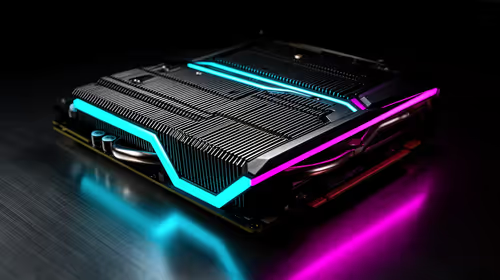
Howzit, fellow PC builders! Picking your next GPU feels like a final boss battle, right? Especially in South Africa, where every rand counts. Team Green's RTX 4080 Super and Team Red's RX 7900 XTX are both top-tier contenders, but which one delivers the best bang-for-your-buck? Let's dive into the ultimate showdown—RTX 4080 Super vs RX 7900 XTX—and find out who wins the crown for SA gamers and creators. 🚀
At a Glance: Key Specs for the RTX 4080 Super vs RX 7900 XTX
Before we get into the benchmarks, let's line up the hardware. Numbers on a page don't tell the whole story, but they give us a solid starting point for understanding the architectural differences between these two beasts.
| Spec | NVIDIA GeForce RTX 4080 Super | AMD Radeon RX 7900 XTX |
|---|---|---|
| GPU Architecture | Ada Lovelace | RDNA 3 |
| CUDA/Stream Cores | 10,240 | 6,144 |
| VRAM | 16 GB GDDR6X | 24 GB GDDR6 |
| Memory Bus | 256-bit | 384-bit |
| Boost Clock | 2550 MHz | 2500 MHz |
| TDP | 320W | 355W |
| AI/RT Cores | 3rd Gen RT, 4th Gen Tensor | 2nd Gen Ray Accelerators |
Specs sourced from official NVIDIA and AMD documentation.
Raw Gaming Performance: Where Your Rands Go
When it comes to pure rasterization—that's traditional gaming without the fancy ray tracing effects—the battle is incredibly tight. In many modern titles at 1440p and 4K, the RX 7900 XTX vs RTX 4080 Super comparison often shows AMD taking a slight lead, thanks to its sheer hardware grunt and wider memory bus.
For gamers who prioritise maximum FPS in titles like Call of Duty or Apex Legends, the 7900 XTX presents a compelling case. Its 24GB of VRAM also offers massive future-proofing for upcoming games with demanding textures. Make no mistake, both cards absolutely shred modern games, delivering the high-refresh-rate experience every serious gamer craves.
If you are looking for an alternative, the market also offers compelling Intel Arc graphics cards that are making waves in the mid-range.
Ray Tracing and AI: The NVIDIA Advantage? ⚡
This is where the fight shifts dramatically. When you switch on ray tracing, NVIDIA's mature technology pulls the RTX 4080 Super ahead. Its 3rd-gen RT cores are simply more efficient at handling complex light and shadow calculations.
But the real ace up NVIDIA's sleeve is DLSS 3 with Frame Generation. This AI-powered tech can dramatically boost frame rates, making demanding, ray-traced worlds feel buttery smooth. While AMD's FSR 3 is an impressive open-source alternative, DLSS generally provides superior image quality. For players who want to experience games like Cyberpunk 2077 or Alan Wake 2 in all their visual glory, the 4080 Super has a clear edge. It's a key reason why NVIDIA's GeForce lineup remains a top choice for visual purists.
Optimise Your Power Plan 💡
In Windows, switch your power plan to "High Performance" before a gaming session. This ensures your CPU and GPU get the consistent power they need to prevent stuttering, giving you a tangible performance boost without costing a cent.
Content Creation & Rendering: A Speedrun for Creatives
For the creators, animators, and video editors in SA, this decision is just as tough. The RTX 4080 Super vs RX 7900 XTX debate extends deep into productivity.
NVIDIA's CUDA cores are the industry standard for many creative applications like Blender, Adobe Premiere Pro, and DaVinci Resolve. This widespread optimisation often gives the 4080 Super a significant advantage in rendering times and viewport performance. However, the 7900 XTX's massive 24GB VRAM pool is a huge benefit for 8K video editing or complex 3D scenes that can eat up memory. For specialised workloads, it's sometimes worth looking at dedicated professional workstation graphics cards to ensure certified driver support.
Price and Power in South Africa: The Deciding Factor
Let's talk rands and cents. Historically, AMD has often won on price-to-performance, and the RX 7900 XTX is a prime example. It frequently comes in at a lower price point in the SA market than the RTX 4080 Super, offering incredible rasterization power for the money. If your budget is the primary driver, it's hard to ignore the value offered by the latest AMD Radeon graphics cards.
Power consumption is another key factor, especially with our temperamental grid. The 4080 Super is slightly more power-efficient with a 320W TDP compared to the 7900 XTX's 355W. It might not seem like much, but over a year of heavy gaming, it adds up... and puts less strain on your PSU and UPS during load shedding. 🔧
The Final Verdict: Which GPU is for You?
So, who wins the RTX 4080 Super vs RX 7900 XTX championship? The honest answer... it depends entirely on you.
- Choose the RTX 4080 Super if: You're a tech enthusiast who wants the best-in-class ray tracing, the magic of DLSS 3, and superior performance in creative apps that lean on CUDA.
- Choose the RX 7900 XTX if: You are a pure gamer focused on maximum FPS for your rand, you want a massive VRAM buffer for the future, and you primarily play esports or traditional rasterized titles.
Both are phenomenal pieces of engineering that will power an epic gaming rig. The best choice is the one that aligns with your games, your work, and your wallet.
Ready to Upgrade Your Rig? Whether you've picked a side or are still exploring options, the perfect GPU is waiting. Browse our massive range of graphics cards for performance that leaves lag in the dust.