You're 30 laps into a gruelling race at Kyalami. Your focus is sharp, but a nagging ache in your lower back is becoming a distraction. Your lap times start to slip. Sound familiar? For many South African sim racers, physical discomfort is the biggest barrier to performance. Mastering your sim racing cockpit ergonomics isn't just about comfort; it's about unlocking consistency, endurance, and your true pace. Let's get your setup dialled in. 🏎️
Why Your Sim Racing Ergonomics Matter
Think of your cockpit like a real race car's chassis. A poorly configured setup forces your body to fight against itself, causing fatigue, muscle strain, and a loss of concentration. A proper ergonomic sim racing setup, however, does the opposite. It supports your body, allowing for precise inputs lap after lap.
The benefits are clear:
- Reduced Fatigue: Proper posture minimises strain on your back, neck, and shoulders.
- Improved Consistency: When you're comfortable, you can focus entirely on your braking points and apexes.
- Injury Prevention: Repetitive strain injuries are a real risk. Good ergonomics is your best defence.
Nailing the Core Cockpit Setup 🔧
Getting your sim racing cockpit ergonomics right involves three key contact points: your seat, pedals, and wheel. Let's break down how to optimise each one for maximum performance and comfort.
The Seat: Your Foundation for Speed
Your seat is the anchor of your entire setup. Your goal is a posture that mimics a real GT or formula-style car, providing stability and support. Start by ensuring your lower back is pressed firmly against the seatback. A slight recline of around 20-30 degrees is ideal for most GT-style racing. If your rig doesn't have a dedicated bucket seat, a quality ergonomic gaming chair with good lumbar support is a fantastic alternative.
Pedal Placement: The Art of Control
Your pedal position dictates how effectively you can modulate the throttle and brake. Slide your seat forward or back until you can fully depress the brake pedal with a slight bend in your knee (around 120-140 degrees). Your heel should remain on the floor or heel plate. This ensures you're using your entire leg for pressure, not just your ankle, giving you far greater control and endurance. This is crucial when using load-cell pedals from brands like Thrustmaster, which demand precise inputs.
Steering Wheel Position: Precision at Your Fingertips
Adjust your steering wheel's height and distance so that when you rest your wrists on top of the wheel, your shoulders are still touching the back of the seat and your arms have a slight bend. A common mistake is having the wheel too far away or too low, which strains the shoulders and reduces leverage. You should be able to turn the wheel 90 degrees without taking your shoulders off the seat.
Pro Tip: Finding Your Perfect FOV ✨
Your Field of View (FOV) is critical for judging distance and speed. Don't just guess! Use an online FOV calculator. You'll need to measure the distance from your eyes to your screen and the screen's diagonal size. A correct FOV makes the simulation feel dramatically more realistic and can instantly improve your cornering accuracy.
Optimising Your View for Total Immersion
What you see is just as important as how you sit. An incorrect monitor setup can cause neck strain and ruin the immersive experience. Your screen(s) should be positioned so the horizontal centre is at your eye level.
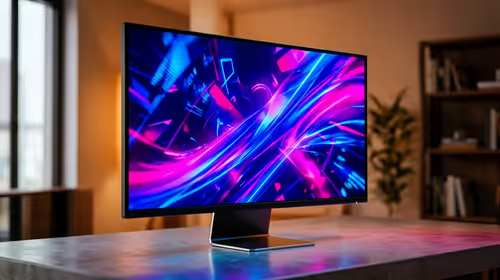
For a single-screen setup, get the monitor as close as possible, ideally right behind your wheel base. This maximises your FOV. For ultimate immersion, nothing beats a triple-screen setup or one of the fantastic immersive curved monitors available today. The wrap-around effect engages your peripheral vision, making it easier to sense cars alongside you. This level of visual detail is vital in graphically intensive titles, from Assetto Corsa Competizione to even complex flight simulators. If you're unsure where to start, you can explore our full range of PC monitors to find the perfect fit for your rig.
Perfecting your sim racing cockpit ergonomics is an ongoing process, but by following these fundamental principles, you'll build a setup that not only feels great but also helps you shave precious tenths off your lap times.
Ready to Build Your Ultimate Racing Rig?
A comfortable and precise setup is your ticket to the top of the podium. From high-torque wheelbases to ultra-responsive pedals, we have the gear to build your dream cockpit. Explore our range of Thrustmaster sim racing gear and start your journey to victory lane.