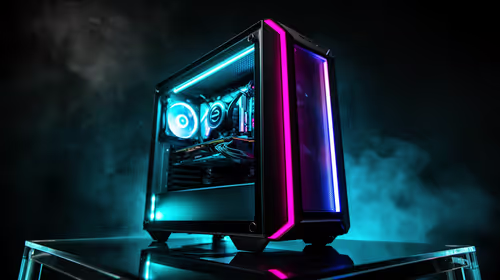
So, you’ve got your hands on the slick TRYX LUCA L70 chassis, a brilliant canvas for a powerful PC build. But in South Africa, where summer temps can turn your gaming room into a sauna, one question looms large: how do you keep it cool? This TRYX LUCA L70 cooling guide dives into the age-old debate of liquid vs air performance, helping you decide which path will lead to frosty frame rates and which might leave you thermal throttling.
The TRYX LUCA L70's Cooling Canvas
Before we pick a side, let's appreciate what we're working with. The LUCA L70 isn't just about looks; its design is geared for serious airflow. With a full mesh front panel and ample ventilation on the top and rear, it's practically begging for a high-performance cooling setup. This inherent breathability is crucial, making it one of the most versatile computer cases for builders who prioritise low temperatures. The spacious interior provides plenty of room for both bulky air towers and lengthy liquid cooling radiators.
Air Cooling Performance: Simplicity and Power 💨
For many builders, air cooling is the gold standard for a reason. It's reliable, cost-effective, and surprisingly powerful, especially in a case with great airflow. The core principle of a good TRYX LUCA L70 cooling setup using air is simple: get cool air in, get hot air out.
The LUCA L70's mesh front allows two or three 120mm/140mm intake fans to pull in a massive volume of ambient air directly over your components. Pair this with a robust tower cooler on your CPU and one or two exhaust fans at the rear and top, and you have a recipe for success. This configuration creates a consistent wind tunnel that prevents heat from stagnating. It's a tried-and-true method that keeps things simple and minimises points of failure... no pumps, no liquid. This approach is perfected in many other excellent air-flow focused cases from brands like Cooler Master as well.
Airflow Pro Tip 🔧
For the best results in the LUCA L70, aim for 'positive pressure'. This means having slightly more intake fan power than exhaust. It helps push hot air out of every vent and panel gap, while also reducing the amount of dust pulled into your rig over time. A simple 3-fan intake (front) and 1-fan exhaust (rear) setup is a great starting point.
Liquid Cooling in the TRYX LUCA L70: The Ultimate Chill ❄️
If you're pushing a high-end CPU like a Core i9 or Ryzen 9, or if you plan on overclocking, liquid cooling enters the chat. An All-in-One (AIO) liquid cooler uses a radiator to offer a larger surface area for heat dissipation than most air coolers, often resulting in lower peak temperatures.
The liquid vs air performance debate in the TRYX LUCA L70 is fascinating because the case accommodates both so well. You can mount up to a 360mm radiator in the front or a 240mm radiator on the top.
- Front-Mounted Radiator: This is often the best for CPU temperatures, as the radiator gets fed with the coolest air from outside the case.
- Top-Mounted Radiator: This configuration exhausts hot air directly out of the case, which can help lower the ambient temperature for other components like your GPU.
Aesthetically, an AIO provides that clean, high-tech look that many gamers love, clearing up space around the CPU socket. While more complex than air coolers, modern AIOs are incredibly reliable and a top choice for builds in chassis like these, including many popular choices from Gamemax.
The Verdict: Liquid vs Air for Your Build
So, what's the final call for your TRYX LUCA L70 cooling setup? It truly depends on your build and budget.
- Choose Air Cooling if: You value simplicity, reliability, and excellent performance for your money. For most mid-range to high-end gaming builds that aren't pushing extreme overclocks, a premium air cooler in the LUCA L70 is more than enough to deliver fantastic results.
- Choose Liquid Cooling if: You're running a top-tier, high-heat CPU, you plan to overclock significantly, or you want that premium, clean aesthetic. The thermal headroom an AIO provides can give you the edge in performance-intensive tasks.
Ultimately, the TRYX LUCA L70 is a winner either way. Its flexible design is a key reason it stands out in the entire lineup of TRYX gaming cases. Whether you need a small footprint like a compact alternative like the Cooler Master E301 or a mid-tower titan, understanding the cooling philosophy is key. For the LUCA L70, both air and liquid are champions... the choice is yours. ✨
Ready to Master Your Temps?
The right cooling solution makes all the difference. Whether you're upgrading your TRYX LUCA L70 or starting a new build, we've got the hardware to keep your PC frosty. Browse our wide selection of CPU coolers and find the perfect match for your rig.