

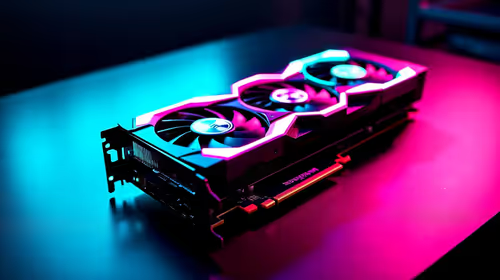
Best RTX 5090 Under R5000 in South Africa 2026
Top RTX 5090 Under R5000 picks evaluated on performance, value & SA availability with current Rand pricing from Evetech.
Read moreDeciding between vertical vs horizontal GPU mounting affects both aesthetics and airflow. We break down thermal performance, riser cable impact, and style points to help you choose the perfect setup. 🖥️ Upgrade your rig's look without sacrificing speed! 🚀

You’ve just unboxed a beast of a graphics card. The RGB is gleaming, the fans are massive, and you can’t wait to see it power your next gaming marathon. But now comes a critical decision that stumps many South African PC builders: do you mount it the old-school way, or turn it sideways for all to see? The vertical vs horizontal GPU mounting debate isn't just about looks; it directly impacts cooling, performance, and your overall build.
For decades, this has been the standard. You slot your GPU directly into the motherboard's PCIe slot, and it runs parallel to the bottom of your case. It’s simple, effective, and the default for a reason.
The biggest advantage is airflow. In most chassis, a horizontally mounted GPU has its fans facing downwards, with plenty of space to pull in cool air from the bottom of the case. This is the optimal setup for keeping temperatures low during those intense sessions of Apex Legends or Warzone. It also provides the most secure connection directly to the motherboard, eliminating any potential issues from extra cables. The only real downside is that you're left staring at the backplate instead of the fancy fan shroud you paid for. It's a key consideration when choosing the right PC case for your setup.
A vertical GPU mount turns your graphics card into the undeniable centrepiece of your build. Using a PCIe riser cable and a special bracket, the card is rotated 90 degrees to face the tempered glass side panel.
If you want your PC to be a visual masterpiece, the answer is a resounding yes. It looks incredible, especially with cards that have elaborate RGB lighting and custom fan designs. Modern cases from brands like Gamemax are often built specifically to show off your hardware this way. However, there’s a crucial catch: airflow. If the GPU's fans are squashed right up against the side panel, they’ll struggle to breathe, potentially leading to higher temperatures and thermal throttling.
Making the best choice for your PC build comes down to balancing looks with performance. Here’s what you need to weigh up.
This is the most important factor. A poorly planned vertical mount can suffocate your GPU. Before committing, check how much clearance the case provides between the card and the side panel. Some high-end chassis are specifically designed with vented side panels or extra space to make vertical mounting viable without sacrificing cooling. Many options in Cooler Master's range of cases offer this kind of build flexibility.
When mounting a GPU vertically, aim for at least 3-4 centimetres of space between the fans and the side panel. Anything less, and you risk choking the card of cool air. If your case is too tight, it's better to stick with a horizontal mount for optimal performance.
Not all cases support vertical mounting out of the box. Many modern chassis from TRYX include the necessary brackets, but for others, you might need to buy a separate conversion kit. You'll also need a quality PCIe riser cable. While modern PCIe 4.0 cables have negligible impact on performance, they do add an extra component and cost to your build.
So, after considering the vertical vs horizontal GPU mounting options, which path should you take?
Ultimately, the best GPU mounting choice depends entirely on your priorities and your components. Plan ahead, and you'll have a build that not only performs brilliantly but also looks the part.
Ready to Build Your Masterpiece? Whether you're going for subtle power or a full RGB showcase, the right case makes all the difference. Explore our massive range of PC cases and find the perfect chassis to bring your vision to life.
Yes, vertical GPU mounting can increase temps by 3-5°C if the card sits too close to the side panel, choking airflow. A mounting kit that sits back helps.
High-quality PCIe 4.0 riser cables show negligible performance loss. However, cheap or older PCIe 3.0 cables may bottleneck modern high-end GPUs.
Horizontal mounting typically offers superior cooling as fans pull air directly from the front intake, and it requires no extra hardware like riser cables.
Yes, vertical mounting eliminates GPU sag entirely by supporting the card's weight via the bracket rather than the PCIe slot, protecting your motherboard.
Not every case supports it natively. You need vertical PCIe slots or a universal vertical gpu bracket kit that modifies your standard expansion slots.
Primarily, yes. It showcases the card's faceplate and RGB lighting, making it a favorite for show builds, though it does solve sagging issues.
Top RTX 5090 Under R5000 picks evaluated on performance, value & SA availability with current Rand pricing from Evetech.
Read more
Top Value RX 9070 XT Under R10,000 picks evaluated on performance, value & SA availability with current Rand pricing from Evetech.
Read more
Top RTX 5090 Under R4000 picks evaluated on performance, value & SA availability with current Rand pricing from Evetech.
Read more
Top RTX 5080 Under R15000 picks evaluated on performance, value & SA availability with current Rand pricing from Evetech.
Read more
Core i5-14400F + B760 + RX 7800 XT Build Under. Full parts list, Rand pricing & expected performance. Build confidently with SA-available components.
Read more
Top Budget RTX 5070 Ti Under R20,000 Gamers picks evaluated on performance, value & SA availability with current Rand pricing from Evetech.
Read more
Can RTX 4080 Super Run AI Workloads for SA Developers Detailed answer with SA data, expert analysis & practical recommendations for local buyers.
Can RTX 4090 Run AI Workloads for SA Developers Detailed answer with SA data, expert analysis & practical recommendations for local buyers.
Top Settings for Intel Arc B580 at Ultrawide 1440p picks evaluated on performance, value & SA availability with current Rand pricing from Evetech.
RX 7600 Overclocking Guide: Safe OC Settings for. Real-world benchmark data, FPS numbers & performance analysis. What SA gamers can actually expect.
RTX 4060 CS2 Low Settings at 1080p: FPS Results. Real-world benchmark data, FPS numbers & performance analysis. What SA gamers can actually expect.

Visual Artifacts: Possible GPU Issue Issue #1. Diagnosis steps, proven fixes & when to seek professional help. SA-specific support info included.
Can the RTX 4090 Handle 1440p 144Hz Gaming. Performance testing verdict with real data & practical recommendations for SA buyers.
Top ASUS GPU Under R15000 picks evaluated on performance, value & SA availability with current Rand pricing from Evetech.
GTA 6 Max Settings on RTX 5070. Tested & verified settings for best FPS and visual quality on SA hardware budgets.
Cyberpunk 2077 Max Settings on RTX 5080. Tested & verified settings for best FPS and visual quality on SA hardware budgets.
Starfield Max Settings on RTX 5070 Ti. Tested & verified settings for best FPS and visual quality on SA hardware budgets.
Top RTX 5090 Under R5000 picks evaluated on performance, value & SA availability with current Rand pricing from Evetech.