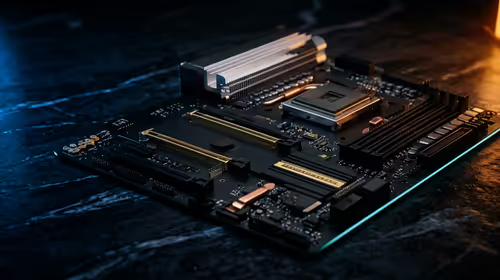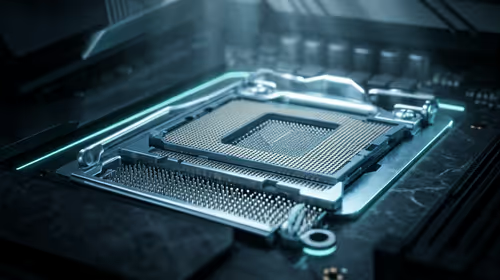
When a current-generation system starts blue-screening, it feels alarming, but on a Core Ultra 9 285K build the cause is almost always a setting, a driver or a thermal limit rather than a failed component. Most early-platform issues trace to memory training, a marginal BIOS or a loose connector rather than a faulty board. South African builders see this most often right after assembly or a major update, when BIOS, memory training and drivers all settle at once. The job is to work through the likely causes in order before booking any repair.
Quick Answer
When a Core Ultra 9 285K build misbehaves, work from the simplest causes outward: load BIOS defaults, update the BIOS, and test with EXPO/XMP off before assuming a hardware fault. Most early-platform issues are memory or BIOS related, not a dead board.
A methodical Core Ultra 9 285K build troubleshooting order
- Load optimised BIOS defaults and update to the latest stable BIOS for your exact model.
- Disable EXPO/XMP and run at DDR5-4800 to confirm whether the memory profile is the cause.
- Reseat the DIMMs and power connectors, then test a single stick to isolate a marginal part.
- Watch CPU and VRM temperatures under load to rule out a thermal limit. Test one change at a time so you know which step actually resolved it.
What to rule out before booking a repair on a Core Ultra 9 285K build
Before you carry the machine back under warranty, confirm the basics that no workshop will charge you for: the latest stable BIOS, a clean GPU and chipset driver set, and an EXPO/XMP profile that holds at its rated speed. Memory training on a fresh DDR5 platform can take several reboots before the first clean POST, which often looks like a fault but is normal. In a warm room without air-con, keep an eye on temperatures too; a CPU sitting at 95C under load will misbehave long before the board does, and a 650W or larger 80+ Gold supply with the right connectors removes power as a variable.
FAQ
Is my Core Ultra 9 285K build faulty if it keeps blue-screening?
Usually not. Most early-platform issues trace to memory training, a marginal BIOS or a loose connector rather than a faulty board. Work through BIOS defaults, a BIOS update and an EXPO/XMP test first; a genuine board fault is rare and only likely once those are ruled out.
Does updating the BIOS really help with this?
Often, yes. Early platforms ship with AGESA or microcode bugs that a later stable BIOS fixes directly, so flashing the newest version for your exact model resolves a large share of blue-screening cases.
Should I disable EXPO or XMP to test?
Yes, as a diagnostic. Running at JEDEC DDR5-4800 with EXPO/XMP off for an hour tells you immediately whether an unstable memory profile, rather than the Core Ultra 9 285K build, is behind the problem.
Sort out a Core Ultra 9 285K build that keeps blue-screening Browse Evetech's core ultra 9 285k parts and matched cooling, memory and power supplies so a clean, stable rebuild starts from parts that are known to work together.