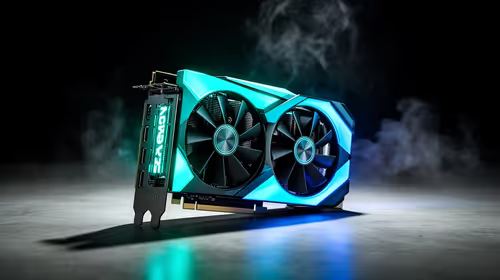
Local AI coding used to mean choosing between a model small enough to fit your card or a model actually clever enough to be useful. A 14B coding model at Q4 quantisation narrows that gap dramatically, dropping a genuinely capable assistant down to roughly 8 to 9GB of weights instead of the 16GB-plus that 27B and 32B models demand. That puts a mid-range desktop GPU within striking distance of running it.
Quick Answer
A 14B coding model such as Qwen2.5-Coder 14B at Q4_K_M weighs in around 8.5 to 9GB. It runs comfortably on a 12GB card like an RTX 5070 or 4070, and is workable on an 8GB card only with a trimmed context window and some layers offloaded to the CPU. Budget 12GB if you want the full experience locally.
What Q4 Quantisation Actually Buys You
Quantisation reduces a model's memory footprint by compressing its weights to a lower bit-width. The original 14B model holds its parameters at 16-bit; a Q4_K_M quant compresses them to roughly 4 bits each. That cuts the memory footprint by about three quarters while keeping most of the coding quality intact, which is why Q4_K_M has become the default download for local use rather than a fallback.
The honest detail people skip: 14B at Q4_K_M is around 8.5 to 9GB of weights alone, before the KV cache and runtime overhead that grow with your context length. On a strict 8GB card the model technically loads but leaves almost nothing for context, so you either shorten the window or split a few layers onto system RAM, which slows generation. Step up to 12GB and the whole thing sits in VRAM with room for a useful 16K to 32K token context.
Which GPU Tier Hits the Sweet Spot
A 12GB card is the practical target. It holds the weights, a real context window, and the KV cache without offloading, so tokens come back fast enough to feel like a proper assistant rather than a slideshow. Cards in the RTX 4070 and 5070 class land here and double as strong gaming GPUs, which matters for a single SA build doing both jobs. If you have a 16GB card you gain headroom for longer contexts or a higher-precision Q5 quant; the AI-ready PCs at Evetech are specced with exactly this VRAM-first priority in mind.
NVIDIA hardware has the edge for local inference because CUDA support across tools like Ollama and LM Studio is the most mature, and the same card accelerates Stable Diffusion or video work if your projects spread that way. For a sense of what people in this bracket are actually buying, the PC best sellers show where the mid-range demand sits right now.
Frequently Asked Questions
Will a 14B Q4 model really fit in 8GB of VRAM?
The weights are around 8.5 to 9GB, so an 8GB card cannot hold the model plus a usable context on its own. It runs only with a reduced context window and CPU offloading, which slows it. A 12GB card avoids those compromises.
What is the difference between Q4 and Q5 quants?
Q5 keeps slightly more precision and so produces marginally better output, but it needs more VRAM. Q4_K_M is the standard choice because it balances quality and size well, fitting comfortably where Q5 would not.
Do I need an NVIDIA card specifically?
NVIDIA is strongly recommended for local AI because CUDA is the best-supported backend across Ollama, LM Studio and similar tools. Other cards can work but with more setup friction and fewer optimised paths.
Can the same GPU still handle gaming?
Yes. The 12GB RTX-class cards that run a 14B coding model well are also capable 1440p gaming GPUs, so one build covers both local AI development and play.
Local AI coding is now a mid-range build, not a workstation splurge. Explore the AI PC range at Evetech to spec a machine with the VRAM these models actually need.