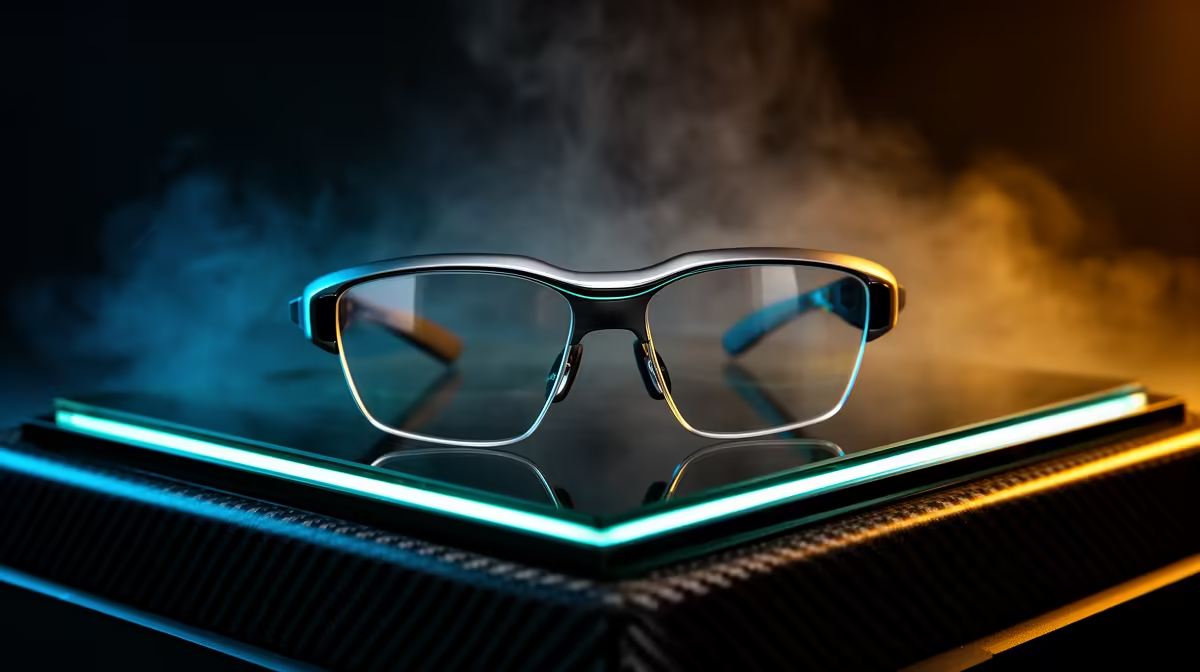
The category that barely registered two years ago is now the fastest-moving corner of wearable tech. AI smart glasses are forecast to leap from about 6 million units in 2025 to 20 million in 2026, according to research firm Smart Analytics Global, with revenue projected to roughly quadruple from around 1.2 billion US dollars to 5.6 billion over the same span. The trigger is simple: the format finally works, and the biggest names in consumer electronics are about to pile in.
Quick Answer
Smart Analytics Global expects AI smart glasses sales to more than triple in a single year, from roughly 6 million units in 2025 to 20 million in 2026, with market value climbing from about 1.2 billion to 5.6 billion US dollars. Ray-Ban Meta's success proved the demand, and the anticipated entry of Apple and Samsung is what pushes the numbers into breakout territory.
What is driving the surge
Two forces are stacking up. First, the commercial success of the Ray-Ban Meta line showed that people will wear a camera, speakers and a voice assistant on their face if the glasses look normal and the everyday features land. That removed the doubt that has dogged the category since the earliest face-worn computers. Second, the looming arrival of Apple and Samsung signals to the whole market that this is now a mainstream product line rather than a niche experiment.
The forecast also points to consolidation. Smart Analytics Global expects Apple, Samsung and Meta to settle in as the top three vendors by 2030, with smaller players squeezed by product sameness and price competition. For buyers that is good news in the short term: more competition means more choice and sharper pricing through 2026 and beyond.
Audio-first today, visual displays next
Most of today's volume is audio-led: glasses that handle calls, music, a camera and an assistant without a screen in your line of sight. The research suggests heads-up display models, which put visual information like navigation arrows or live translation in front of your eye, will overtake audio-only designs from around 2028 as the optics and battery life improve. The United States and China are expected to make up nearly 80 percent of demand in 2026, but the technology filtering down means more of these wearables reach South African shelves as the year goes on.
For local buyers the practical takeaway is to watch the AR and smart glasses range as the new entrants land, since a wave of competing platforms tends to drag prices down and widen the feature set quickly. If you are kitting out around a new pair, the accessories best sellers page is a useful stop for charging gear and the everyday extras that go with a new wearable.
Frequently Asked Questions
How many AI smart glasses will sell in 2026?
Smart Analytics Global forecasts about 20 million units in 2026, up from roughly 6 million in 2025. That is more than a tripling in a single year, which is why analysts describe it as a breakout phase for the category.
Are Apple and Samsung releasing smart glasses?
Both are widely expected to enter the AI smart glasses market in 2026, joining Meta. Their arrival is the main reason the forecast jumps so sharply, and the same firms are tipped to be the top three vendors by 2030.
What is the difference between audio and HUD smart glasses?
Audio glasses handle sound, calls and a voice assistant with no screen, while HUD models add a small visual display for things like navigation and translation. Audio leads today, with HUD designs expected to overtake from around 2028.
Where does most of the demand come from?
The United States and China together are expected to account for nearly 80 percent of global demand in 2026. Other regions, including South Africa, grow as the technology matures and prices ease.