


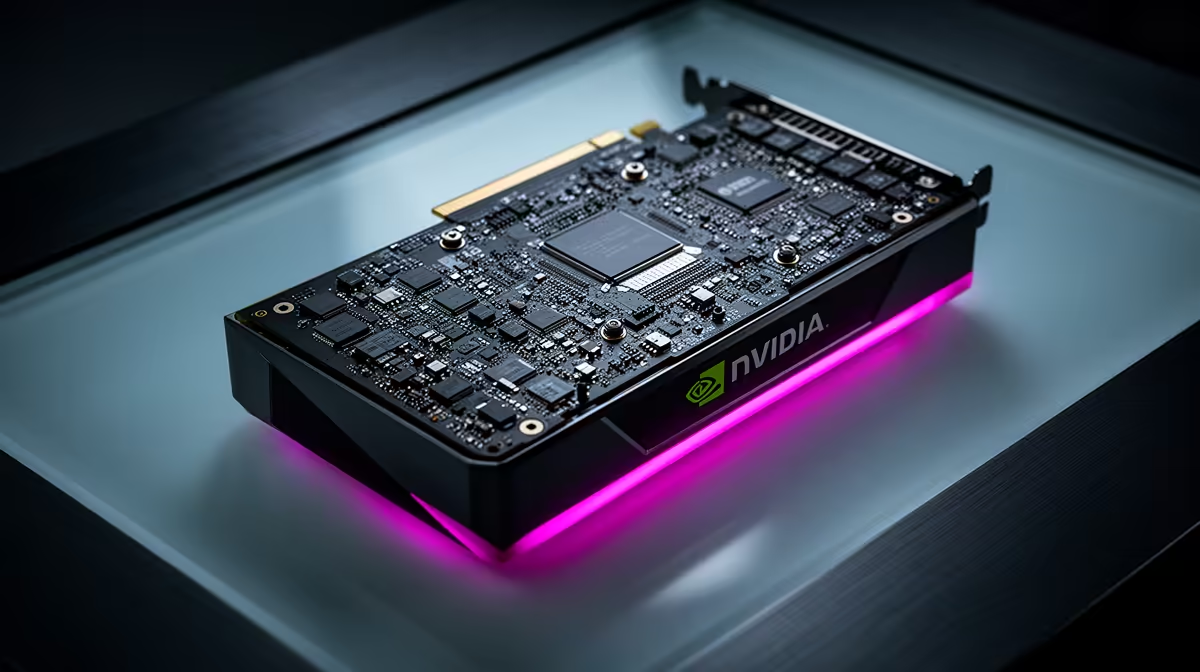
For developers who want to run reasoning and coding models on their own desk, the DGX Spark answers one question loudly and another quietly. Its 128GB of unified memory lets it hold models that would never fit on a normal desktop GPU, so capacity is rarely the problem. The catch sits in the memory bandwidth, roughly 273 GB/s, which is what decides how fast those models actually spit out tokens.
Quick Answer
The DGX Spark is good for AI coding when the win is fitting a large model locally, since 128GB of unified LPDDR5x memory can hold models up to around 200B parameters at 4-bit precision. It is weaker for raw speed, because its roughly 273 GB/s bandwidth caps how fast tokens generate. Capacity wins, throughput bites.
Where the 128GB unified memory wins
Token generation speed depends heavily on memory bandwidth, and a large language model has to read its entire weight set for every token it produces. On a normal gaming GPU with 12 or 16GB of VRAM, a big coding or reasoning model simply will not load, so you are forced into smaller, less capable models or into the cloud. The GB10 superchip sidesteps that wall by pooling 128GB across CPU and GPU, so the model that would not fit anywhere else loads in one piece and stays resident.
That makes the Spark genuinely useful as a local development and prototyping box. You can run quantised models in the tens to low hundreds of billions of parameters, keep your codebase and prompts entirely on-device, and iterate without a metered bill ticking over. The current AI PC range at Evetech shows the broader category these unified-memory machines sit in.
Where 273 GB/s bites
Bandwidth is the ceiling on tokens per second. A datacentre card like an H100 moves data at several thousand GB/s, so the Spark's roughly 273 GB/s feels slow by comparison on long generations. For a coding assistant that streams paragraphs of output, you will notice the model thinking rather than racing.
NVIDIA has clawed some of that back in software. The CES 2026 update brought up to 2.5x speed improvements over launch through TensorRT-LLM optimisations and speculative decoding, which softens the bandwidth limit without changing the silicon. Quantising to 4-bit precision (NVFP4) also helps, since fewer bits per weight means less data to shuffle for each token. The Spark shines as a research and prototyping tool, not as a brute-force inference server.
What this means for an SA buyer
There is no official local channel for the DGX Spark in South Africa, so getting one means a grey import with the usual warranty and support caveats that carries. Before committing, be honest about your workload: if you need a model that only fits in 128GB and value keeping data on-premises, the trade-off makes sense. If you mainly want fast responses from a model that fits comfortably on a strong consumer GPU, a high-VRAM workstation card is the better spend. The PC best sellers give a feel for locally supported machines that cover most coding workloads.
Frequently Asked Questions
How large a model can the DGX Spark run for coding?
Up to roughly 200B parameters at 4-bit precision, thanks to the 128GB of unified memory. That covers most open-weight reasoning and coding models you would want to run locally.
Why is the DGX Spark slower than a datacentre GPU?
Its memory bandwidth is roughly 273 GB/s, while cards like the H100 move data many times faster. Since every token requires reading the model's weights, lower bandwidth directly limits tokens per second.
Can software updates improve its speed?
Yes. NVIDIA's CES 2026 update delivered up to 2.5x improvements over launch through TensorRT-LLM and speculative decoding, so real-world throughput is better than the launch figures suggested.
Is the DGX Spark sold officially in South Africa?
Not through an official local channel at the time of writing, so a unit would be a grey import. Factor warranty, support and pricing uncertainty into the decision before buying.
If local large-model capacity is your priority, study the AI PC range at Evetech to see how unified-memory and high-VRAM machines compare for your coding workflow.










