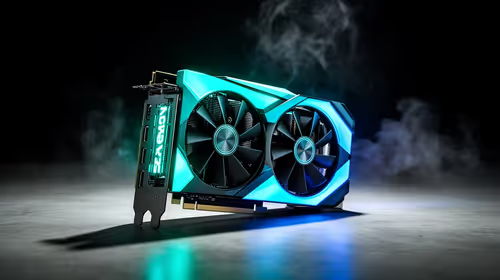
The number that matters most on the RTX 5090 is not the frame rate, it is 1,792 GB/s. That is how fast the card moves data across its 32GB of GDDR7, and for anyone running large language models on their own machine, memory bandwidth is the speed limit that actually bites. Against the RTX 4090's 1,008 GB/s, that is a 78 percent jump, and it lands exactly where local AI work has been starved.
Quick Answer
The RTX 5090 pairs 32GB of GDDR7 with 1,792 GB/s of bandwidth, up 78 percent over the RTX 4090. Because local LLM token generation is bandwidth-bound, that translates to meaningfully faster inference, roughly 25 to 35 percent quicker on a 70B-class model at Q4, while the extra 8GB of VRAM lets a single card hold 30B-class coding models that the 4090 could not fit comfortably. It is the strongest single-card option Evetech stocks for local AI.
Why bandwidth, not cores, sets the pace
When a model generates a token, the GPU spends most of its time reading the model's weights out of VRAM rather than crunching maths. That makes token output almost directly proportional to memory bandwidth at low batch sizes, which is how most people run a local assistant. The 5090's 1,792 GB/s is the reason it pulls ahead: published comparisons put it around 25 to 35 percent faster than the 4090 on a 70B model at Q4 single-stream, and the gap narrows on tiny 7B models where neither card is bandwidth-starved.
The 32GB capacity is the other half of the story. A 30B-class coding model at Q4 quantisation sits comfortably in 32GB with room for a useful context window, whereas the 4090's 24GB forced compromises, smaller context, heavier quantisation, or offloading layers to system RAM and watching speed collapse.
What this unlocks for a local build
If you have been renting cloud GPU time to run a coding model, a 5090 changes the maths. You can keep a 30B assistant resident, feed it a real chunk of your codebase as context, and get responses fast enough to stay in flow, all on hardware sitting under your desk in Johannesburg or Cape Town rather than metered by the hour overseas. For image generation, video upscaling and fine-tuning smaller models, the same bandwidth-and-capacity combination pays off.
A complete machine matters as much as the card. The 5090 draws serious power, so it wants a strong PSU and good airflow, which is why buying it inside a balanced system rather than dropping it into an ageing build is the safer route. The AI PC range at Evetech is stocked with systems configured precisely for this kind of demanding workload.
Who should actually buy one
This is a card for people running local models seriously, developers, researchers and creators, not a casual upgrade for 1080p gaming. If your work is genuinely VRAM-bound, the 5090 removes the ceiling. If you mostly game, the value case is softer and a step down may serve you better. Comparing where it lands against the rest of the lineup, the current best selling PCs at Evetech show what a balanced high-end build looks like in Rand.
Frequently Asked Questions
How much faster is the RTX 5090 than the RTX 4090 for local LLMs?
On a 70B model at Q4 quantisation, single-stream, expect roughly 25 to 35 percent more tokens per second thanks to the 78 percent bandwidth increase. On small 7B models the gain shrinks to single digits because those are not bandwidth-limited.
Can the RTX 5090 run a 30B coding model on its own?
Yes. At Q4 quantisation a 30B-class model fits inside the 32GB of VRAM with headroom for a working context window, which the 4090's 24GB struggled to do without offloading or heavier compression.
Is the extra VRAM or the bandwidth more important?
For fitting a model at all, capacity wins, you cannot run what does not fit. For how fast it then responds, bandwidth wins. The 5090 improves both, which is why it resets the VRAM-per-rand equation rather than just nudging it.
Do I need a new power supply and case for a 5090?
Almost certainly. The card's power draw and physical size mean an older mid-range PSU or a cramped case will hold it back or risk instability, so plan the whole system around it rather than swapping the card alone.
Running models locally is far cheaper than metered cloud GPUs over time. See the AI PC range at Evetech to spec a machine built around the RTX 5090's 32GB.