


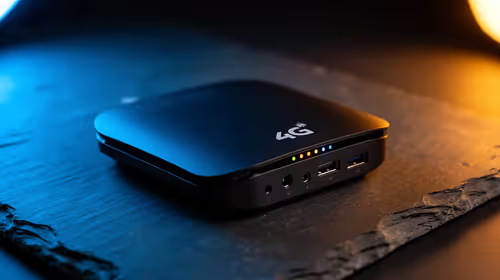
How to Use a Nano SIM 4G Router for Reliable Home Internet
Master using a Nano SIM 4G router as your primary internet solution. Get stable speeds and seamless connectivity for gaming and streaming at home! 🌐🚀
Read more💻 Find how 16:9 vs 16:10 monitors boost coding comfort. 📊 More vertical space, better multitasking. 🛠️ Upgrade your dev environment smartly.

Staring at lines of code all day? Your neck and eyes probably feel it. While we obsess over CPUs and GPUs, your monitor's aspect ratio might be the unsung hero... or villain... of your daily grind. The classic 16:9 widescreen is everywhere, but that taller 16:10 panel is making a comeback. So, in the great 16:9 vs 16:10 for coding debate, which one actually boosts your comfort and productivity? Let's break it down.
Before diving in, what exactly is an aspect ratio? It’s the proportional relationship between a screen's width and its height. A 16:9 monitor is 16 units wide for every 9 units tall. A 16:10 monitor is slightly taller, offering more vertical space.
For coders, this vertical real estate is gold. More vertical space means you can see more lines of your code at once without constantly scrolling. Less scrolling means less interruption to your flow state and less strain on your eyes and wrist. It’s a small difference on paper, but it makes a huge impact during a long day in VS Code or JetBrains. Choosing the right one from a selection of PC monitors is a crucial first step.
The 16:9 aspect ratio is the undisputed king of media and gaming. It’s the standard for YouTube, Netflix, and nearly every modern PC game. If your rig is a dual-purpose machine for both work and play, a 16:9 panel is often the default, practical choice.
Pros for Coding:
Cons for Coding:
For many, especially those looking at high-resolution 4K and 5K monitors, the sheer pixel density of a 16:9 screen can compensate for the shorter height.
The 16:10 aspect ratio offers roughly 11% more vertical screen space than its 16:9 counterpart. It doesn't sound like much, but it translates to seeing several extra lines of code at a glance. Think of it as a quality-of-life upgrade that reduces friction throughout your workday.
This extra height makes the screen feel more like a document, which is perfect for reading and writing code. The argument of 16:9 vs 16:10 for coding comfort often leans toward 16:10 because it directly addresses the primary task: viewing vertical text. While less common in the world of all gaming monitors, its popularity is surging among developers and content creators for a reason.
Regardless of your monitor, configure your IDE to maximise vertical space. Move sidebars to auto-hide, use a condensed font like Fira Code, and tweak your layout to see more code before needing to scroll.
So, which aspect ratio wins for programming?
Ultimately, the best monitor is one that fits your specific needs. Some developers even find that immersive curved monitors reduce eye strain, while others need the flexibility of portable monitors for working on the go. Don't forget to pair your choice with the right monitor accessories like a VESA mount to perfect your ergonomic setup. ✨
Ready to Upgrade Your View? The right monitor is a long-term investment in your comfort and productivity. Explore our massive range of PC monitors and find the perfect fit for your coding and gaming needs.
16:10 boosts coding with more vertical space.
Yes, 16:10 excels at multitasking for developers.
16:10 enhances code readability with more lines visible.
16:9 remains okay but offers less vertical room.
16:10 optimizes dual screen coding setups effectively.
Pick 16:10 for better workspace organization.
Yes, 16:10 improves efficiency with added workspace.
Master using a Nano SIM 4G router as your primary internet solution. Get stable speeds and seamless connectivity for gaming and streaming at home! 🌐🚀
Read more
Confused by Cat4 vs Cat6 LTE routers? 🌐 We break down the technical differences to help you choose the right router for faster gaming and streaming. Get the speed you deserve today! 🚀
Read more
Learn how to setup a VPN server on your 4G LTE router to secure your remote access. Protect your data and browse safely from anywhere with our easy guide! 🌐🔐
Read more
Choosing the best 4G LTE router for South Africa ensures reliable internet when fibre is unavailable. Discover top connectivity tips for rural and urban areas. 🌐📶
Read more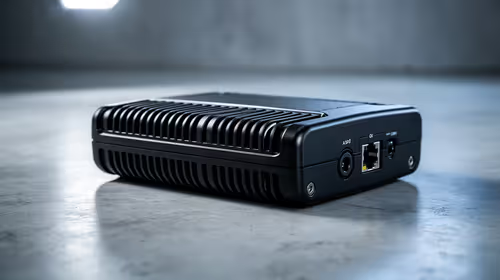
Discover what is passive PoE and how it streamlines outdoor router installations. Eliminate messy cabling and simplify your network setup with this efficient power delivery method. ⚡🌐
Read more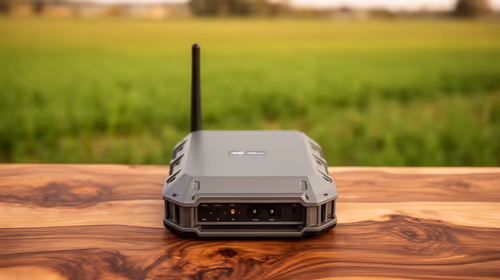
Need to extend internet coverage to outbuildings or farms? 📡 An outdoor 4G router is the ultimate solution for stable, high-speed connectivity in remote locations. Discover how to boost your range and stay connected anywhere on your property. 🌐
Read more
Wondering if a TKL wireless mechanical keyboard is worth it for everyday productivity? We break down latency, battery life, comfort, and workflow gains for real work. ⚡⌨️

Maximise battery life on a fanless 15-inch laptop using efficiency core architecture. Cut idle drain, tune power profiles, and improve thermals for longer runtime. 🔋⚙️

Learn how to reduce desk clutter with a TKL wireless keyboard using fewer cables, smart placement, and tidy essentials. Get a faster, calmer workspace with better ergonomics. ✅🧼

RGB keyboard lighting too distracting? Learn how to manage backlight modes, set brightness, and reduce distraction for focus and productivity 😌🖱️

Are themed gaming keyboards worth the extra cost? Compare build quality, switch options, features, and resale value to find the best fit for your setup 🎮⌨️

Full-Size vs Tenkeyless mechanical keyboards for gaming: find out if a smaller layout truly improves aim, speed, and comfort. We break down layout, desk space, latency-feel, and keybinds 🎮⌨️

Dedicated media rollers vs function key shortcuts: learn which setup gives you better workflow control, faster media access, and fewer mistakes. 🖱️🎧

Best Mechanical Switch Type for Gaming: Clicky vs Linear vs Tactile. Find your feel, speed, and noise balance with practical guidance for FPS, MOBA, and productivity 😄🎮

Direct mouse answer: Mouse not keeping up with your work? Everything that matters about dual-mode 2.4GHz + BT 5.0: DPI behaviour, channel switching, battery curves and per-app button mapping. Covers when 2.4GHz USB wins (low-latency desk) and when BT 5.0 wins (laptop, d

Plain wireless mouse guide: Mouse not keeping up with your work? Everything that matters about wireless productivity mouse: DPI behaviour, channel switching, battery curves and per-app button mapping. Includes DPI tuning tips, channel switch shortcuts, and ZAR-aware fea

Real productivity numbers: Set up your wireless mouse in this order: everything that matters about wireless productivity mouse: DPI behaviour, channel switching, battery curves and per-app button mapping. Includes DPI tuning tips, channel switch shortcuts, and ZAR-aware

Pen not feeling like paper? Stylus lag and skipping usually trace to old drivers, dirty nibs, or display refresh mismatches, not the pen itself. Covers pressure curve tuning, tilt thresholds, nib swap timing, and SA pricing brackets.