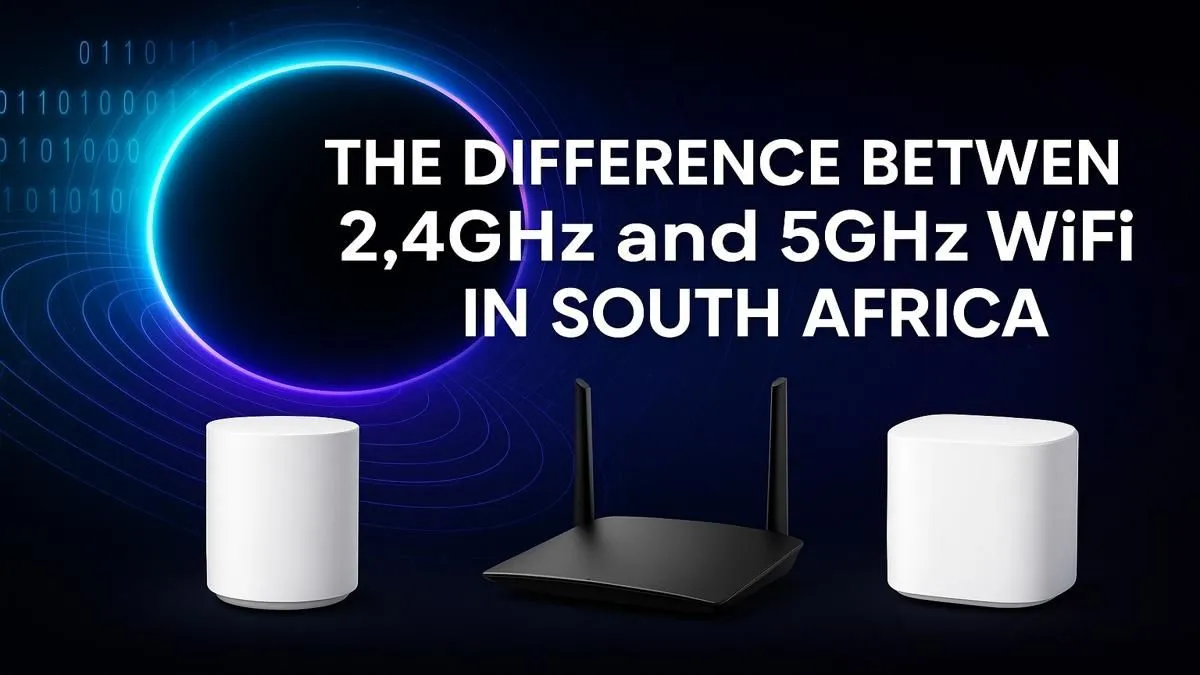
You’re in the final circle, the tension is thick... and then your connection stutters. That dreaded lag spike hits. It’s a uniquely South African frustration, where fast fibre can be crippled by bad WiFi. The culprit is often your WiFi band. The debate over 2.4GHz vs 5GHz WiFi in South Africa isn’t just tech talk; it’s the difference between a glorious win and a screen-punching loss. Let’s get you on the right frequency.
Understanding 2.4GHz WiFi: The Reliable Workhorse
Think of the 2.4GHz band as the trusty bakkie of the WiFi world. It’s not the fastest on the highway, but its range is fantastic. This lower frequency is a champion at penetrating solid objects like the thick brick walls common in many South African homes. If your router is in the lounge and you need a signal in the bedroom down the hall, 2.4GHz is your friend.
The downside? It's a crowded space. Your microwave, Bluetooth speakers, and half of your neighbours' routers are all competing for airtime on the same limited channels, which can cause interference and slow things down. Still, if your signal struggles to reach the braai area, a good wireless range extender can give your 2.4GHz network the boost it needs.
Unleashing 5GHz WiFi: The Speed Demon 🚀
If 2.4GHz is the bakkie, then 5GHz is the high-performance sports car. It offers significantly faster speeds and operates on a much wider, less congested spectrum. This makes it the undisputed champion for bandwidth-hungry tasks like competitive online gaming, 4K streaming on Showmax, and downloading massive game updates. For gamers, the lower latency on the 5GHz band is a massive advantage.
The trade-off is range. Those high-frequency signals don't punch through walls as effectively as 2.4GHz. The connection is best when you have a clear line of sight, or are at least in the same room as your router. To get the best of both worlds, you’ll need one of the modern dual-band wireless routers that can broadcast on both frequencies simultaneously.
Check Your Connection 🔧
Most modern routers combine 2.4GHz and 5GHz into one network name (SSID). For gaming, consider logging into your router's settings and splitting them into two separate names, like 'MyFibre_2.4GHz' and 'MyFibre_5GHz'. This lets you manually force your gaming PC or console onto the faster 5GHz band every time.
The South African Showdown: Which Band Wins Here?
Choosing between 2.4GHz vs 5GHz WiFi in a South African context depends heavily on your home and habits. In a large, double-brick house in the suburbs, you might need the range of 2.4GHz for general coverage. But for your main gaming rig or smart TV, you'll want the raw speed of 5GHz.
Living in a dense apartment block in Joburg or Cape Town? The 2.4GHz band is likely a chaotic mess of competing signals. Switching to 5GHz can feel like moving from a traffic jam onto an open highway. But what if your PC can't even see the 5GHz network? Many older or budget machines can't. A simple upgrade with one of these USB wireless adapters can unlock those top-tier speeds instantly. ✨
Making the Final Call: Your Perfect WiFi Match
So, which is the best WiFi band for you? There's no single right answer, but there is a right answer for your needs.
You should probably use 2.4GHz if:
- Range is your #1 priority and you need to cover a large area.
- You have many thick walls between your devices and the router.
- Your internet activities are limited to browsing, email, and standard-definition streaming.
You should definitely use 5GHz if:
- Speed is critical for competitive gaming, 4K streaming, or large file transfers.
- Your gaming PC or console is relatively close to your router.
- You live in a high-density area with lots of WiFi interference.
For any serious South African gamer, the verdict is clear: 5GHz offers the superior performance needed to compete. Optimising your home network is the key to unlocking the full potential of your fibre. Investing in the right wireless networking gear pays for itself in frustration-free gaming and seamless streaming.
Ready to Banish Lag for Good?
The choice between 2.4GHz and 5GHz WiFi in South Africa is clear for serious gamers. Don't let a weak signal bottleneck your performance. Explore our massive range of networking gear and build the stable, high-speed connection you deserve.