Quick Answer
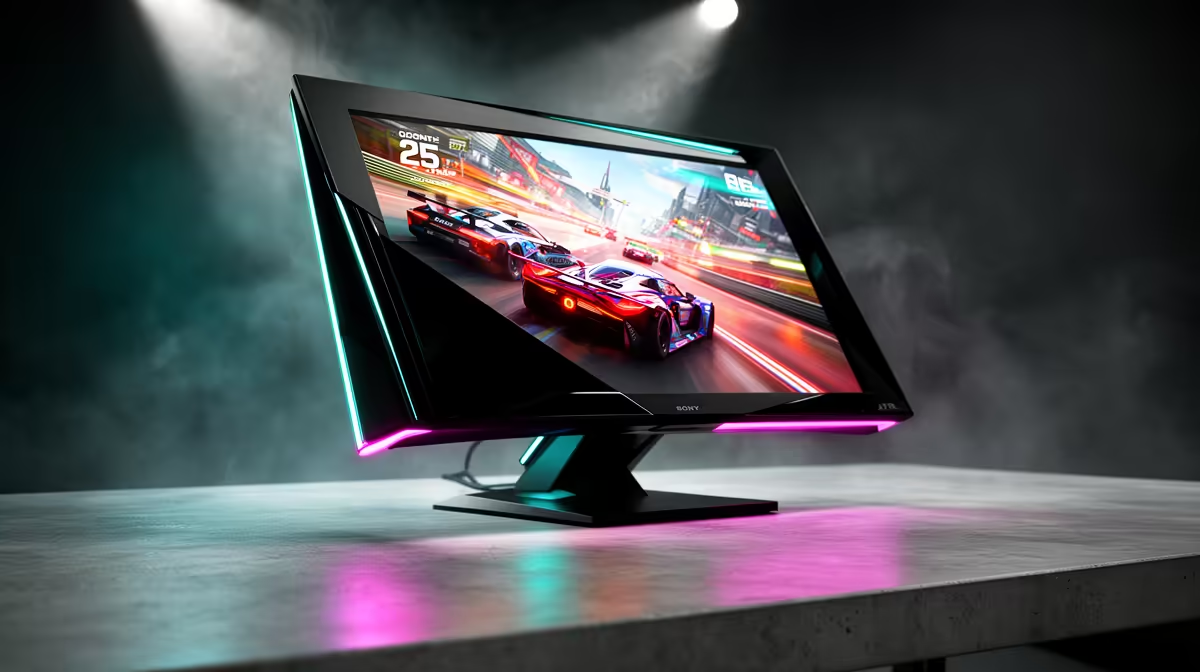
Upgrading from 144Hz to 240Hz provides a real, measurable advantage in competitive FPS and racing games: motion resolves more clearly between frames, target tracking is smoother, and input lag decreases by approximately 2.8ms per frame (from 6.9ms to 4.2ms per frame). The benefit is most pronounced when your GPU can consistently deliver 200-plus fps.
What Actually Changes at 240Hz Versus 144Hz 🎮
At 144Hz, the display refreshes every 6.94ms. At 240Hz, it refreshes every 4.17ms. In a competitive FPS like CS2 or Valorant, an opponent moving across your screen at high speed is shown in more intermediate positions per second at 240Hz, making it easier for your eye to track their precise location. This is not a placebo: studies from display researchers and pro player feedback consistently confirm that players with 200-plus fps on 240Hz monitors react to fast-moving targets measurably faster than on 144Hz monitors at equivalent fps.
Racing Games: How High Refresh Affects Precision 🏁
In sim racing titles like iRacing, Assetto Corsa Competizione, or F1 25, 240Hz brings two specific benefits. First, the faster refresh rate captures fine steering and braking inputs with less temporal lag, which matters at the precision margins where lap time improvements are decided. Second, at high speeds where the scenery scrolls quickly across the screen, 240Hz reduces the stutter and judder that can make edge-tracking visually difficult at 144Hz.
When the Upgrade Is and Is Not Justified 🔧
The 240Hz upgrade is justified when your GPU consistently outputs above 180 fps in your primary game. An RTX 5070 running CS2 at 1080p medium settings easily exceeds 300 fps. An RTX 5060 Ti running at 1080p medium achieves 200 to 280 fps in CS2. Both scenarios make a 240Hz panel genuinely useful. The upgrade is harder to justify when your GPU delivers 100 to 140 fps consistently, because you are spending between R4,500 and R7,000 more for a 240Hz monitor versus a 144Hz equivalent while rarely touching the frame-rate ceiling. In that case, the GPU investment takes priority.
Frame Rate Cap at Your Monitor's Refresh Rate ⚡
Cap your in-game frame rate at exactly your monitor's refresh rate when using adaptive sync. Running uncapped frames above your refresh rate does not improve visual quality and can cause adaptive sync to disengage momentarily when frames exceed the monitor's maximum frequency. For a 240Hz monitor, cap at 238 fps in games using G-Sync Compatible or FreeSync.
FAQ
Can the human eye really tell 240Hz from 144Hz in gaming?
Yes, though the degree varies by individual. Most competitive players report a perceivable improvement in motion smoothness and target tracking at 240Hz versus 144Hz when running sufficient fps to fill both refresh rates. The improvement is less dramatic than the jump from 60Hz to 144Hz, which most people notice immediately.
What GPU is needed to actually run 240 fps in competitive FPS games?
At 1080p in CS2 or Valorant with medium to high settings, an RTX 5060 Ti or RX 9070 consistently delivers 200 to 300 fps. At 1440p in the same games, an RTX 5070 or RX 9070 XT maintains 180 to 250 fps. For 240Hz to be meaningful, match your settings and resolution to what your GPU can realistically sustain.
Is a 27-inch 1440p 240Hz monitor better than a 24-inch 1080p 240Hz for FPS?
For pure competitive advantage, 1080p 24-inch is the traditional esports standard because the lower resolution means more consistent high frame rates on a given GPU. However, 1440p 27-inch 240Hz panels have become the preferred choice among semi-serious and enthusiast players who want better image quality alongside competitive refresh rates, and most modern GPUs in the R10,000-plus tier handle 1440p 240Hz without difficulty.
Ready to feel the difference that 240Hz makes?
Evetech stocks 240Hz gaming monitors at 1080p, 1440p, and 4K across IPS and OLED panel types. Browse the Evetech monitor section to find your competitive edge.