Most camera accessories make one trade-off or another, but the gap between a 360 degree ball head and a fixed camera mount is about far more than that single trade-off. One gives you a fully articulating joint that moves in every direction; the other locks your lens at whatever angle the bracket ships with. Which you need depends entirely on how often you reframe, and how much you are willing to pay for the freedom to do so.
Quick Answer
A ball head offers full 360 degree pan and close to 90 degrees of tilt from a single knob, while a fixed mount holds one position permanently. Choose the ball head for any setup that reframes regularly; a fixed bracket works fine for a face-cam you set once and leave.
🔧 How a Ball Head Actually Moves
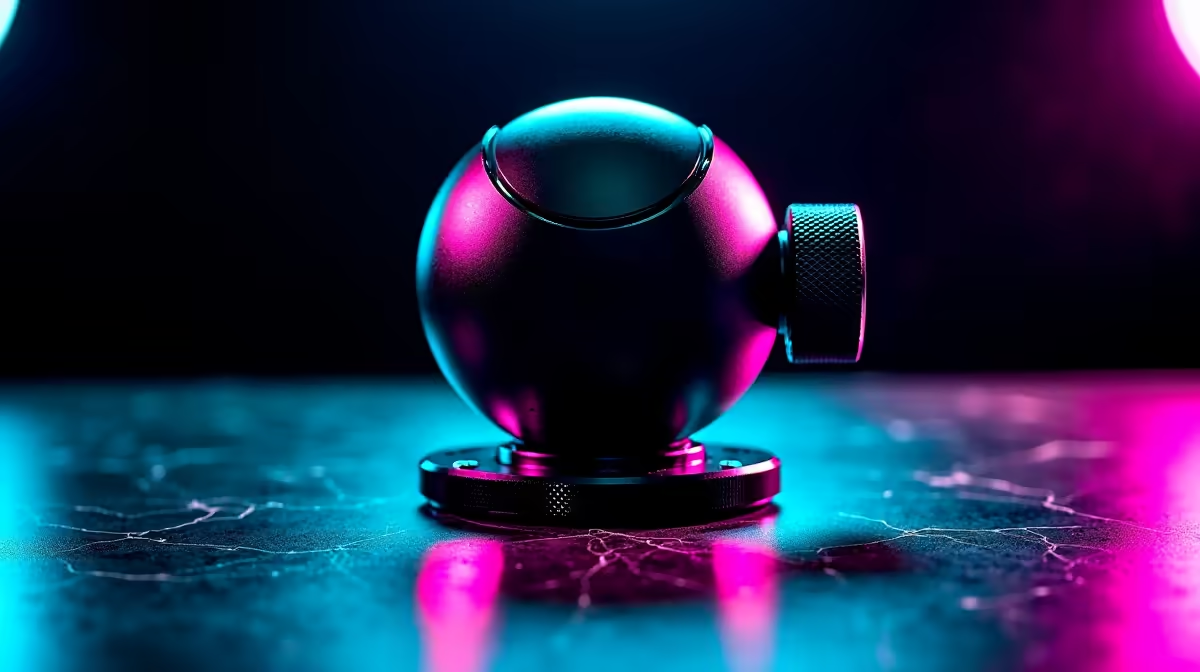
The ball head design places a polished sphere inside a threaded housing. Loosen the tension knob and the sphere turns freely in any direction, letting you sweep the camera across a full horizontal circle or tilt it nearly upright or flat. The camera goes where you point it, and tightening the knob freezes that position.
That range covers the most common framing challenges at a desk: swinging from a frontal face shot to a top-down overhead, angling the lens toward a second display, or compensating for an off-centre stand position. A single twist unlocks the whole geometry, and a second twist locks it solid again.
The precision of the lock matters as much as the range. A quality ball head with a well-machined housing holds its position without creep, even with a 200g webcam or a small action camera mounted. Cheap versions with loose tolerances drift slowly under load, which defeats the purpose of the joint entirely.
What the Tension Knob Controls
Most ball heads use one knob to manage both the drag feel when loose and the locking force when tight. Some higher-end units separate these into a drag control and a dedicated lock, which is worth having if you frequently make small incremental adjustments. For desktop streaming and conferencing use, a single knob design is usually sufficient.
🔆 What a Fixed Mount Commits You To
A fixed bracket bolts the camera to one position. There is no internal joint, no adjustment, no opportunity to swing the lens without physically relocating the entire stand. For many users, that is not a problem at all.
If you set a face-cam once during initial desk setup and never touch it again, a fixed mount is genuinely the better tool. There is less to go wrong, fewer parts to tighten, and nothing to come loose mid-stream. The bracket either bolts to a wall, clips to a monitor, or sits on a surface, and it holds that angle indefinitely.
The weight saving is real but modest, typically 50 to 100g less than a comparable ball head unit because the fixed bracket skips the internal sphere and housing. For a mounted solution where you value minimal hardware, that matters. For a desktop stand where a few extra grams change nothing, it rarely does.
The price gap is worth noting. Fixed brackets often cost R100 to R200 less than equivalent ball heads, which reflects the simpler construction. That margin is meaningful on a tight budget, less so once you factor in that you may need to replace the bracket if your setup ever changes.
✨ Stability When Locked: Comparing the Two
A torqued ball head and a bolted fixed bracket hold a lightweight camera with comparable firmness. The concern that ball heads wobble under load applies only to loose or worn units. A ball head with a properly tightened tension knob grips the sphere against the housing walls, and at webcam weights that contact area resists vibration well.
The distinction emerges under very heavy continuous loads or on mounts that experience regular motion, like a boom arm that swings daily. Fixed brackets have no moving part to fatigue, so their structural integrity is essentially permanent. Ball heads develop minor play in the sphere housing over years of heavy cycling, though for a desktop camera this timeline is measured in years rather than months.
For a streamer or video caller, the practical stability of either option under normal use is the same. The choice comes down to whether you want to reframe at all.
Pro Tip ⚡
If you run a dual-camera setup, fit a ball head to the secondary angle and a fixed bracket to your primary face-cam. The face-cam stays untouched; the secondary reframes in seconds for product shots or overhead angles without touching the main framing.
🎯 Matching the Mount to Your Workflow
Multi-camera streaming setups benefit heavily from ball heads because switching between face, overhead, and wide angles takes seconds rather than requiring a full rig teardown. If you switch shot types during content, the R150 to R300 premium over a fixed mount pays for itself in the first session where you would otherwise have struggled with a fixed bracket.
Single-camera setups, especially where the frame never changes, are the natural home of the fixed bracket. A content creator who films a fixed talking-head shot at the same desk every day has nothing to gain from a ball head's range. The simpler hardware is the right hardware.
The beginner question is whether the flexibility will actually be used. For most people starting out, a ball head is still the wiser choice: it accommodates a setup that will almost certainly change as skills develop, desk layouts evolve, and content types expand. Locking yourself into a fixed angle before you know exactly what framing you want is the more limiting bet.
Frequently Asked Questions
How much angular freedom does a ball head provide over a fixed bracket?
A ball head rotates the full 360 degrees horizontally and allows roughly 90 degrees of tilt in any direction from a single tension knob. A fixed bracket offers exactly one angle: whichever position it was installed in. The practical difference is the ability to reframe in seconds versus dismounting and repositioning the entire unit.
Are there situations where a fixed mount genuinely outperforms a ball head?
Yes, in two specific cases. First, a face-cam that is set once and never reframed is better served by a fixed mount: no knob to come loose, fewer points of mechanical failure, and a simpler rig. Second, on a very tight budget the R100 to R200 cost saving matters more than the flexibility most beginners assume they will use from day one.
Does a torqued ball head hold as firmly as a bolted fixed bracket?
Under webcam and small camera loads, yes. A properly tightened ball head grips the sphere against its housing with enough friction to hold a 200g camera without drift. The distinction becomes relevant only under heavier loads or after years of high-cycle use, neither of which applies to a typical desk streaming or conferencing setup.
Why would I choose a ball head for a multi-camera streaming rig?
Because reframing one angle does not disturb the others. In a multi-camera setup you may swing the secondary camera from face to overhead between segments, and a ball head does that without tools or stand adjustment. A fixed bracket forces you to physically relocate the mount, which risks shifting the primary framing in the process.
Is a fixed bracket meaningfully lighter than a ball head?
Modestly, typically 50 to 100g, which reflects the missing sphere and housing. On a wall or monitor mount where total weight matters for the fixing point, that saving is relevant. On a desktop stand sitting on a desk, the difference is negligible and should not be the deciding factor.
Ready to nail your camera angle and keep it there?
Browse the camera mount and stand range at Evetech and find the ball head or fixed bracket that fits your desk, your camera, and how often you actually reframe.