Quick Answer
A 240mm radiator is sufficient for CPUs with a sustained TDP up to 125W, covering most mid-range gaming processors. A 360mm radiator is necessary for CPUs with sustained all-core power draw above 150W, such as the AMD Ryzen 9 9950X or Intel Core i9-14900KS, or for any build where aggressive overclocking is planned.
Surface Area and Heat Dissipation Explained 🌡️
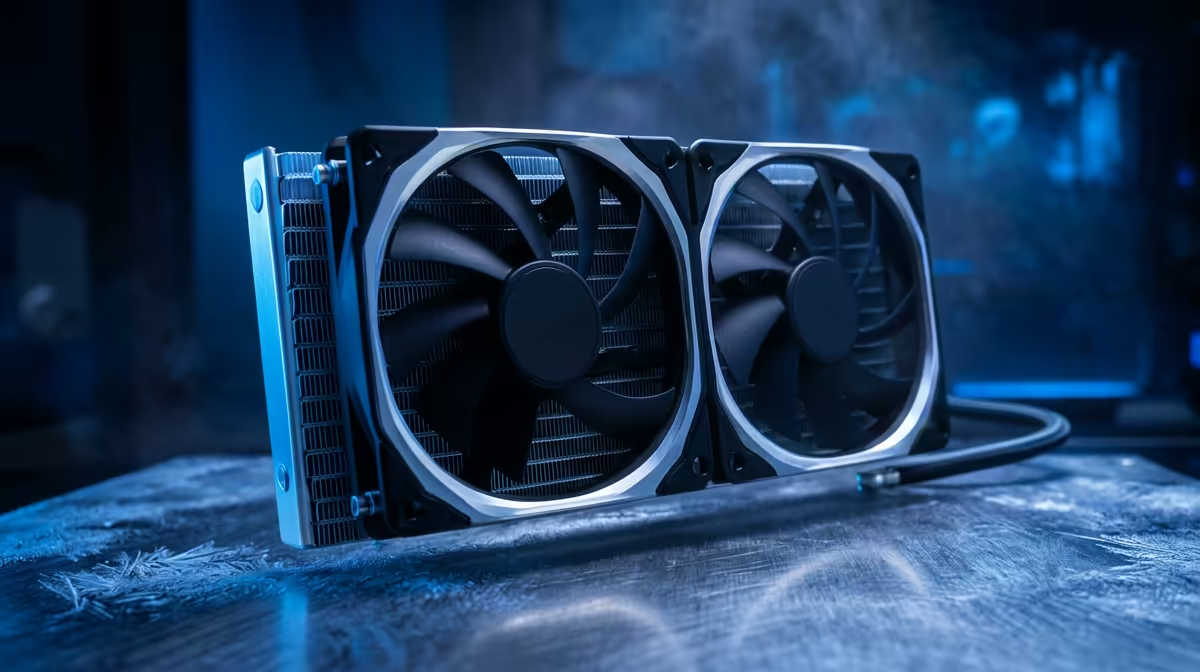
Radiator cooling capacity scales directly with fin surface area. A standard 360mm radiator (360 x 120mm, housing three fans) offers roughly 50% more surface area than a 240mm unit (240 x 120mm, housing two fans). In practical terms, this means the 360mm radiator can dissipate more watts of heat per degree Celsius of coolant-to-ambient temperature difference. Under a sustained Cinebench R24 all-core test, a Ryzen 9 9950X paired with a 240mm AIO stabilises around 94 to 97 degrees Celsius at full power, while the same processor on a 360mm AIO typically stabilises at 82 to 87 degrees Celsius, a difference that directly impacts thermal throttling and sustained clock speeds.
When a 240mm is the Smarter Choice 💡
For the majority of SA gaming rigs built around a Ryzen 5 7600X, Core i5-14600K, or Ryzen 7 9700X, a 240mm AIO sits in an ideal cost-to-performance position. These CPUs rarely sustain more than 90 to 110W during gaming, which the 240mm radiator handles with fans running at 60 to 70% speed. The cost difference between a quality 240mm and 360mm AIO in SA is typically R600 to R1,200, which can be better spent on a faster NVMe SSD or an additional stick of RAM. A 240mm AIO also fits in a wider range of mid-tower cases, including compact ATX builds where a 360mm position is absent.
Case Compatibility and Physical Constraints 🔩
Before choosing based on thermal needs, confirm your case supports the radiator size you intend to install. Most ATX mid-tower cases support 240mm in multiple positions but offer 360mm support only at the front or top. A 360mm top-mounted radiator in a case with a cramped interior can conflict with PSU cables routed through the top cable channel, which is a common frustration in South African pre-built and self-built scenarios where cable management space is limited. If your case guarantees a 360mm front intake position without conflicts, that is the preferred placement for cooling a high-TDP processor.
Pair the Right Processor with the Right Radiator Size ⚡
Match radiator size to your CPU's actual sustained TDP, not its marketing wattage. A Ryzen 7 9800X3D with its 120W TDP is perfectly served by a 240mm AIO in most ambient conditions. Moving to a 360mm purely for bragging rights when your CPU never needs it is money that could improve other parts of your build.
FAQ
Can a 240mm AIO cool an overclocked Core i7 processor?
Light overclocking on a Core i7-14700K at modest power limits (up to 150W) is achievable on a quality 240mm AIO, but temperatures will sit near 88 to 92 degrees Celsius under sustained load. For aggressive overclocking that pushes the i7-14700K beyond 180W, a 360mm AIO is the safer choice.
Does a 360mm AIO always cool better than a 240mm?
Generally yes, but the gap shrinks significantly when the CPU's TDP is below 125W. The larger performance differential appears only when the processor genuinely sustains high power draw. For efficiency-focused CPUs at stock settings, the additional cost of 360mm may deliver only 3 to 5 degree Celsius gains.
Is there any benefit to a 280mm AIO over these two options?
A 280mm AIO (two 140mm fans) sits between a 240mm and 360mm in cooling capacity and is a good fit for mid-tower cases that support 140mm fan positions but not 360mm. The slightly larger fan diameter allows quieter operation at similar airflow compared to 120mm fans, making it an attractive quiet-build option.
Not sure whether a 240mm or 360mm AIO fits your build?
Browse the full AIO cooler range at Evetech and filter by radiator size to find the right match for your CPU and case.