Two homes on the same street can have wildly different best answers to this question, because the real choice between 5G and fibre in South Africa comes down to what is physically available at your address and how much your connection's steadiness matters. Fibre still sets the standard for consistent, low-latency performance, but 5G fixed wireless installs in minutes with no trenching, which makes it the practical winner wherever fibre has not reached or never will.
Quick Answer
If fibre is available at your address, choose fibre. It delivers the lowest, steadiest latency, typically around 5 to 15ms on local networks, with no peak-hour throttling. Choose 5G fixed wireless when fibre is not an option or you need a connection running today, since it installs in minutes with no digging and runs roughly R599 to R1,299 a month.
Latency and consistency: fibre's home ground
For anything real-time, gaming, video calls, cloud applications, the metric that matters is not peak speed but how steady the connection stays. Fibre wins here clearly. A local fibre link delivers latency in the 5 to 15ms range with very low jitter, which is the clean, predictable behaviour competitive gaming and crisp video calls depend on.
5G has closed the speed gap and in a strong-signal area can match or beat entry-level fibre tiers on raw throughput. Where it still trails is consistency. Because it is a shared wireless medium, latency varies more and speeds dip when many users hit the same tower, especially at busy times. For a household that games seriously or works on constant calls, that variability is the deciding factor in fibre's favour.
Installation and availability: 5G's knockout punch
This is where 5G turns the tables. Fibre requires physical infrastructure run to your home, which means trenching, a wait for the provider, and the simple fact that if the line has not reached your suburb, you cannot have it at any price. Fibre availability across South Africa is still uneven, strong in established metro suburbs and thin or absent elsewhere.
5G fixed wireless needs none of that. You get a router, place it where the signal is strongest, and you are online in minutes with no digging and no installation crew. For a new estate, a rental where you will not commit to infrastructure, a rural or peri-urban address fibre has skipped, or anyone who needs a connection working this week rather than next month, that speed and flexibility is decisive. The plans are also typically month-to-month, so you are not locked in.
The spectrum reality in 2026
South African 5G fixed-wireless runs almost entirely on sub-6GHz spectrum, with the n78 band at 3.5GHz central to urban deployments. MTN's coverage now reaches roughly 40 percent of the South African population as of early 2026, with the network expanding into secondary and tertiary cities where fibre infrastructure remains thin. Rain operates its own dedicated 5G network of over 3,000 towers focused primarily on urban areas. Vodacom and Telkom also offer competing fixed-wireless packages, creating genuine price competition that was absent a few years ago.
Industry analysis projects that 5G will account for 67 percent of all residential fixed-wireless connections in South Africa by 2029, up from around 35 percent in 2024, driven by aggressive package pricing and the practical reality that fibre is unlikely to reach every suburb within the decade. That trajectory means the availability gap between 5G and fibre will close further, but the performance gap will narrow more slowly because it is inherent to the physics of wireless versus fibre. The point is that coverage has expanded significantly and is no longer a metro-only story, though signal quality still varies suburb to suburb.
Upload speeds and symmetry
One practical difference often overlooked is upload. Fibre plans in South Africa frequently offer symmetrical speeds, where your upload rate matches your download rate, which matters for cloud backups, large file transfers, video content creation, and long video calls where your stream quality depends on outbound bandwidth. 5G fixed wireless typically delivers lower upload than download, and the gap widens on congested towers. For a household where someone regularly uploads large files or hosts video meetings all day, fibre's upload symmetry has real daily value beyond the headline speed figure.
Price and the household question
On headline cost the two are close. Fibre packages start at roughly R600 a month for an entry tier and climb toward R1,500 for gigabit speeds, while 5G fixed wireless from the major operators runs in the R599 to R1,299 range. The difference is in behaviour: fibre gives you a consistent speed for a fixed fee with no surge pricing, whereas some 5G plans throttle at peak hours when the tower is congested.
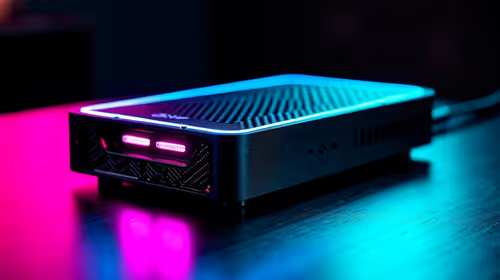
Match the technology to how your home uses the internet. A serious gaming or work-from-home household leans fibre for stability. A lighter household, or one where fibre simply is not available, gets excellent value and instant setup from 5G. Either way the right router matters, and you can compare both 5G-capable units and fibre routers in the networking range. Mesh nodes and adapters to extend either signal across a larger home sit among the accessories best sellers.
Frequently Asked Questions
Is 5G faster than fibre in South Africa?
In a strong-signal area, 5G can match or exceed entry-level fibre on raw speed. The difference is consistency: fibre holds steady latency and speed regardless of how many neighbours are online, while 5G can dip at peak times on a congested tower.
Why does fibre have lower latency than 5G?
Fibre carries data over a dedicated physical line straight to your home, giving latency around 5 to 15ms with low jitter. 5G is a shared wireless medium, so latency varies more and is generally higher and less predictable than a local fibre link.
When should I choose 5G over fibre?
Choose 5G when fibre is not available at your address, when you rent and do not want fixed infrastructure, or when you need a connection working immediately. It installs in minutes with no trenching and the plans are usually month-to-month.
How much does each cost per month?
Entry fibre starts around R600 and rises toward R1,500 for gigabit tiers, while 5G fixed wireless typically runs R599 to R1,299. Fibre charges a flat fee with no surge pricing, whereas some 5G plans throttle during peak hours.
Can I switch from 5G to fibre later?
Yes, and many households start on 5G for instant connectivity then move to fibre once it reaches their area. Because 5G plans are commonly month-to-month, switching is straightforward when fibre becomes available.
Whichever way your address points you, the router makes or breaks the experience. Browse the networking range at Evetech to find a 5G-ready or fibre router matched to your home and get the most from your line.