

AIO Liquid 240mm Setup and Configuration: Complete Tutorial
AIO Liquid 240mm Setup and Configuration. Clear setup instructions with SA-specific considerations, troubleshooting tips & recommended components.
Read moreDeciding on an 8-bit vs 10-bit monitor can be a challenge for any gamer. This guide breaks down the real-world difference in color depth, explains concepts like FRC, and helps you determine if a 10-bit panel will truly elevate your gaming experience or if it's an unnecessary expense. 🎨 Get the clarity you need to choose wisely!
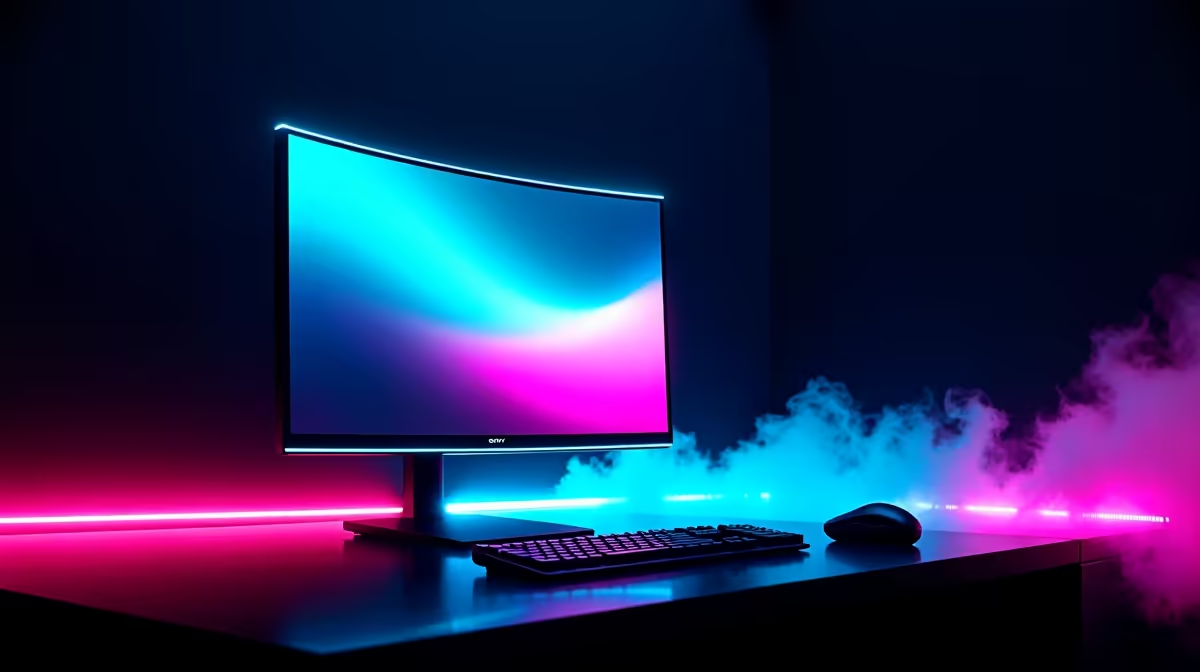
You've just dropped some serious cash on a beastly new GPU, ready to crank everything to Ultra. You launch your favourite AAA title, but something feels… off. The sunsets in Red Dead Redemption 2 don't quite melt, and the neon-drenched streets of Cyberpunk 2077 lack that vibrant punch. The culprit might not be your graphics card, but your monitor's colour depth. This is the heart of the 8-bit vs 10-bit monitor debate that every serious SA gamer faces.
Let's break it down without the confusing jargon. "Bit depth" refers to the amount of colour information your monitor can display for each of the three primary colours (red, green, and blue).
Think of it like a box of crayons 🖍️:
That massive leap from millions to billions means a 10-bit panel can show much smoother gradients and transitions between colours. You'll see less "colour banding"—those ugly, blocky steps you sometimes notice in a sky or a shadowy corner.
This is the big question. Does a billion colours actually make a difference when you're trying to clutch a 1v3 in Apex Legends? The answer is… it depends on the game you play.
For gamers who love visually rich, cinematic experiences, a true 10-bit monitor is a revelation. Think of games with stunning environments and realistic lighting:
In these titles, the enhanced colour depth makes the world feel more alive and immersive. It's especially crucial for getting the most out of High Dynamic Range (HDR) content. HDR requires that extra colour data to display those incredibly bright highlights and deep, detailed shadows simultaneously. Many of today's stunning 4K monitors leverage 10-bit colour to deliver breathtaking HDR performance.
For the competitive esports crowd, refresh rate and response time are far more important than perfect colour gradients. In games like CS:GO, Valorant, or Fortnite, you're focused on pixel-perfect aim and spotting enemies, not admiring the sunset. An 8-bit, high-refresh-rate monitor is often the smarter, more budget-friendly choice that gives you the competitive edge you need. The visual difference in these fast-paced titles is negligible, and you can put the money you save towards other performance-boosting components.
As you browse through all our gaming monitors, you'll often see "8-bit + FRC" listed in the specs. FRC, or Frame Rate Control, is a clever technology that lets an 8-bit panel simulate 10-bit colour. It rapidly flashes between two adjacent colours to create the illusion of an intermediate shade that the panel can't physically produce.
Is it as good as true 10-bit? No. A trained eye, especially a content creator's, can spot the difference. But for gaming, 8-bit + FRC is an excellent compromise, offering a noticeable improvement over standard 8-bit without the premium price tag of a native 10-bit display. You get smoother gradients and better HDR performance, making it a fantastic value proposition.
Owning a 10-bit monitor is only half the battle. You need to ensure your GPU and operating system are sending a 10-bit signal. In the NVIDIA Control Panel, go to 'Change Resolution', select your monitor, then choose 'Use NVIDIA colour settings'. Under 'Output colour depth', select the highest available option (hopefully 10 bpc). For AMD, you'll find a similar 'Colour Depth' setting in the Radeon Software under the 'Display' tab.
So, is the colour upgrade worth it? Let's wrap it up.
Ultimately, the right choice depends on your priorities and your budget. While some niche displays like portable monitors serve specific functions, your main gaming display deserves careful thought. Remember to also grab the right DisplayPort cable and other monitor accessories to ensure you're getting the best possible signal to your new screen.
Ready to See the Difference? The 8-bit vs 10-bit monitor debate comes down to your games, your creative needs, and your budget. Whether you're chasing cinematic beauty or competitive glory, the perfect display is waiting. Explore the best PC monitor deals in South Africa and find the screen that will bring your world to life.
For most users, the difference is subtle but noticeable in scenes with smooth gradients, like sunsets. 10-bit color reduces distracting "color banding," creating a smoother image.
It depends. For competitive FPS players, high refresh rates are more important. For gamers who love visually rich RPGs and HDR content, a 10-bit monitor is a worthy upgrade.
8-bit + FRC (Frame Rate Control) flashes between colors to simulate shades in-between. It's a clever way to approximate 10-bit color but isn't as accurate as a native 10-bit panel.
While not strictly required, a 10-bit panel is highly recommended for a true HDR experience. It can display the wider color gamut and luminance range that makes HDR content so stunning.
Yes. To get the full benefit, your GPU, monitor, cable (DisplayPort is best), OS, and the game or application itself must all support 10-bit color output.
Native 10-bit panels are typically more expensive. However, monitors using 8-bit + FRC technology offer a great middle-ground, providing a noticeable improvement over 8-bit.
AIO Liquid 240mm Setup and Configuration. Clear setup instructions with SA-specific considerations, troubleshooting tips & recommended components.
Read more
Setting Up DDR5 64GB Kit. Tested & verified settings for best FPS and visual quality on SA hardware budgets.
Read more
Overwatch 2 Setup Guide Gamers. Clear setup instructions with SA-specific considerations, troubleshooting tips & recommended components.
Read more
R and RStudio on Mac: Data Science Setup Guide. Clear setup instructions with SA-specific considerations, troubleshooting tips & recommended components.
Read more
NVIDIA Broadcast Setup with GPU: Streamer Guide. Clear setup instructions with SA-specific considerations, troubleshooting tips & recommended components.
Read more
Core Ultra 7 265K Temperature Guide: Normal Range. Complete product range with SA pricing, key specs & recommendations for different budgets.
Read more
AMD RX 9050 XT: Rumoured Specs, Price & Release. SA-focused analysis with local pricing data, real-world insights & actionable buying advice.
Can RTX 4080 Super Run AI Workloads for SA Developers Detailed answer with SA data, expert analysis & practical recommendations for local buyers.
Can RTX 4090 Run AI Workloads for SA Developers Detailed answer with SA data, expert analysis & practical recommendations for local buyers.
Top Settings for Intel Arc B580 at Ultrawide 1440p picks evaluated on performance, value & SA availability with current Rand pricing from Evetech.
RTX 4060 CS2 Low Settings at 1080p: FPS Results. Real-world benchmark data, FPS numbers & performance analysis. What SA gamers can actually expect.
Visual Artifacts: Possible GPU Issue Issue #1. Diagnosis steps, proven fixes & when to seek professional help. SA-specific support info included.
Can the RTX 4090 Handle 1440p 144Hz Gaming. Performance testing verdict with real data & practical recommendations for SA buyers.
Top ASUS GPU Under R15000 picks evaluated on performance, value & SA availability with current Rand pricing from Evetech.
GTA 6 Max Settings on RTX 5070. Tested & verified settings for best FPS and visual quality on SA hardware budgets.
Cyberpunk 2077 Max Settings on RTX 5080. Tested & verified settings for best FPS and visual quality on SA hardware budgets.
Starfield Max Settings on RTX 5070 Ti. Tested & verified settings for best FPS and visual quality on SA hardware budgets.
Top RTX 5090 Under R5000 picks evaluated on performance, value & SA availability with current Rand pricing from Evetech.