Quick Answer
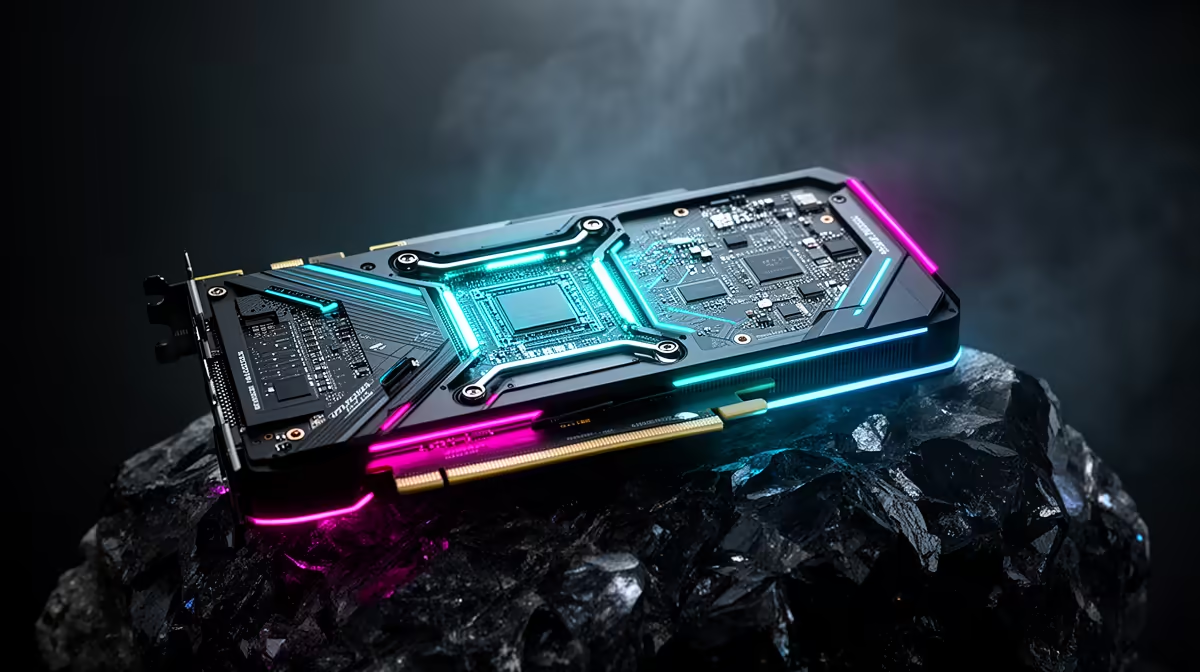
5th-generation Tensor Cores in NVIDIA's Blackwell RTX 50-series GPUs are AI matrix multiplication hardware units optimised for sparse matrix operations, which is exactly what DLSS 4 Multi Frame Generation requires. Compared to 4th-generation units in Ada Lovelace, they enable real-time AI frame generation on mid-range RTX 5060-tier hardware.
What Tensor Cores Are and Why Generation Matters 🤖
Tensor Cores are dedicated hardware blocks that accelerate matrix multiplication at very high throughput, running in parallel with shader cores without competing for the same execution resources. 5th-generation Tensor Cores in Blackwell improve sparse matrix operation throughput specifically, because the neural network models DLSS 4 uses have sparse weight matrices that allow reduced computation while maintaining output quality.
The practical result: an RTX 5060 with 120 Tensor Cores can generate up to three additional frames between each rendered game frame as a separate execution domain from shader cores. A 60 fps native output becomes 240 perceived fps in supported titles. MFG is exclusively an RTX 50-series feature.
5th-Gen Tensor Cores for Gaming: DLSS 4 in Practice 🎮
DLSS 4 Multi Frame Generation uses Tensor Core compute to infer motion vectors, extrapolate scene content, and synthesise pixel output for moments the game engine never rendered. For SA gamers on 144 Hz or 165 Hz monitors, this transforms an entry-tier card's output to well above the display refresh rate in supported titles. DLSS Reflex integration minimises the latency increase: at 60 to 80 native fps with MFG x3, the latency increase is typically 5 to 15 ms, within the perception threshold for most players.
5th-Gen Tensor Cores for Content Creation 🖥️
In DaVinci Resolve, Tensor Core-accelerated noise reduction and neural engine features run faster on 5th-generation Blackwell hardware than on 4th-generation Ada equivalents. For SA video editors working in Resolve, this reduces preview and export rendering time when AI tools are active. Stable Diffusion SDXL image generation is measurably faster on an RTX 5060 than an RTX 4060 at the same model and image size due to improved Tensor Core throughput.
Enable Tensor Core Acceleration in DaVinci Resolve ⚡
In DaVinci Resolve Preferences, confirm GPU processing mode is set to CUDA with your RTX card selected. In Stable Diffusion webUIs such as ComfyUI, enable xformers in the launch arguments to activate Tensor Core-optimised operations. These settings can double AI generation throughput on Blackwell cards versus default configurations.
FAQ
Can Tensor Cores be used for general computing tasks?
Only if the workload is structured as matrix math. Programs using NVIDIA's CUDA libraries for neural networks, signal processing, or scientific computing can access Tensor Core throughput. General-purpose code that does not restructure as matrix operations cannot use Tensor Cores directly.
Do Tensor Cores degrade over time?
No. Tensor Cores are silicon transistors like any other GPU component and do not wear out faster from normal compute or gaming use. Primary GPU aging factors are thermal cycling and electromigration, addressed by proper cooling.
Is the DLSS 4 output quality improvement visible over DLSS 3.5?
Yes. The DLSS 4 transformer model produces sharper fine detail and less ghosting on fast-moving objects. DLSS upscaling quality improvements are available to RTX 40-series through driver updates; however, MFG with x3 frame generation requires RTX 50-series hardware specifically.
Want 5th-generation Tensor Core performance for gaming and creative work?
Evetech stocks the full Blackwell RTX 50-series lineup from the RTX 5060 to the RTX 5090 with local SA warranty. Browse the graphics card section to find the right Tensor Core tier for your workload.