Quick Answer
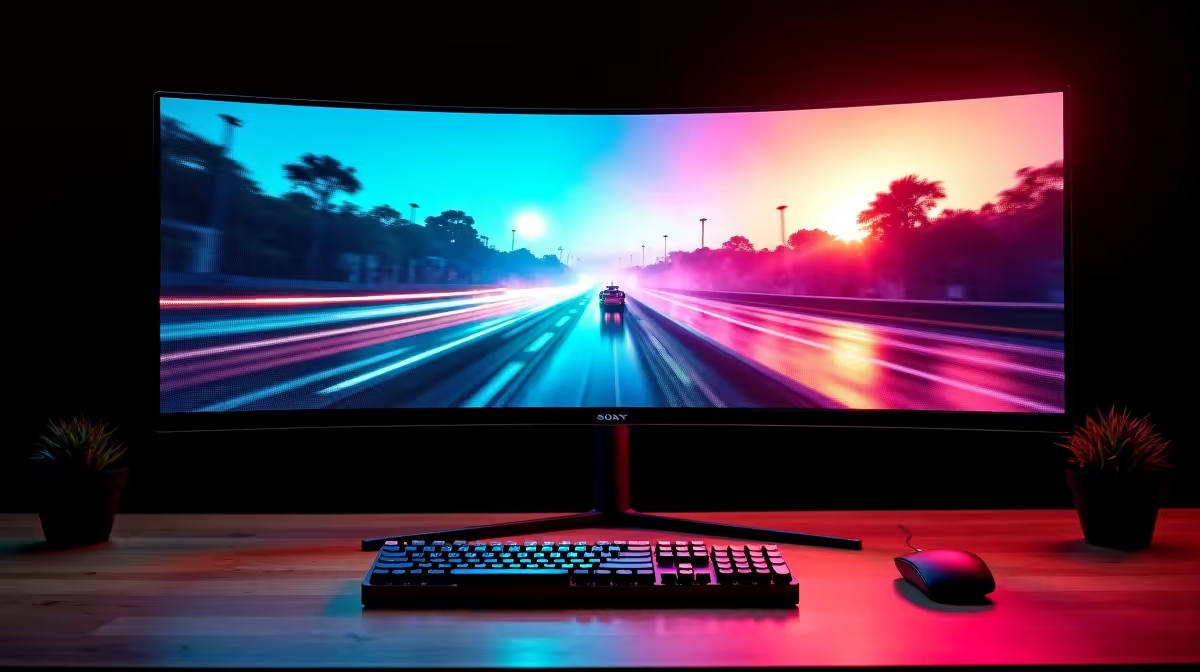
3840x1080 is a 32:9 dual-FHD ultrawide resolution found primarily on 49-inch monitors. It gives you the panoramic field of two 1920x1080 displays merged into one bezel-free screen, but its pixel density of around 87 PPI on a 49-inch panel is noticeably softer than QHD alternatives at the same size, making it better suited for immersive gaming than sharp productivity work.
Pixel Density and Sharpness at 3840x1080 🔍
At 87 PPI on a 49-inch screen, individual pixels become visible at close viewing distances of under 60 cm. Text and UI elements appear soft compared to a 5120x1440 panel at the same physical size (which hits around 109 PPI). For productivity tasks like document editing, coding, or spreadsheet work, this softness is a real limitation over a full workday. For gaming, the lower pixel density is far less noticeable when camera motion and action fill the screen. Older VA-panel 49-inch models using 3840x1080 typically start at around R8,000 to R12,000 at Evetech, making them significantly more affordable than the 5120x1440 alternatives.
Game Compatibility at 32:9 Aspect Ratio 🎮
3840x1080 uses the same 32:9 aspect ratio as 5120x1440. Game compatibility is therefore identical: a game that supports 32:9 will run at 3840x1080 or 5120x1440 depending on which resolution you select. Racing simulators, flight sims, and space games like Elite Dangerous offer native 32:9 support that genuinely transforms the experience. First-person shooters are mixed: some titles allow the wider aspect but show a competitive advantage from the extended horizontal FOV; others stretch the image or lock to 16:9. Always check your game's settings menu before assuming ultrawide support.
GPU Load and Frame Rate Reality 💻
3840x1080 has approximately 4.1 million total pixels, compared to 7.4 million in 4K. This makes it considerably lighter on GPU resources than 4K and roughly 60% more demanding than standard 1080p. An RTX 4060 or RX 7700 XT can comfortably hit 100-plus fps at 3840x1080 in most titles at high settings, which is notably more achievable than chasing high frame rates at 5120x1440. For South African gamers on mid-range budgets, this resolution-to-GPU-cost trade-off can be genuinely attractive: you get the ultrawide panorama without needing an R15,000-plus GPU.
Set Your Desktop Scaling Correctly ⚡
Windows 11 at 3840x1080 defaults to 100% scaling, which can make desktop icons and taskbar text very small. Set display scaling to 125% in Settings under System, then Display, then Scale, to get comfortable desktop proportions without excessive UI blurring.
FAQ
Is 3840x1080 good enough for streaming and content watching?
For movies and streaming content the wider field of view is immersive, but most video content is mastered in 16:9 and will display with black bars on the sides at 32:9. Some streaming platforms support 21:9 but not 32:9 natively. Gaming and sim content benefit most from this resolution.
Can I use 3840x1080 for dual-screen productivity?
Yes, it works well for side-by-side app layouts if you use window snapping. The limitation is text sharpness: if you spend most of your day reading documents or writing code, consider stepping up to 5120x1440 for the same footprint with meaningfully sharper output.
What refresh rate do 3840x1080 monitors typically offer?
Most 3840x1080 panels are 60Hz or 100Hz. A few models reach 144Hz. For smooth gaming you want at least 100Hz, and enabling FreeSync or G-Sync Compatible adaptive sync removes tearing at variable frame rates below the monitor's cap.
Considering a 49-inch ultrawide for your setup?
Evetech stocks 32:9 ultrawide monitors at multiple price points, including 3840x1080 and 5120x1440 options, available for online order with delivery across South Africa.