Quick Answer
ATX 3.1 is a PSU design specification covering transient load handling and voltage hold-up. PCIe 5.1 is the slot and connector standard covering bandwidth and power delivery. The 12V-2x6 is the physical 16-pin connector that formalises high-wattage GPU power delivery under both standards. You need all three to be current when building a system around an RTX 5090 or RX 9000-series flagship.
ATX 3.1 Explained: What the PSU Must Do 🔧
ATX 3.1, published by Intel, sets requirements for what a PSU's power circuitry must withstand. The headline requirement is transient response: the PSU must handle a 200 percent peak load event for up to 100 microseconds without triggering overcurrent protection or shutting down. Modern GPUs create these spikes during rapid shader loading, which ATX 2.x PSUs were not designed for. ATX 3.1 also tightens voltage hold-up time, requiring the PSU to maintain stable output for at least 17 milliseconds after mains power drops, giving the system time to save state. In South Africa, where minor grid fluctuations can occur, this hold-up requirement provides extra resilience.
PCIe 5.1 Explained: Bandwidth and Connector Standards 🔌
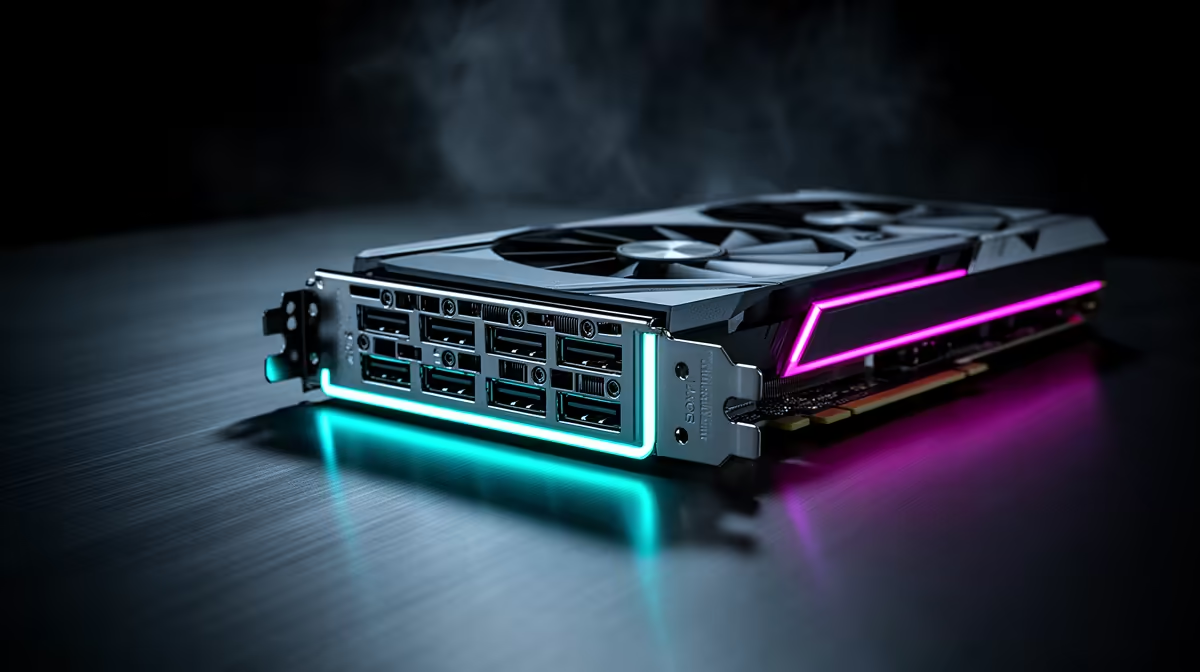
PCIe 5.1 is PCISIG's slot specification, most visible in the 16x GPU slot and the M.2 storage interface. For GPUs, PCIe 5.1 doubles the per-lane bandwidth of PCIe 4.0 to 64 GT/s per lane, giving the 16x slot a theoretical 256 GB/s bidirectional bandwidth. In current gaming, GPU bandwidth from the slot rarely saturates even PCIe 4.0 capacity, so 5.1 is forward-looking infrastructure. More immediately relevant is the PCIe 5.1 power connector specification, which formally standardises the 12V-2x6 design with shorter sense pins and tighter impedance tolerances for delivering up to 600W safely.
The 12V-2x6 Connector: Why It Replaces 12VHPWR 💡
The 12VHPWR connector, introduced with PCIe 5.0 and the RTX 40-series, encountered partial-insertion reliability concerns at 600W. The 12V-2x6 addresses this with shorter sense pins that cannot make electrical contact unless the connector is fully and correctly seated. This eliminates the main failure mode of the predecessor. The connector looks nearly identical from the outside, but the shortened sense-pin length is the distinguishing physical feature. PSUs made in 2024 onward targeting 600W GPU compatibility ship with native 12V-2x6 cables rather than the earlier 12VHPWR design. When buying in South Africa, confirm the connector label in the PSU specification sheet.
Inspect the Connector Label on Your PSU Cable ⚡
Turn the modular cable over and look for the printed label or moulded marking on the GPU connector head. A cable marked "12V-2x6" has the updated shorter sense pins. A cable marked "12VHPWR" has the older design. Both work for RTX 50-series, but the 12V-2x6 provides better mechanical insurance at 600W TDP cards like the RTX 5090.
FAQ
Do I need PCIe 5.1 to use a 12V-2x6 connector?
No. The 12V-2x6 connector is a physical cable specification that can be included with any PSU regardless of the motherboard's PCIe slot generation. The connector specification is defined by the PSU and GPU hardware, not the slot bandwidth standard.
Can I use a PCIe 5.0 motherboard with an ATX 3.1 PSU?
Yes. ATX 3.1 PSUs are fully backward compatible with PCIe 4.0, 5.0, and older platforms. The transient response and hold-up requirements are internal PSU design features that do not affect slot compatibility.
What happens if I use an ATX 2.x PSU with an RTX 5090 in South Africa?
If the ATX 2.x PSU has sufficient wattage and a native 12V-2x6 output, it will power the card. The risk is that the older PSU design may trip overcurrent protection during GPU power spikes, causing system reboots. For a card costing R45,000 to R55,000 in SA, pairing it with an ATX 3.1 certified PSU is the recommended approach.
Navigating ATX 3.1 and PCIe 5.1 ready power supply options?
Evetech stocks a curated range of compliant power supplies for current and next-gen GPU builds, with local SA warranty support.