The line between laptop and desktop gaming is getting blurrier. For years, "integrated graphics" meant you could barely run Minecraft. But now, the Intel Arc A380 iGPU vs GPU debate is heating up a new question for South African gamers: can a slim, modern laptop finally deliver a proper gaming experience without a dedicated graphics card? Let's dive in and see if these new integrated powerhouses are ready for the big leagues. ⚡
Understanding the New Wave: What is Intel Arc Integrated Graphics?
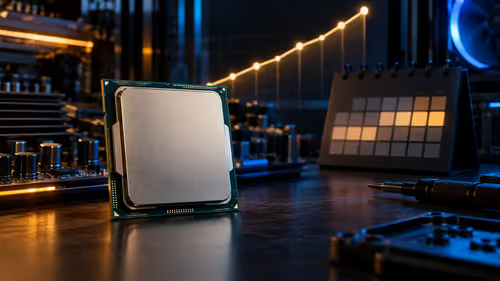
Before we compare, let's clarify what we're talking about. An Integrated Graphics Processing Unit (iGPU) is a graphics solution built directly onto the same chip as the CPU. It shares system memory (RAM) instead of having its own dedicated video memory (VRAM).
Historically, this meant poor performance. But Intel's Arc graphics, built on their new Xe-HPG architecture, are a different beast. They bring features previously reserved for dedicated cards, like hardware-accelerated ray tracing and AI-powered XeSS upscaling, to the integrated space. This makes the Intel Arc A380 iGPU vs GPU conversation more relevant than ever, especially for portable setups.
The A380 iGPU vs. a Dedicated GPU: A Practical Showdown
So, how does the integrated Arc A380 stack up against a traditional, separate graphics card? The answer depends entirely on what you play and what you expect.
Performance & Use Case
For popular esports titles like Valorant, CS2, or League of Legends at 1080p resolution, the Arc A380 iGPU delivers a surprisingly playable experience. You can expect smooth frame rates on medium settings, making it perfect for casual or competitive play on the go.
However, for graphically intense AAA titles like Cyberpunk 2077 or Alan Wake 2, a dedicated card is non-negotiable. The sheer power, dedicated VRAM, and mature drivers of cards from NVIDIA's GeForce lineup or AMD's Radeon family provide the muscle needed for high resolutions and ultra settings. While an iGPU sips power, a dedicated GPU drinks it to deliver maximum performance. 🚀
Optimise Your iGPU Power
To get the most out of your Intel Arc iGPU, make sure you're running in dual-channel memory mode. Because iGPUs use system RAM, having two sticks of fast RAM gives them double the bandwidth, significantly boosting frame rates.
Cost and Convenience
This is where the Arc iGPU truly shines. A laptop featuring these powerful integrated graphics is often thousands of Rands cheaper than one with a mid-range dedicated GPU. You get a thinner, lighter, and more power-efficient machine that can still handle a solid gaming session after a day of lectures or work. For many, this is the perfect compromise.
Of course, for those building a rig from the ground up, the flexibility of a desktop is unmatched. You can start with a powerful CPU and add a graphics card later, or go all-in on one of our pre-built Intel Arc gaming PCs for balanced performance right out of the box.
The Verdict: Who Wins the iGPU vs. GPU Battle?
So, can laptops win? For a huge portion of the PC gaming community, the answer is a resounding yes. The latest integrated graphics from Intel have made casual and esports gaming on thin-and-light laptops a fantastic reality. The debate between an Intel Arc iGPU vs a dedicated GPU isn't about one being better, but about which is better for you.
If you're a student, a frequent traveller, or a budget-conscious gamer who sticks to esports titles, a laptop with Arc graphics is an incredible value proposition. ✨
However, if you're a hardcore enthusiast, a streamer, or a content creator who demands uncompromising performance and visual fidelity, the crown still belongs to desktops equipped with powerful, discrete graphics cards. The raw power and dedicated architecture are simply in a different league.
Ready for a Real Power Upgrade?
If your gaming ambitions demand more muscle, exploring dedicated graphics is your next step. Check out our latest and best graphics card deals for performance that leaves lag in the dust.