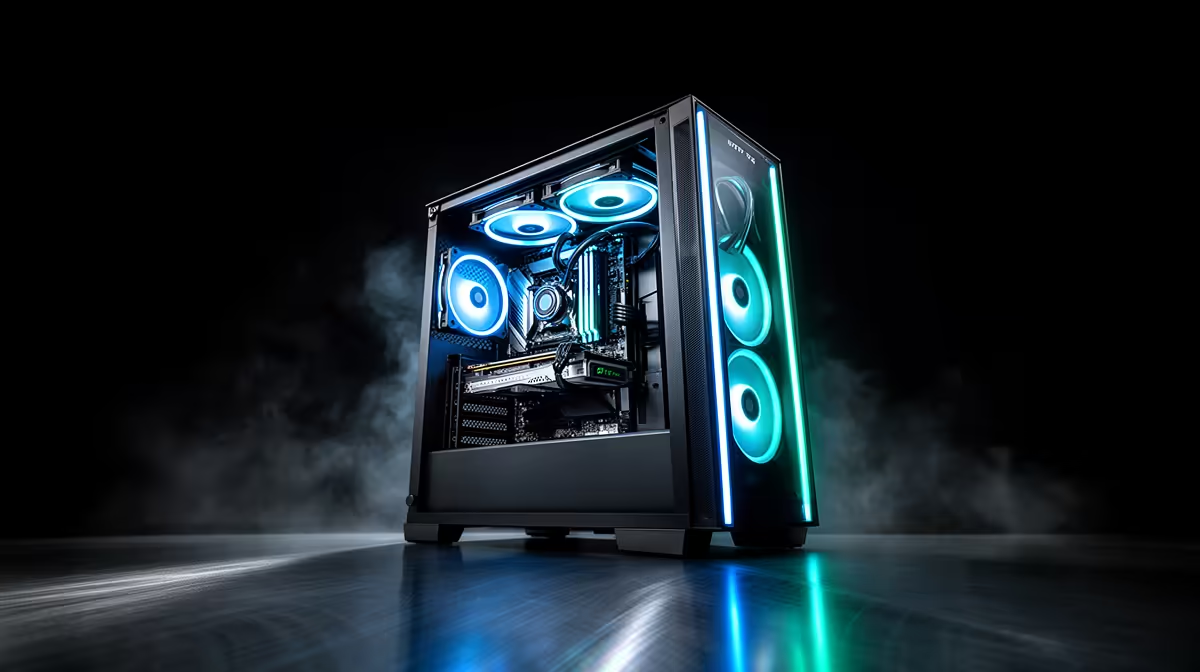
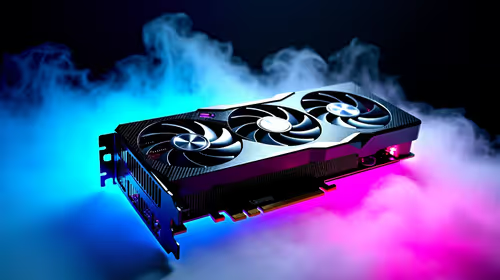
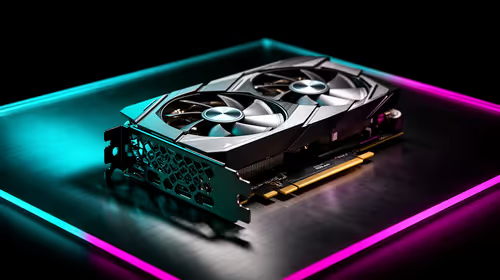
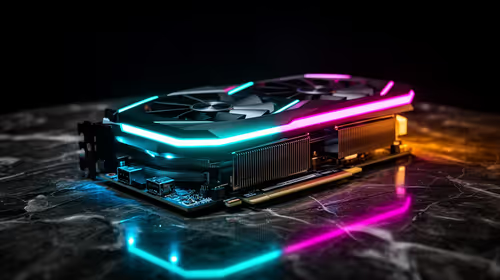
Cloud coding assistants bill by the token, and a founder shipping code all day watches that meter spin in dollars that land on a Rand card. A local AI coding build flips the model: you pay once for a graphics card, then run a capable assistant on your own machine with no per-request charge and nothing leaving your network. The card that makes this practical today is the RTX 5090, whose 32GB of GDDR7 holds a serious coding model entirely in memory.
Quick Answer
An RTX 5090 with 32GB of VRAM runs a 32B parameter model at Q4 quantisation, which occupies roughly 19 to 20GB and generates around 61 tokens per second at a working context size. That is fast enough for real coding assistance, it costs nothing per token after the hardware, and your source never touches a third party server.
Why the token meter is the real cost
A cloud coding subscription looks cheap until you measure a founder's actual usage. Long context windows, repeated file edits, agentic loops that re-read a codebase on every step, and a habit of asking for one more refactor all add tokens. For a solo founder living in their editor, monthly bills creep from comfortable to uncomfortable, and they scale with how productive you are, which is the wrong incentive. The more you build, the more you pay.
A local build breaks that link. Once the card is in the case, an extra thousand prompts cost the same as zero prompts: the electricity to keep the GPU busy for a few more minutes. For a founder who codes daily over months and years, the one-time spend amortises into something the cloud cannot match, unlimited local inference at a flat hardware cost.
The card that makes it work
The reason this build hinges on one specific GPU is memory. A language model runs at full speed only when its weights sit entirely in VRAM. The moment the model spills into system RAM, throughput collapses from useful to unusable. The RTX 5090's 32GB is the figure that matters, because it comfortably fits a 32B model at Q4 with headroom left for the context window and the operating system's own GPU use.
Capacity is only half the story. The 5090 pairs that 32GB with around 1,792 GB/s of memory bandwidth, which is the number that governs how fast tokens come out once the model is loaded. Token generation is bandwidth-bound, so that figure, roughly 77 percent more than the previous generation flagship, is why the same model that crawls on a smaller card streams smoothly here. In practice a dense 32B model at Q4 generates close to 61 tokens per second at a few thousand tokens of context, which reads on screen faster than most people speak and keeps pace with an interactive coding session. If sourcing parts individually is not your preference, the AI PC range at Evetech offers complete GPU-forward systems built around exactly this kind of local inference workload.
What a 32B model can actually do for code
A 32B parameter model at Q4 is the sweet spot for local coding right now. It is large enough to understand a real codebase, follow multi-file context, write functions that compile, explain unfamiliar code, and handle the back-and-forth of refactoring. It is small enough to fit one consumer card and respond at conversational speed. Modern 32B coding models hold their own on day-to-day tasks: scaffolding, test generation, bug hunting, and the constant small questions that otherwise interrupt your flow.
It is not a frontier model, and being honest about that matters. For the hardest reasoning, the largest architectures, or the most exotic problems, a top-tier cloud model still pulls ahead. The local build's pitch is not that it beats everything, it is that it handles the overwhelming majority of a founder's daily coding for free, privately, and instantly, leaving the cloud for the rare heavy lift.
Quantisation in plain terms
Q4 means the model's weights are compressed to roughly four bits each instead of the full sixteen, shrinking the memory footprint by about four times with only a small quality cost. This is what lets a 32B model fit in 32GB rather than needing 60GB-plus. For coding work the quality drop at Q4 is minor and usually invisible in practice, making Q4 the near-universal choice for running capable models on a single consumer card.
Context window matters as much as the model
A coding assistant is only as useful as the amount of your project it can hold in mind at once. The 5090's spare VRAM after loading the model goes toward context, letting you feed in larger files and longer conversations before the model starts forgetting the start of the thread. Founders working in big repositories feel this directly: a generous context window means fewer re-explanations and more answers that actually account for how your code is structured.
Privacy and control, not just cost
For a founder, the privacy angle can outweigh the money. A local model means your proprietary code, your unreleased features, and your customer logic never leave the building. There is no question of what a vendor retains, no data residency worry, and no dependency on someone else's uptime or pricing decisions. You own the stack end to end, which for early-stage IP is a genuine advantage rather than a nice-to-have.
Control extends to availability. A cloud outage or a sudden rate change cannot stall your work. The model runs as long as your machine runs, at a speed you have measured and can rely on. The best selling PCs give a clear picture of current pricing and the configurations that SA builders are choosing for GPU-intensive work.
Who this build suits and who should wait
This makes sense for a founder or developer who codes most days, values privacy, and is tired of a metered bill that grows with their productivity. The upfront hardware cost is real, so the maths works best for sustained, long-term use rather than occasional dabbling. If you code only now and then, a pay-as-you-go cloud tier may still be cheaper in absolute terms.
It also suits anyone whose work simply cannot leave their premises for compliance or confidentiality reasons, where the local option is less about saving money and more about being the only acceptable answer.
Frequently Asked Questions
Will a 32B local model replace a top cloud coding model entirely?
For most daily coding, yes, it handles scaffolding, refactoring, tests, and explanations well. For the hardest reasoning tasks a frontier cloud model still leads, so the realistic setup is local for the bulk of work and cloud reserved for occasional heavy lifts.
Why does the model have to fit in VRAM?
Once any part of the model spills into system RAM, generation speed drops sharply because system memory is far slower than the GPU's. Keeping the full model in the 5090's 32GB is what sustains the roughly 61 tokens per second that makes the assistant feel responsive.
What does Q4 quantisation cost in quality?
Very little for coding. Q4 compresses the weights to about four bits each, cutting memory use by roughly four times, while the accuracy loss on practical coding tasks is small and usually unnoticeable in normal use.
Do I need two GPUs for this?
No. The point of the 32GB card is that a single GPU holds a 32B model at Q4 with room for context. Dual-GPU rigs are for much larger models, not the 32B class this build targets.
Is the running cost really just electricity?
Effectively, yes. After the one-time hardware purchase, every prompt costs only the power to run the GPU for the seconds it works. There is no per-token charge and no subscription, which is the entire reason founders move local.
Stop paying per token and own your AI coding stack outright. Explore the AI PC range at Evetech to find an RTX 5090 build ready for local inference, and turn a recurring cloud bill into a one-time investment.