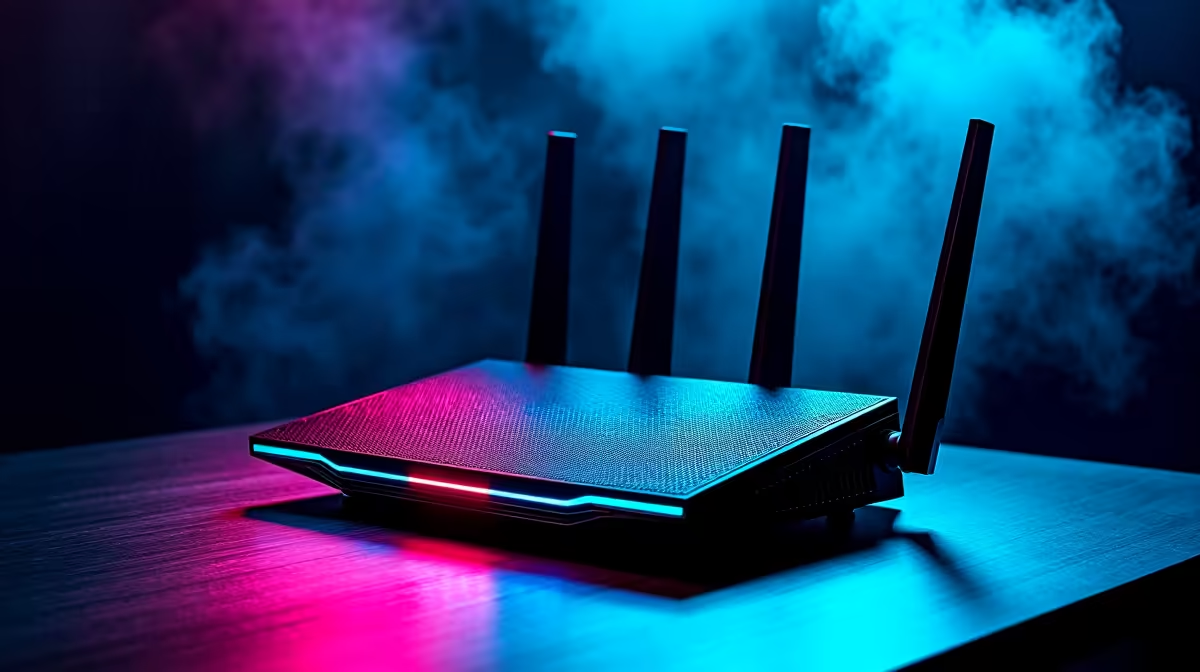
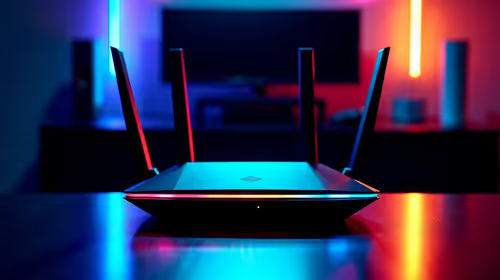
A double-storey house in Joburg or a sprawling single-level home in the Cape almost always defeats a single router, leaving cold spots in the far bedroom and dead air upstairs. The fix for a 5G router and mesh setup is to pair a 5G CPE, which pulls in the mobile signal, with mesh nodes that blanket the whole house in one seamless network, so you roam from the lounge to the upstairs study without dropping a connection.
Quick Answer
For whole-home coverage from a 5G connection in a large SA house, pair a 5G CPE router with a multi-node mesh system. The CPE handles the internet link via its SIM, while the mesh nodes spread one continuous Wi-Fi network across every floor and far room. A Wi-Fi 7 mesh such as a TP-Link Deco tri-band set covers a large home comfortably, with nodes placed roughly one per floor or zone.
Why one router never covers a big house
Wi-Fi signal weakens fast through brick walls and across floors, both common in larger SA homes. A single router sitting near the front of the house simply cannot push a usable signal to the opposite corner or the storey above, which is why you get full bars in one room and buffering in another. Adding range extenders helps a little but creates separate networks you have to switch between manually.
A mesh system solves this properly. Multiple nodes share one network name and hand your devices off automatically as you move, so a video call survives the walk from kitchen to bedroom. For a large home, that seamless roaming is the whole point. The networking range at Evetech carries both the 5G routers and the mesh systems that make this work together.
How the 5G CPE and mesh fit together
The 5G CPE as your internet source
A 5G CPE (customer premises equipment) is a router with a SIM slot that connects to a mobile 5G network for your internet, useful where fibre is not available or as a fast alternative. It receives the 5G signal and converts it into a local network. Some CPE units, like Huawei's, can build their own whole-home mesh, but the more flexible approach is to let the CPE handle the connection and a dedicated mesh handle coverage.
Letting a dedicated mesh do the coverage
Run the 5G CPE in a mode that passes the connection through to a capable mesh system, then let the mesh blanket the house. A Wi-Fi 7 tri-band mesh such as a TP-Link Deco set is a strong choice for large homes, using its extra band as a fast dedicated backhaul between nodes so coverage does not come at the cost of speed. Major mesh brands available locally, including TP-Link, Netgear, and others, all work with SA networks and simply connect to the router you are feeding them from.
Specific TP-Link Deco options worth knowing
TP-Link's Deco range is well represented in SA. The Deco X80-5G integrates a 5G modem with a Wi-Fi 6 mesh gateway in a single unit, so you can insert a SIM and have both your internet source and your home mesh in one box. For a large home that wants the simpler setup, one Deco X80-5G as the primary node paired with additional Deco units gives whole-home coverage without needing a separate CPE. The Deco X50-5G is the more compact option in the same family, better suited to medium-sized homes where a slightly lower ceiling speed is fine.
Placing the nodes for full coverage
Position the main node centrally and near the CPE, then place additional nodes about one per floor or one per problem zone, keeping each within solid signal range of the next. In a double-storey home, a node upstairs roughly above the main one carries the signal up cleanly. Wired backhaul between nodes, where your home has Ethernet runs, gives the most reliable result. For the cabling and adapters to wire backhaul or position gear neatly, the accessories best sellers at Evetech cover the extras.
How many nodes and what speed to expect
A typical large SA home is well served by a two or three node mesh. A three-pack tri-band Wi-Fi 7 set covers a sizeable multi-room home with margin to spare. Your real-world speed is ultimately capped by the 5G signal the CPE pulls in, so position the CPE where reception is strongest, often near a window facing the nearest tower, and let the mesh distribute that connection evenly rather than fighting walls from one corner.
Troubleshooting a weak 5G signal before adding mesh
One trap to avoid: buying a mesh will not fix a poor 5G signal. If the CPE is pulling in weak or inconsistent reception, the mesh nodes simply redistribute a bad connection more evenly. Before investing in extra nodes, place the CPE at a high point near a window facing the nearest mast and run a speed test. If speeds jump, placement was the issue. If speeds remain low even in an optimal spot, you may need an outdoor CPE or an external antenna before the mesh will make a meaningful difference.
Frequently Asked Questions
Do I need both a 5G router and a mesh system?
For a large home, yes. The 5G CPE provides the internet connection, while the mesh nodes spread that connection across the whole house as one seamless network. A single CPE rarely covers a big home alone.
How many mesh nodes for a double-storey house?
Usually two or three. Place one centrally near the CPE and another roughly above it on the upper floor, adding a third for distant wings. A three-node tri-band set suits most large homes.
Will mesh slow down my 5G connection?
A good tri-band mesh uses a dedicated backhaul band between nodes, so coverage does not sacrifice speed. Your ceiling is set by the 5G signal itself, which is why CPE placement near strong reception matters most.
Can I wire the mesh nodes together?
Yes, and it is the most reliable setup. If your home has Ethernet runs, connecting nodes by cable (wired backhaul) frees the wireless bands for your devices and gives steadier speeds.
Does mesh work with any SA network?
Yes. The 5G CPE handles the mobile connection via its SIM, and major mesh brands sold locally simply connect to whatever router or CPE feeds them, so they work across SA networks.
Blanketing a large SA home in fast, seamless Wi-Fi is a matter of pairing the right 5G router with the right mesh. Explore the networking range at Evetech to match a 5G CPE with a multi-node mesh system sized for your home's layout.