Running a chatbot or image generator on your own machine, with no cloud bill and no data leaving the desk, has stopped being a niche trick and become a real reason to buy a PC. The AI PC for everyday local AI is built around three numbers most spec sheets now print proudly: 16GB of RAM, a fast SSD, and an NPU rated above 40 TOPS. Get those right and a laptop or desktop can run useful local models without breaking a sweat.
Quick Answer
A capable everyday AI PC needs at least 16GB of RAM, a fast NVMe SSD, and an NPU delivering 40 or more TOPS. Qualifying chips include the AMD Ryzen AI 300, Intel Core Ultra 200V, and Qualcomm Snapdragon X. For the most capable local AI, add a discrete GPU with 8GB or more of VRAM, since larger models lean on the graphics card.
What The NPU Actually Buys You
The NPU, or neural processing unit, is a dedicated block on modern chips built to run AI tasks efficiently. Its rating in TOPS, trillions of operations per second, signals how much AI work it can chew through. Microsoft's Copilot+ tier sets the bar at 40 TOPS, and that figure is the practical floor for smooth on-device features like live captions, image cleanup and small assistant models.
The reason the NPU matters is efficiency, not peak power. It runs sustained AI tasks at a fraction of the wattage a CPU or GPU would draw, which on a laptop means these features can stay on without melting the battery. For background AI that hums along all day, the NPU is the right tool.
The Three Qualifying Chip Families
Three platforms currently clear the bar for an everyday AI PC, and each has a character.
AMD Ryzen AI 300
Ryzen AI 300 chips pair a strong NPU with capable integrated graphics and solid multi-core performance. They suit people who want one machine that runs local AI features and still games or edits respectably on the integrated GPU. They tend to land in well-rounded thin-and-light laptops, and the 50 TOPS-plus NPU rating comfortably clears the Copilot+ threshold.
Intel Core Ultra 200V
Intel's Core Ultra 200V series focuses on battery life and quiet, efficient AI acceleration. If your priority is a laptop that runs cool, lasts a long day, and handles Copilot+ features without fuss, this family fits. It is a sensible mainstream pick, with strong software support across the Windows ecosystem.
Qualcomm Snapdragon X
Snapdragon X brings Arm-based efficiency and very long battery life, with a powerful NPU that exceeds 45 TOPS on the top-tier variants. The trade-off is that some older Windows apps run through emulation, so check that your essential software has a native Arm version before committing. For anyone whose workflow runs on modern apps, the battery life advantage is real and noticeable.
Why RAM And Storage Round Out The Build
The NPU is the headline, but it does not work alone. Local AI models load into memory, and 16GB is the sensible minimum because the model, the operating system and your other apps all share that pool. If you plan to run larger language models locally, 32GB makes life far smoother, particularly for anything in the 13B parameter range or above.
A fast NVMe SSD matters because models are large files that must be read quickly when they load. A 7B model at Q4 quantisation typically weighs four to six gigabytes; a 13B model runs to eight to ten. On a slow drive, loading times drag. On a fast NVMe, the same model loads in seconds. If you keep several models, budget at least 100GB of free storage.
When You Need A Discrete GPU
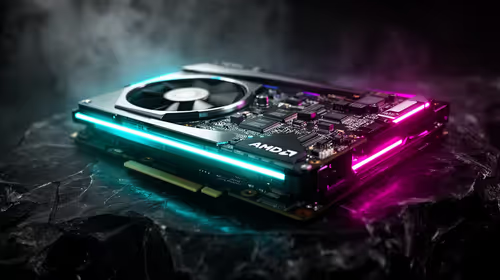
The NPU handles light, efficient AI brilliantly, but bigger workloads change the picture. Running a sizeable local language model, generating images at speed, or fine-tuning a model leans on raw parallel power and large VRAM, which is exactly what a discrete GPU provides. A card with 8GB or more of VRAM lets you load chunkier models and run them quickly, and 12GB or 16GB opens the door to genuinely large ones.
What VRAM actually unlocks
Keeping a model in VRAM means fast, parallel inference rather than slower CPU-bound processing. An 8GB card handles a 7B model at Q4 with room for a modest context window. A 12GB to 16GB card is the sweet spot for 7B to 13B models with a larger conversation history. If image generation is on the agenda alongside text chat, 12GB or more gives you comfortable headroom to run both types of model without constant unloading.
So the layered answer is: NPU for always-on efficiency, discrete GPU for heavy lifting. A creator or developer serious about local AI wants both. You can see how these parts come together in complete machines on the PC best sellers page, and the dedicated AI PC builds live in the AI PC range at Evetech.
What AI Tasks You Can Actually Run Day to Day
Getting specific about real use cases helps set sensible expectations before you buy.
On any Copilot+ machine, the always-on features work without user intervention: live captions on video calls, automatic transcript summaries, intelligent photo search, and real-time translation in supported apps. These run on the NPU and drain little battery in the process.
For chat-style local AI, a 7B or 8B parameter model at Q4 quantisation runs acceptably on a 16GB RAM machine with no discrete GPU, using the CPU for inference. Response generation is slower than a cloud API, typically a few words per second, but it is private, free after purchase, and works offline. Step up to a discrete GPU and the same model runs at comfortable conversational speed.
For local image generation on a Stable Diffusion-class model, the NPU alone is not enough. You need a discrete GPU with at least 8GB of VRAM for a workable experience, which is why the AI PC buying decision often splits between "everyday features" machines and "serious local compute" machines.
Frequently Asked Questions
What specs make a PC an AI PC?
At minimum, 16GB of RAM, a fast NVMe SSD, and an NPU rated above 40 TOPS. That combination meets the Copilot+ bar and runs everyday on-device AI features smoothly.
Which chips qualify for local AI?
The AMD Ryzen AI 300, Intel Core Ultra 200V, and Qualcomm Snapdragon X families all clear the 40 TOPS NPU threshold and are designed for efficient local AI work.
Do I need a discrete GPU for local AI?
Not for light features the NPU handles efficiently. For running larger language models, fast image generation, or fine-tuning, a discrete GPU with 8GB or more of VRAM makes a big difference.
Is 16GB of RAM enough for an AI PC?
It is the sensible floor for everyday AI features. If you want to run larger local models comfortably alongside your other apps, step up to 32GB.
Should I worry about app compatibility on Snapdragon X?
Check first. Snapdragon X uses an Arm architecture, so some older Windows apps run through emulation. Most mainstream software now has native Arm versions, but confirm your essential tools before buying.